GTA VI on PS5 Pro: clearer detail and steadier 30fps in Digital Foundry’s tests
Both PlayStation versions render at 1440p, but reconstruction, shadows and performance consistency separate them. The Pro’s advantages still stop short of a 60fps mode.
In this guide
GTA VI’s first independent technical analysis gives PS5 Pro a more concrete advantage than the feature list did: a clearer reconstructed image and a more dependable 30fps, while the standard PS5 is more vulnerable to drops during demanding scenes. Digital Foundry’s findings also explain why saying that both versions render at 1440p misses much of the visible difference.
This is the useful next step after Rockstar’s announced 30fps target. A target describes the intended experience. John Linneman’s technical review and Digital Foundry’s subsequent console comparison describe how the launch versions behave in their testing. Neither supplies a hidden 60fps mode: the PlayStation choice remains about the quality and consistency of a 30fps presentation.
Why the same 1440p produces different results
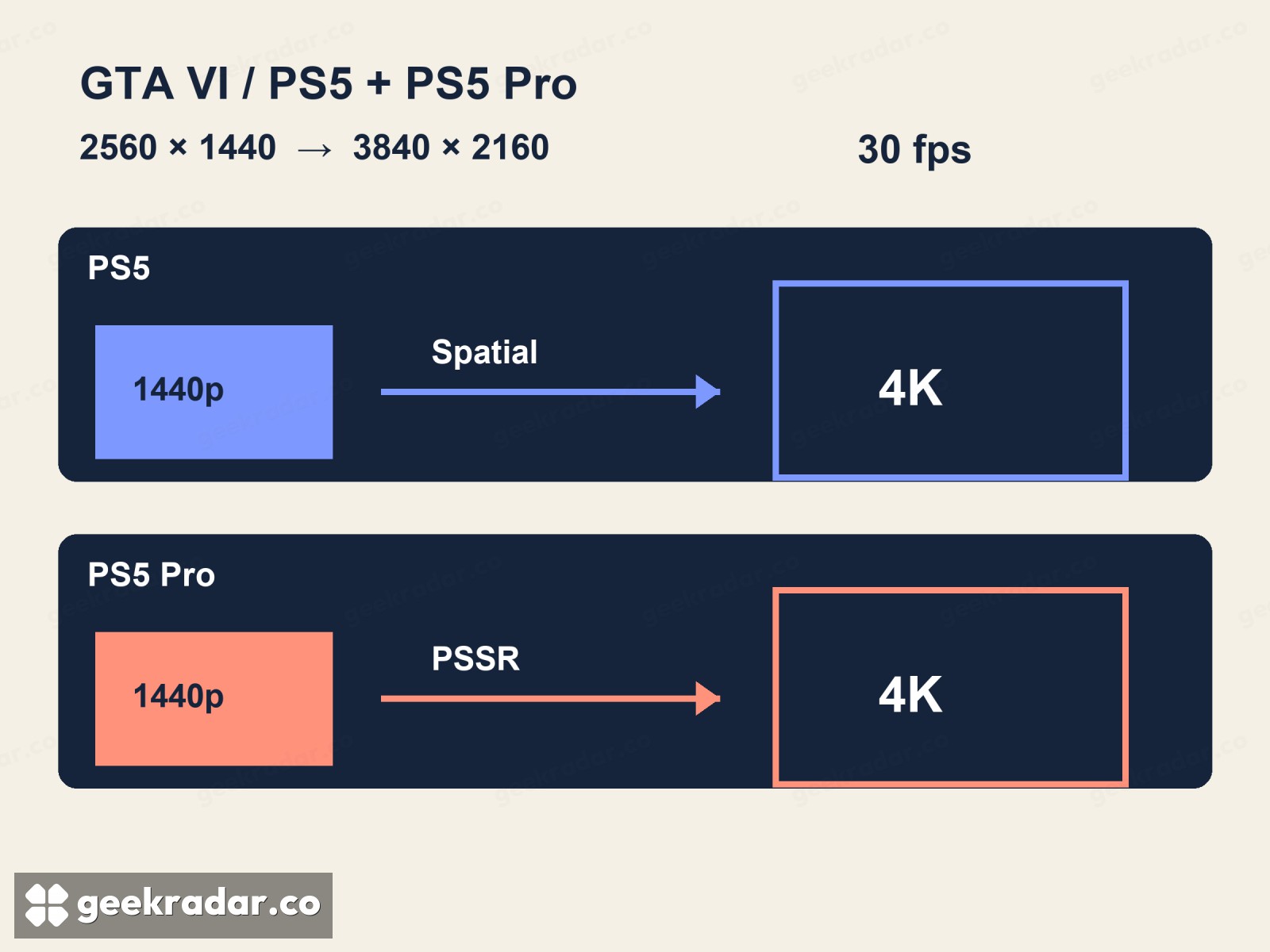
Digital Foundry identifies a 2560 × 1440 rendering resolution on both PS5 and PS5 Pro. That is the starting image, not a complete account of what reaches a 4K television. The base console uses spatial upscaling; the Pro uses PlayStation Spectral Super Resolution, or PSSR, to reconstruct the higher-resolution output. Linneman finds a substantially cleaner result on Pro, particularly in fine and distant detail.
The distinction matters in a city full of thin edges, distant buildings and small objects. Enlarging a frame gives it more output pixels without necessarily recovering the detail that a more sophisticated reconstruction method can resolve. PSSR’s result should still be described as reconstructed 4K, rather than native 4K rendering. A favourable comparison with native 4K is a judgment about the finished picture, not a change to its underlying pixel count.
There is a second difference that resolution numbers cannot express. Digital Foundry reports ray-traced global illumination and reflections on both PlayStation versions. These contribute to how light spreads through a scene and how surfaces reflect their surroundings. Pro additionally uses ray-traced shadows, where the base console relies on shadow maps. The upgrade therefore affects both reconstruction and the lighting information being reconstructed.
Those observations apply to GTA VI’s tested launch versions. They are not general performance scores for the consoles or a promise about every future patch.
A strong 30fps result still has limits
Digital Foundry’s later comparison puts a useful boundary around the initial description of Pro’s stability. It reports a consistent 30fps through roughly 75 hours of standard play, but also short drops as low as 24fps when deliberately destroying vehicles with a grenade launcher. The frame rate recovers quickly in that test. “Locked 30fps” is therefore a reasonable shorthand for the reported ordinary experience, but an absolute claim that the game never drops would go further than the evidence.
The base PS5 has less room to absorb demanding moments. Digital Foundry describes dips during driving and more sustained reductions in heavy destruction scenes. ComputerBase’s account of the analysis likewise distinguishes Pro’s short stress-test interruptions from the base console’s longer slowdowns. The important comparison is not simply the lowest number each machine can be pushed to; it is how often performance drops, how long the interruption lasts and whether it occurs during ordinary play.
At 30fps, a new frame has about 33.3 milliseconds to arrive. At 24fps, the interval is about 41.7 milliseconds. That arithmetic illustrates why a sustained reduction can change the feel of motion, but it is not an input-latency measurement: controller processing, game logic and the display introduce other delays. Pro’s steadier delivery can help preserve the intended rhythm without making the game respond like a 60fps title.
What this means for a PS5 owner
For someone choosing between the two PlayStation consoles specifically for GTA VI, the evidence now supports a more precise reason to prefer Pro: clearer distant detail, better shadows and fewer interruptions to the target frame rate. Sony’s general PS5 Pro feature description establishes what PSSR and enhanced graphics can support; Digital Foundry’s game-specific work shows what Rockstar has actually done with them here.
That does not make the base PS5 version a different game, nor does it establish that replacing an existing console is worthwhile for every player. The standard machine retains the major ray-traced lighting features. The value of the visual upgrade will depend partly on display size and viewing distance, while the significance of the performance difference depends on tolerance for uneven motion. Those are considerations for a purchase, not measurements of a universal threshold at which an upgrade becomes necessary.
The practical conclusion is narrower, and more useful, than a console winner’s badge. PS5 Pro improves the delivery of Rockstar’s chosen experience. It does not remove the choice at its centre: this is still an unusually elaborate world presented at 30fps. Anyone waiting for a high-frame-rate option should not mistake a sharper image for the arrival of one.