Chandra finds the X-ray clue to a star’s recurring eruptions
AT 2016blu’s compact companion could be a neutron star or black hole; coordinated observations reveal the feeding cycle.
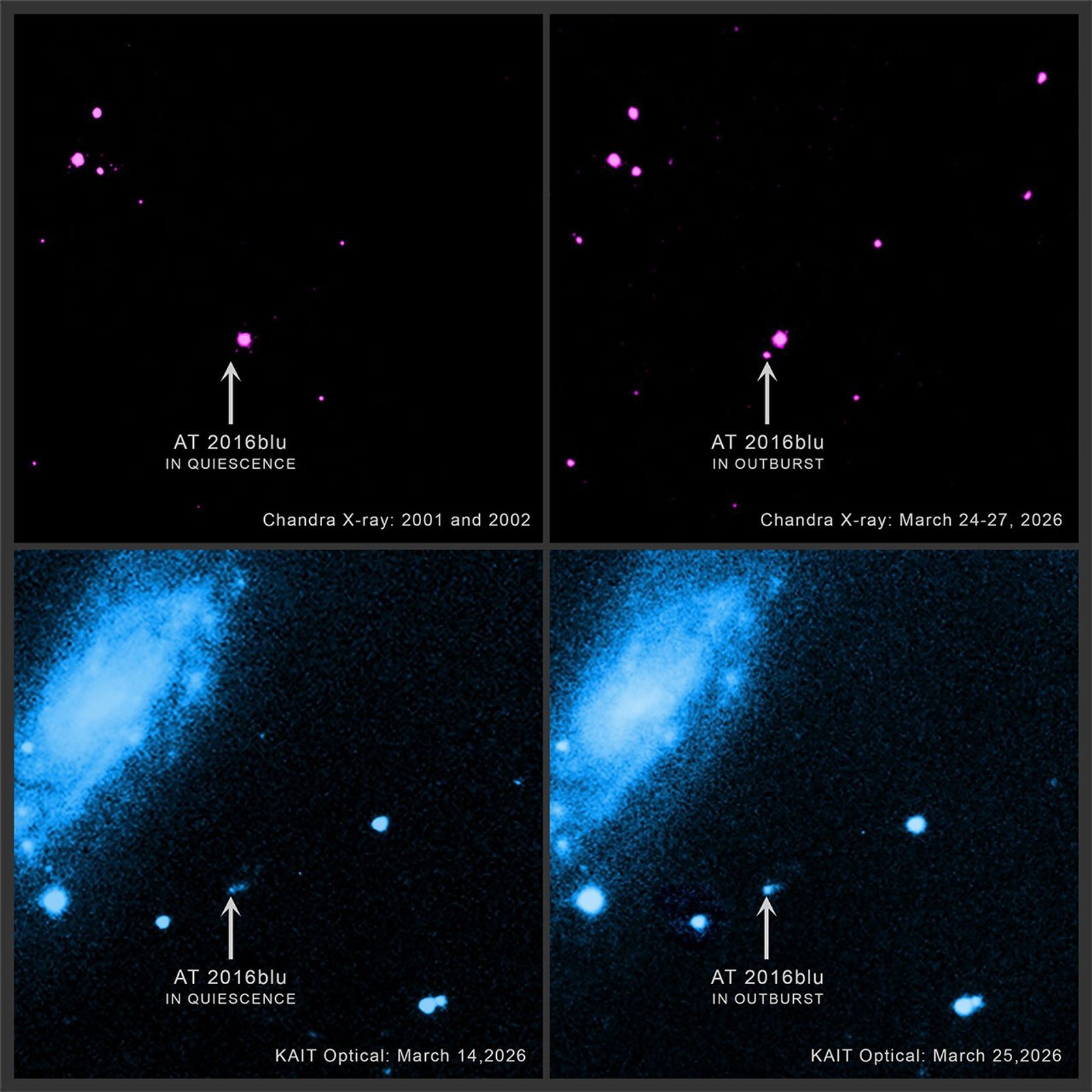
A star that repeatedly brightens in another galaxy appears to have a compact companion feeding on its material. New Chandra observations of AT 2016blu provide the X-ray evidence behind that interpretation: the source was at least a hundred times brighter in X-rays during the observed 2026 outburst than the limits established by observations in 2001–2002. The companion could be a black hole or a neutron star; the result does not identify which.
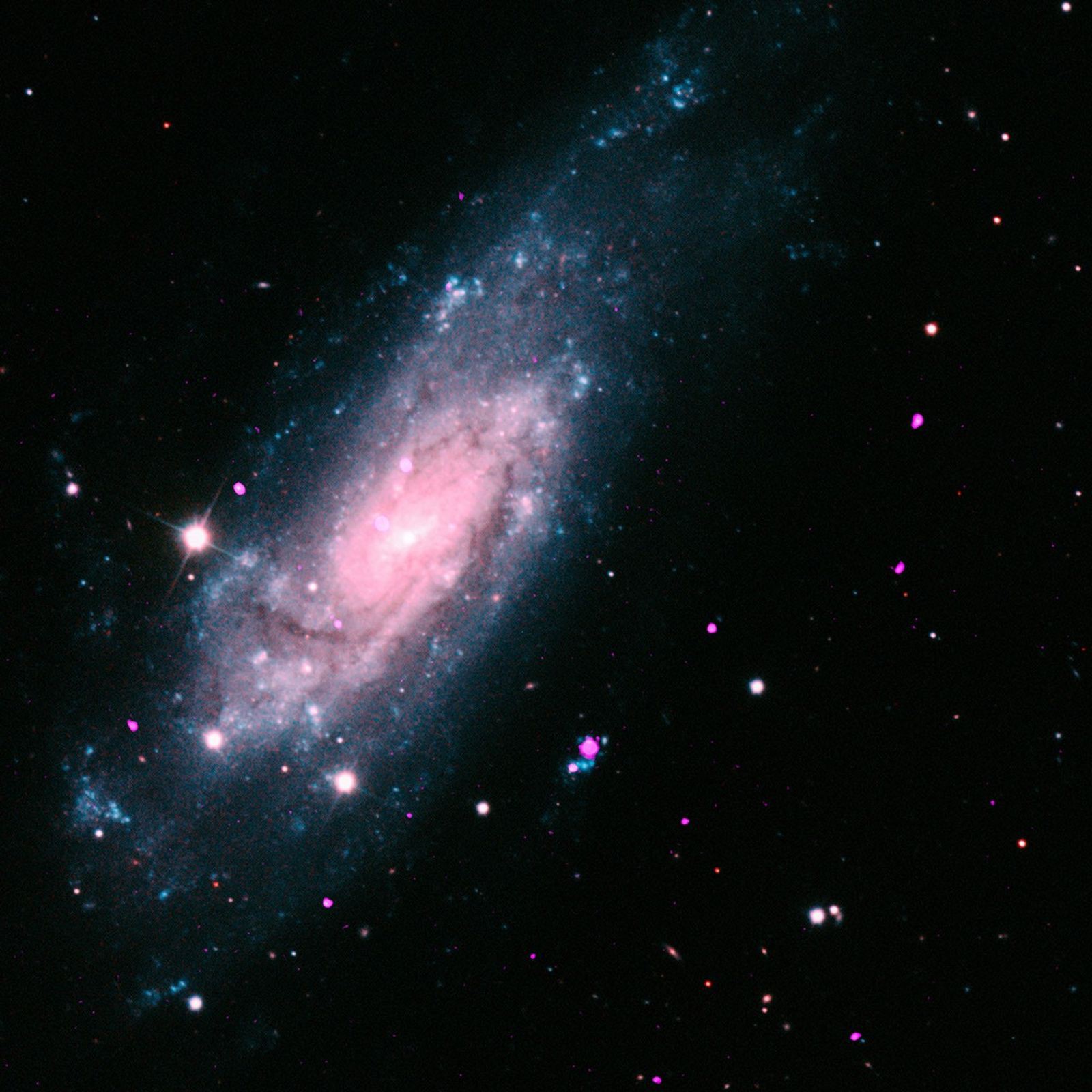
The NASA account, updated November 12, places the system in NGC 4559, roughly 30 million light-years away. The visible star has an estimated mass of at least 33 Suns. Its repeated optical outbursts had already made it an unusual target. The new observations help explain what powers them.
A recurring optical signal led to an X-ray appointment
The research paper by Mojgan Aghakhanloo and colleagues records 27 detected outbursts from 2012 through June 2026, with a roughly 113-day recurrence. “Roughly” matters: this is quasiperiodic behavior, not a clock that guarantees an identical event at an exact instant.
The team followed the star in visible light around the expected next episode. Observations from professional facilities and more than thirty amateur astronomers helped identify renewed activity. That signal triggered Chandra observations in March through its Target of Opportunity programme, which allows a response to an event rather than relying only on a fixed observing calendar.
Chandra then detected the source across five closely spaced observing epochs. Earlier archival observations had not detected it in X-rays. The comparison is therefore between a new detection and an earlier upper limit, not two equally strong measurements of a continuously bright source.
An eccentric orbit provides a plausible feeding cycle
The favored explanation is an elongated binary orbit. Near the closest approach, the compact companion captures material expelled by the massive star. Gas moving into a deep gravitational well becomes hot enough to emit X-rays. That radiation can in turn heat surrounding material, helping explain the visible-light activity.
This interpretation connects the recurrence to the orbit and the new X-rays to accretion. It is more specific than saying that a massive star is unstable, while retaining an unresolved distinction between the possible compact objects. A neutron star and a stellar-mass black hole can both supply a sufficiently intense environment for accretion-powered emission.
The authors describe AT 2016blu as a case where X-ray observations strongly favor intermittent accretion onto a compact object as the origin of this kind of outburst. That is a conclusion about the mechanism, rather than a direct picture of the companion’s surface or horizon.
Resolution matters as much as brightness
The system lies among other sources in a distant galaxy. Chandra’s ability to separate nearby points is important because a bright X-ray neighbor could otherwise confuse the identification. The composite image places the target in its galactic setting; the supporting close views and observations establish which source changed.
NASA describes it as a candidate ultraluminous X-ray source, a class that includes systems still being investigated. The result may connect some of those bright sources with recurring eruptions in massive stars, but one system cannot establish the explanation for all of them.
The discovery also shows the value of modest telescopes in a coordinated campaign. The optical observers did not need to detect X-rays themselves. They supplied the timing that let a different instrument ask the decisive question. A faint point repeatedly changing brightness became a way to reveal an otherwise hidden companion.