ESCAPADE has left its year-long wait behind. Two views of Mars are the point
Powered Earth flybys send the twin probes toward a 2027 arrival and a coordinated atmospheric-science campaign.
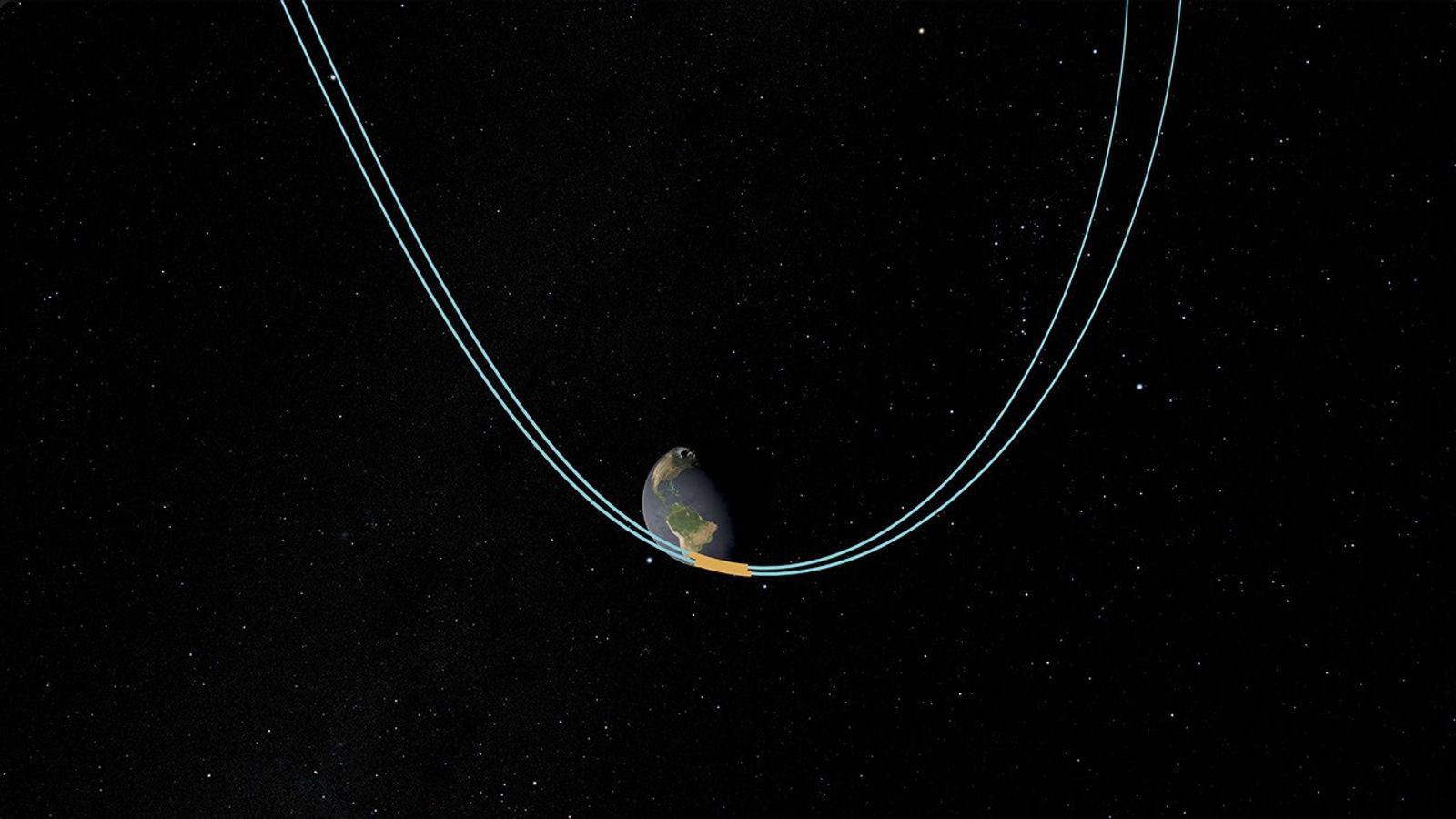
NASA’s twin ESCAPADE spacecraft are finally on their interplanetary journey to Mars, almost a year after launch. The mission’s November 9 update confirms powered Earth flybys on November 7 and 9: each probe combined a close passage by our planet with an engine burn of about nine minutes. The long wait was part of the route, not a year spent drifting toward the wrong destination.
ESCAPADE launched on November 13, 2025, when Earth and Mars were not positioned for the mission’s direct departure. Instead, the spacecraft followed a loitering path around the region of Earth’s second Lagrange point, roughly a million miles away on the side opposite the Sun. The return to Earth supplied the opportunity to redirect that motion toward Mars.
A launch date and a departure date can be different
A mission can leave the ground without immediately entering its final interplanetary transfer. ESCAPADE’s route separates those events. The initial launch established a useful waiting trajectory; the powered flybys used Earth’s gravity and the spacecraft engines to set up the next leg.
That approach matters because planetary geometry constrains a transfer. The spacecraft cannot simply point toward Mars’s current position and arrive there later: both planets continue moving. The trajectory has to meet the planet where it will be, with a speed that the spacecraft can reduce enough to enter orbit.
During the waiting phase, the probes also gathered observations of Earth’s magnetic environment. The detour therefore provided an opportunity to operate instruments before their primary target, although those measurements should not be confused with the planned Mars science campaign.
Arrival is followed by another careful sequence
NASA targets Mars orbit insertion on September 7 and 9, 2027. Each probe is expected to fire its engine for roughly eleven minutes to slow into an initial capture orbit. These are planned future events, not completed milestones.
The mission overview describes initial orbits lasting about sixty hours, followed by reductions and adjustments. The two craft must then be placed in suitable, safely separated orbits before the interruption in communication associated with solar conjunction. Final adjustments follow, with the science phase planned for mid-2028.
The months between arrival and routine science are doing useful orbital work. Reaching the planet is one problem; arranging two instruments in space so their measurements can answer a shared question is another.
Two spacecraft separate changes in place from changes in time
Mars’s upper atmosphere interacts with the solar wind, the flow of charged particles from the Sun. A single spacecraft moving through that environment can struggle to distinguish a changing region from a change occurring over time. Two coordinated probes add another reference point.
In the first campaign, one follows the other through almost the same path, sampling similar places at different times. In the second, they occupy different orbits, allowing one to observe incoming conditions while the other measures the response elsewhere around Mars. The mission plans to connect those observations to the processes that remove atmospheric material.
This is why the twin arrangement matters beyond redundancy. The instruments can ask whether a disturbance traveled through the system or whether they merely crossed different structures. ESCAPADE has now completed the Earth maneuver that makes that experiment possible. Its eventual value will come from comparing two views of the same changing planet.