PC shipments fell 21%. Apple and ASUS gained share while shipping fewer machines
Counterpoint’s preliminary Q3 figures show why relative resilience is not unit growth—and why component costs matter to the computer a buyer can afford.
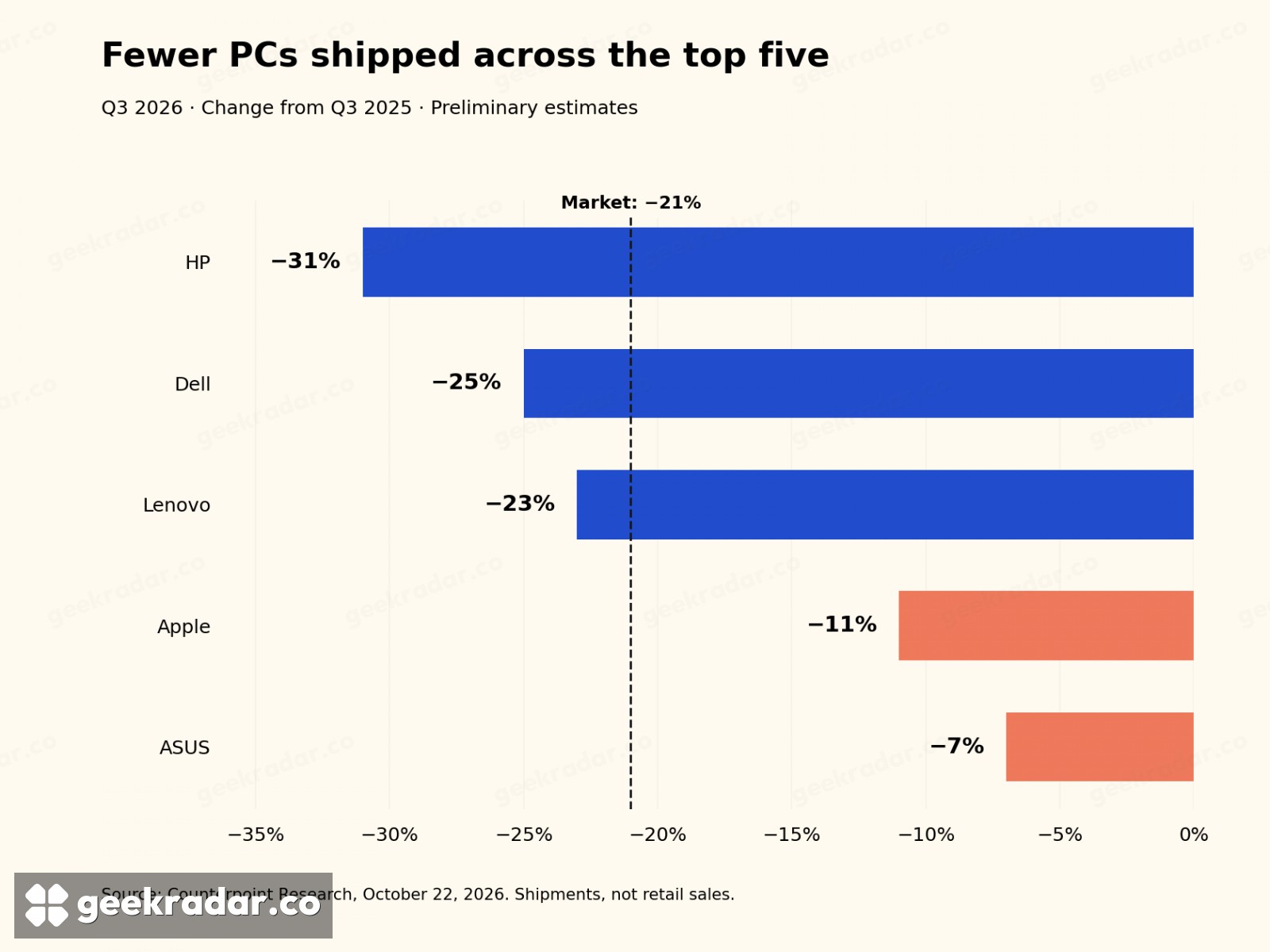
The PC market shipped 57 million machines in the third quarter of 2026, down 21% from a year earlier, according to Counterpoint's preliminary figures. The striking detail is that Apple and ASUS gained market share while shipping fewer computers. Their relative resilience is real; calling it growth would describe the wrong thing.
Counterpoint's October 22 report attributes the wider contraction to pressure from memory and other component costs, with consumer demand weak and commercial replacement providing only partial support. It is a shipment estimate, not a count of active PCs, retail transactions or people who have abandoned computers.
A larger slice of a smaller market
Apple's estimated shipments fell 11%, while ASUS's fell 7%. Those declines were smaller than the market's 21% contraction, so both companies took a greater share of the remaining volume. ASUS's share reached 9.2%; Apple's reached 9.8%.
The arithmetic is worth making explicit because it frequently disappears in brand comparisons. If a market falls from 100 units to 79 and a company falls from ten units to nine, its share rises from 10% to roughly 11.4%. It has improved its position relative to competitors while still shipping one fewer unit. That illustrative example is not a reconstruction of either vendor's actual figures.
This also explains why a company can describe a quarter favorably while the category looks uncomfortable. Competitive position, unit volume, revenue and profit answer different questions. A shipment table alone does not tell us whether a vendor protected margins, sold more expensive configurations or offered deeper discounts.
A component problem becomes a buying problem
Memory sits inside the complete system price. When its cost rises, manufacturers can absorb some of the increase, raise prices, change configurations or emphasize products with more room in their margins. Those responses have different consequences for buyers even if the chip behind the increase is the same.
Someone shopping to a fixed budget may experience that pressure as less memory at a familiar price, fewer suitable models or a reason to postpone replacing a working laptop. That is a mechanism through which component inflation can reduce unit demand; it is not a claim that every manufacturer made the same choice this quarter.
We saw a related affordability problem in the smartphone shipment figures. PCs add their own replacement dynamics: a household can often keep an adequate machine longer, while a business may need to replace hardware on a compatibility, management or support timetable.
Counterpoint also notes that the comparison is against a 2025 period helped by replacement purchases and inventory decisions. A year-on-year fall therefore combines current weakness with the strength of the earlier baseline. It should not be converted into a claim that demand dropped 21% between two consecutive quarters.
AI demand does not automatically rescue the affordable laptop
The industry's investment story is broader than consumer PCs. As our server CPU analysis explained, spending around AI systems creates demand for infrastructure beyond the accelerator itself. That can coexist with a difficult market for ordinary computers.
An enterprise buying infrastructure and a student replacing a laptop face different budgets and reasons to buy. An attractive local AI feature will not solve an affordability problem if the complete machine sits beyond the buyer's spending limit. Equally, weak PC shipments do not prove that every AI-capable model is unwanted; the aggregate data cannot isolate that conclusion.
Counterpoint forecasts a further 27% year-on-year shipment decline in the fourth quarter and broadly flat annual volume in 2027. These are forecasts, not results already recorded. Flat growth after a contraction would mean stabilization around a lower base, not an automatic return to the earlier market size.
For anyone comparing PC hardware, the useful response is to compare the whole configuration and its price rather than the vendor's share headline. A company can win ground in the rankings while the computer a buyer can afford becomes a more difficult compromise.