AI’s fiber demand runs into a manufacturing clock measured in years
A shortage forecast and a long Corning–Verizon supply deal reveal the pressure on optical fiber. Fiber-kilometers do not mean kilometers of new cable routes.
The AI infrastructure build-out is putting pressure on a component that rarely appears in a processor launch: optical fiber. TrendForce’s October 19 assessment forecasts a global supply shortfall of around 180 million fiber-kilometers in 2026, with data centers taking a growing share of demand.
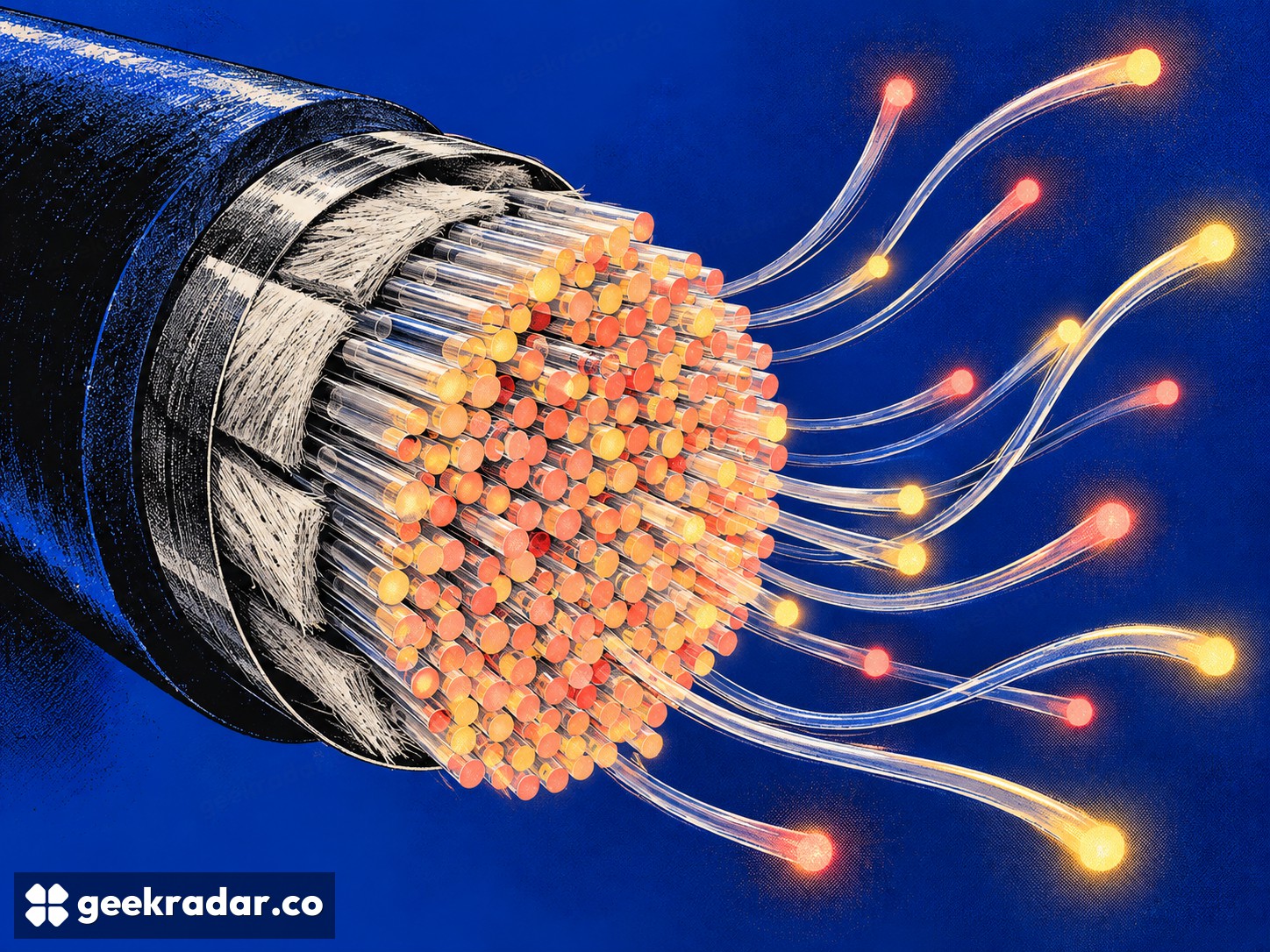
The unit matters. A fiber-kilometer measures one kilometer of an individual fiber. A cable containing many fibers can account for many fiber-kilometers along the same physical route. The forecast does not mean the world is missing 180 million kilometers of new trenches, and it should not be read as a count of homes waiting for broadband.
A dense cable is still made of individual fibers
Data centers need connections within and between facilities, while telecom operators continue building access networks. These uses can compete for upstream manufacturing capacity even though they serve very different customers.
TrendForce estimates total demand at 577 million fiber-kilometers in 2026 and puts data centers at roughly 18–20% of that demand. It forecasts their share reaching 30–35% in 2027. These are the research firm’s estimates, rather than a completed census of every installation or a guarantee about next year’s market.
The supply constraint is harder to solve than simply deciding to manufacture more cable. TrendForce says expanding optical preform capacity can take 18–24 months. A preform is the glass starting material from which fiber is drawn; a shortage at that stage cannot be fixed solely by adding downstream cable assembly capacity.
Long contracts offer a different signal from spot prices
A concrete example of demand is Verizon’s September agreement with Corning. The companies described a multibillion-dollar arrangement covering more than 80 million fiber miles from 2027 through 2032. It is a forward supply commitment, not evidence that all that fiber has already been delivered.
The agreement also highlights Corning’s high-density Contour Flow cable, which is intended to put more fiber into constrained pathways. Density can make existing duct space more useful. It does not eliminate the need to manufacture the individual fibers occupying that space.
TrendForce reports sharply higher spot prices for finished fiber relative to 2025. Those prices should not be translated directly into a prediction about a household’s next broadband bill. A retail service includes installation, active equipment, network operation and commercial pricing decisions; long-term purchasing contracts can also differ from spot transactions.
For readers in Italy and elsewhere in Europe, this is a supply-chain story with international relevance, rather than evidence of a newly announced local broadband shortage. Neither source establishes a specific Italian operator’s stock position, deployment delay or tariff change.
Our look at Wi-Fi 8 and GFiber concerns another part of the connection: the network experience near the user. Better wireless equipment cannot substitute for upstream capacity, just as additional long-distance fiber cannot correct every problem inside a home.
The revealing detail in this market is the production lead time. Buyers can sign for years of supply quickly; the factories supplying the underlying glass take much longer to expand. That gap makes an apparently passive strand of fiber an active constraint on how quickly new computing capacity can become a usable network.