
Saros Zenith gives players more time to read the fight
Slow Game Speed and automatic firing address different accessibility barriers. Housemarque’s free update keeps the choices while changing how players reach them.
Saros's new accessibility setting changes the amount of time available to make a decision. It leaves the incoming attack intact. That is the most interesting part of Zenith, Housemarque's free update released on 19 October: players can slow combat without having to remove the projectile patterns around which the game is built.
The studio's announcement also introduces automatic firing and motion aiming, alongside new challenges for returning players. The additions address different obstacles. A player who struggles to hold a trigger does not necessarily need weaker enemies; someone who needs longer to read an attack may still want to choose the correct response themselves.
More time to read the same attack
Slow Game Speed lets players adjust the slowdown and choose whether it activates during combat or through a manual toggle. The distinction matters. An automatic setting reduces the need to remember another input; a toggle leaves the player in charge of when to use the assistance.
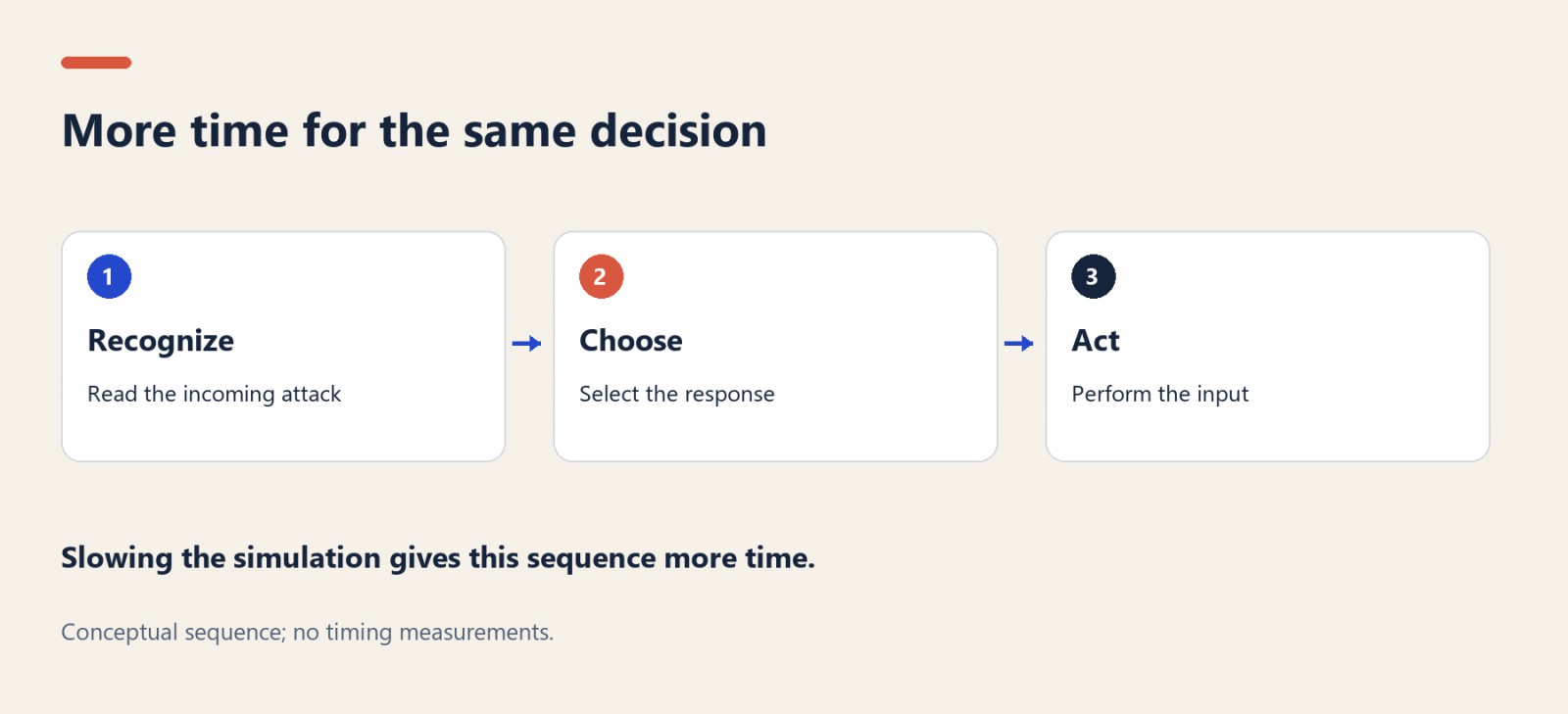
Consider the decisions behind a busy action sequence. First the player must distinguish the attack from the background, then identify its trajectory, then select and execute a response. Increasing health changes the cost of getting that sequence wrong. Slowing the simulation changes the time available to complete it. These interventions can help different people, even when both eventually make a fight easier to survive.
That is why a single difficulty slider is an incomplete description of accessibility. Seeing a threat, reaching the right control and performing an action repeatedly are separate demands. A game can preserve its tactical choices while changing one of those demands. Whether Zenith's particular settings work for an individual player still depends on that person's needs; the announcement is not evidence of universal accessibility.
A useful baseline already existed
Before launch, Housemarque described protection and trial modifiers that could soften or intensify combat, alongside color distinctions for projectile types, dialogue emphasis and remappable controls. Zenith therefore extends an existing approach rather than introducing customization from scratch.
That history makes the new controls more meaningful. Modifiers change the rules or consequences of a run; input options change how a person interacts with those rules. Keeping both available creates more combinations than a conventional easy/normal/hard menu. It also avoids assuming that everyone who uses an accessibility feature wants the least demanding version of the game.
Automatic firing operates while aiming at an enemy, but a perfect reload still requires a timed input. Motion aiming adds another way to direct a shot. Those are useful boundaries to understand before expecting the update to automate every part of combat. The aim is to remove particular physical or timing burdens while leaving decisions in the player's hands.
More replay options, without the story details
Zenith also adds protection and trial modifiers, a New Game+ structure and a boss-rush mode. We are leaving its narrative additions and encounter details out of this overview. The Italian announcement confirms the free update for existing owners; online ranking features require an internet connection and a PlayStation Network account.
For a returning player, the important distinction is between a reason to replay and a way to make replay physically manageable. Zenith supplies both. For someone who stopped because combat was difficult to parse or a sustained input was uncomfortable, the new controls offer a concrete reason to reconsider the settings before abandoning the game.
Our Accessibility topic follows changes of this kind across software and hardware. Here, the strongest idea is unusually specific: retain the challenge's shape, then let the player adjust the time and controls needed to engage with it.