BERT’s tokenizer can get much faster without making the whole AI app 50× faster
Hugging Face’s Unicode optimization shows why preprocessing deserves attention. The useful gain depends on the baseline and on what dominates the application.
Hugging Face has reported a large speedup in the text preparation used by BERT-style models, by spending less time doing unnecessary Unicode work. The headline figure is striking: up to roughly 50 times the encoding throughput of its older tokenizers 0.23 baseline. It is also easy to misread. This is a tokenizer result, not a claim that an entire AI application runs 50 times faster.
Simon Brandeis's 15 October technical account describes work still at the pull-request stage when published. The accompanying reproduction repository identifies the compared revisions and provides benchmark tooling. The result is a developer measurement with inspectable supporting material, rather than an independent GeekRadar benchmark.
The model cannot process the original text directly
A tokenizer turns text into the identifiers a model consumes. Before selecting those tokens, it may normalize characters: handling case, accents or equivalent Unicode representations according to the tokenizer's rules. Hugging Face's component documentation separates normalization, pre-tokenization and the model-specific token-selection stage.
That separation explains why an old-looking part of the pipeline can still matter. A service may use a compact encoder to search documents, classify text or rank candidate results. If the model itself is fast, the CPU work needed to prepare each input can take a meaningful share of the total request time. Buying a faster accelerator would not necessarily remove that bottleneck.
The optimization described by Brandeis avoids expensive general processing when the input permits a cheaper equivalent path, including common ASCII text. The essential constraint is equivalence: speed is useful only if the tokenizer still produces the token identifiers the model expects. Changing normalization can change the model's input even when the visible text looks similar to a reader.
A fast component and a fast application are different results
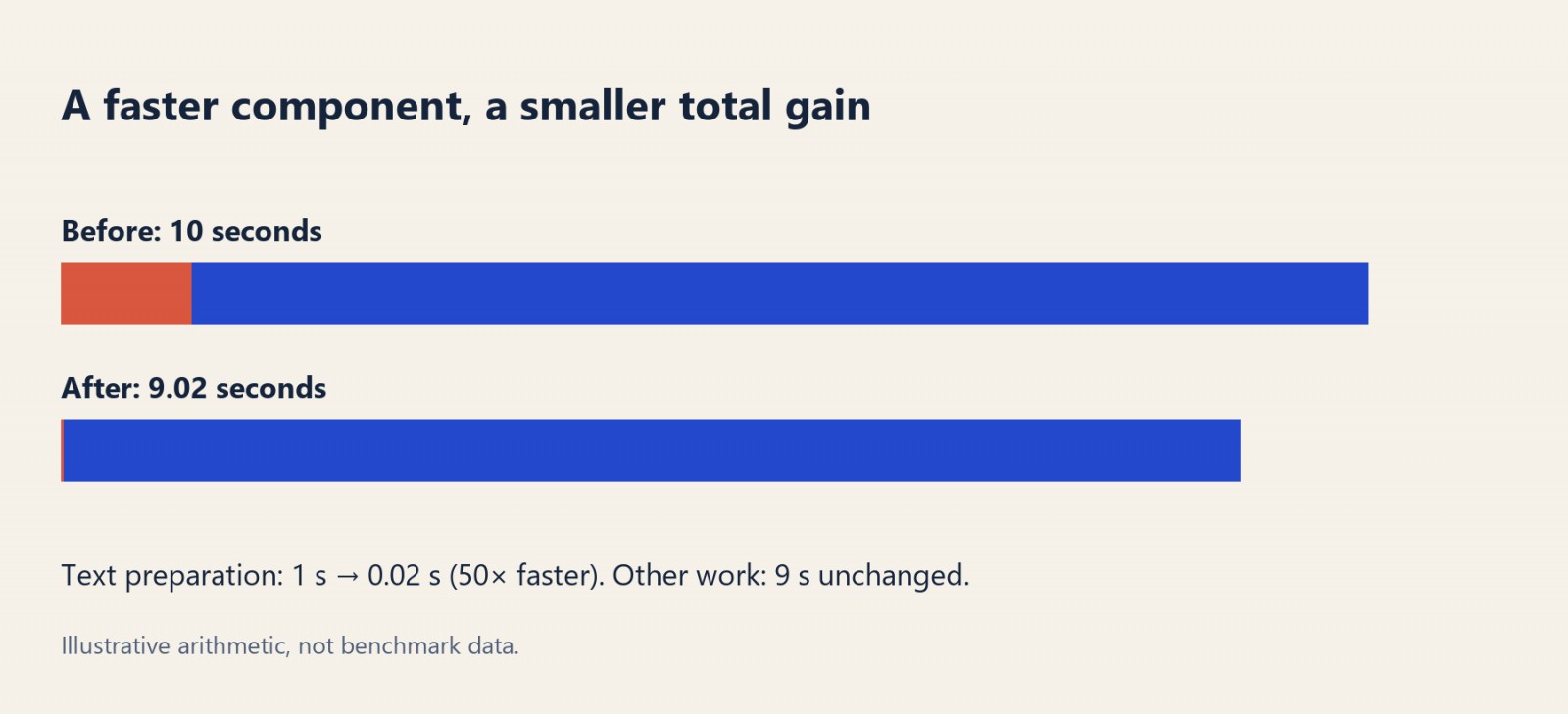
Suppose, as a simple illustration, text preparation takes one second and everything else takes nine. Even eliminating preparation entirely leaves nine seconds of work. That is a modest end-to-end improvement despite an unlimited speedup in the isolated component. Conversely, a workload dominated by preprocessing has much more to gain.
This is why a throughput multiplier needs a baseline and a workload beside it. The comparison with 0.23 includes earlier improvements as well as the new optimization. It should not be presented as the gain from installing a single small patch over the latest development build. Nor should a result on one kind of text become a promise for every language or input length.
The published methodology uses single-threaded measurements on AMD EPYC and Intel Xeon systems, with alternating runs and output checks. The repository makes the comparison more inspectable: a reader can identify what changed and which code produced a result. That is a stronger basis for discussion than an isolated chart with unnamed software versions, although reproducing a vendor's setup is still different from measuring one's own application.
Older model families still deserve engineering attention
BERT-style encoders continue to serve tasks that do not require a conversational model to generate an answer. A search system can rank or embed text without paying for a long generated response. Improving the surrounding software can therefore make an existing architecture more useful without changing its learned weights.
That complements the broader discussion in our AI evaluation topic: the useful unit of comparison depends on the job. For an interactive application it may be latency; for a document-processing pipeline, sustained throughput; for a constrained deployment, memory use and operating cost.
The immediate takeaway from the BERT work is to profile the whole path from incoming text to returned result. If normalization dominates, this optimization is worth tracking and testing when available in the chosen release. If inference or data retrieval dominates, the impressive tokenizer multiplier may barely move the number the user experiences.