Volvo and NVIDIA expand their driving partnership—with the vehicle still unnamed
The new agreement names the hardware and software stack, but a future product must establish its operating limits and driver responsibilities.
Volvo Cars is expanding its NVIDIA partnership to develop automated driving for a future generation of vehicles. The 15 October announcement names NVIDIA's Hyperion sensor-and-compute architecture, Halos OS and Alpamayo Stack driving software. It describes an ambition spanning highways, urban streets and parking, with a gradual move toward eyes-off and mind-off driving. It does not identify a vehicle buyers can order today with all of those capabilities. The joint announcement is a development commitment, rather than a retail specification.
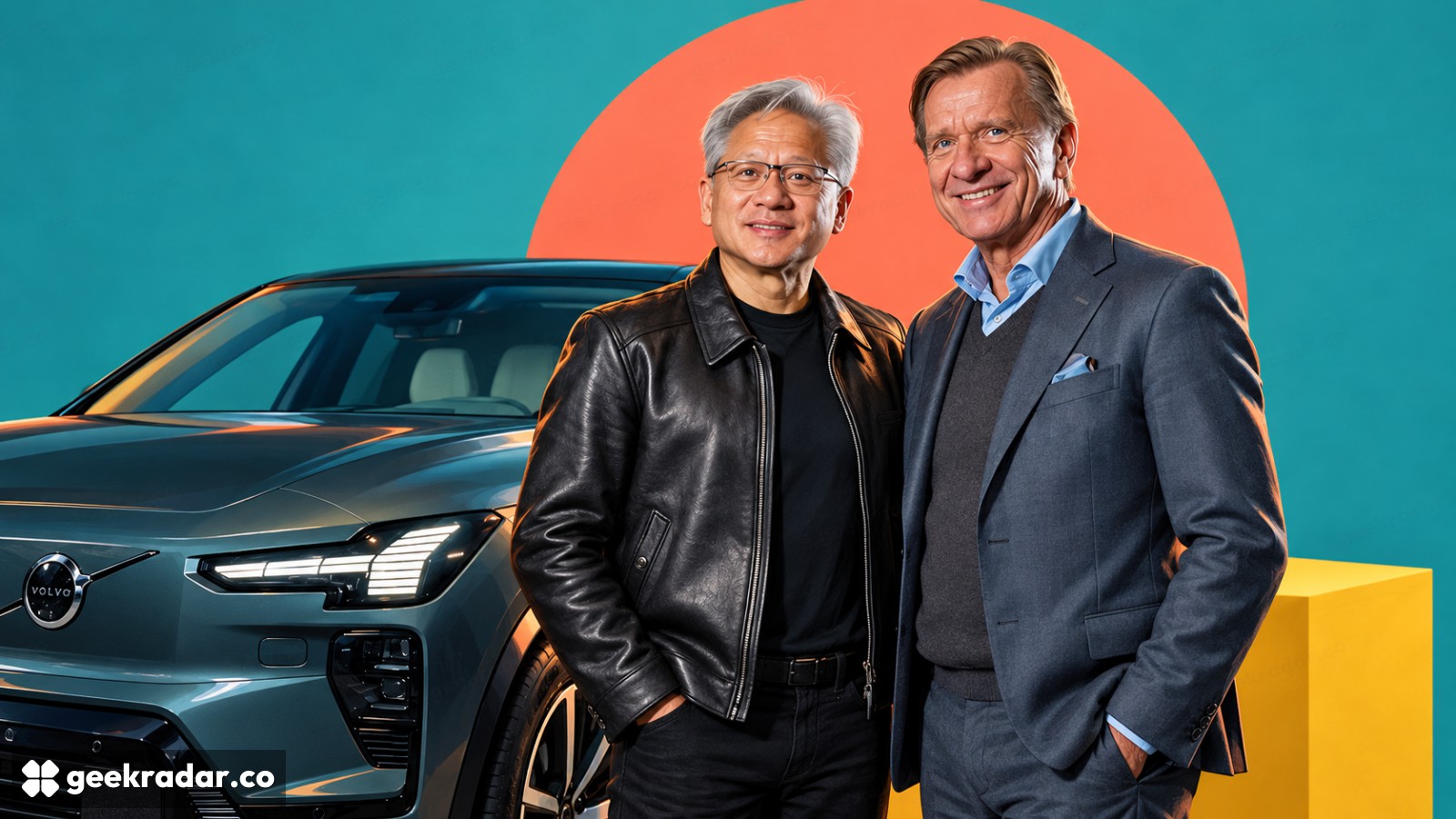
The first application is described as a next-generation Volvo car. No model name, customer launch date or country-by-country availability is established in that release. A photograph of an existing Volvo beside the executives should not be read as proof that the pictured model will receive the announced system.
Three kinds of work inside one driving system
The partnership combines sensing and onboard computation, a software platform and the driving stack. Those layers solve connected but different problems. Sensors provide observations; computing hardware processes them; driving software must interpret a situation and select a response. A capable part does not independently establish a safe complete system.
The consequences are physical. An urban junction may contain a pedestrian partly hidden by a parked vehicle, an unusual road layout and a driver who signals incorrectly. The system has to respond to the combination, including uncertainty about what it cannot yet see. That makes the scope of supported conditions as important as a demonstration on an uncomplicated route.
Hands-free and eyes-off are different promises
The US road-safety agency NHTSA's explanation of automation levels distinguishes driver assistance from systems that assume more of the driving task. At Level 2, a system may continuously assist with both steering and acceleration or braking while the driver remains engaged and attentive. Removing hands from the wheel is not by itself permission to stop supervising.
That framework explains why wording matters in this announcement. “Door to door” describes the intended span of a journey. It does not, by itself, specify who must supervise each part, which conditions are supported or what happens when the system reaches its limits. Those details will have to belong to the eventual product and its approved operating conditions.
The companies' gradual rollout language leaves room for those distinctions. It should not be compressed into a headline saying that Volvo has launched an everywhere-autonomous car.
For GeekRadar's AI coverage, this is an example of AI moving into a complete physical system. Our earlier Hopper analysis examined how much performance depends on the system around a processor; automated driving adds a much stricter operational question. The meaningful product milestone will be a named vehicle with documented responsibilities and limits, followed by evidence of how it behaves within them.