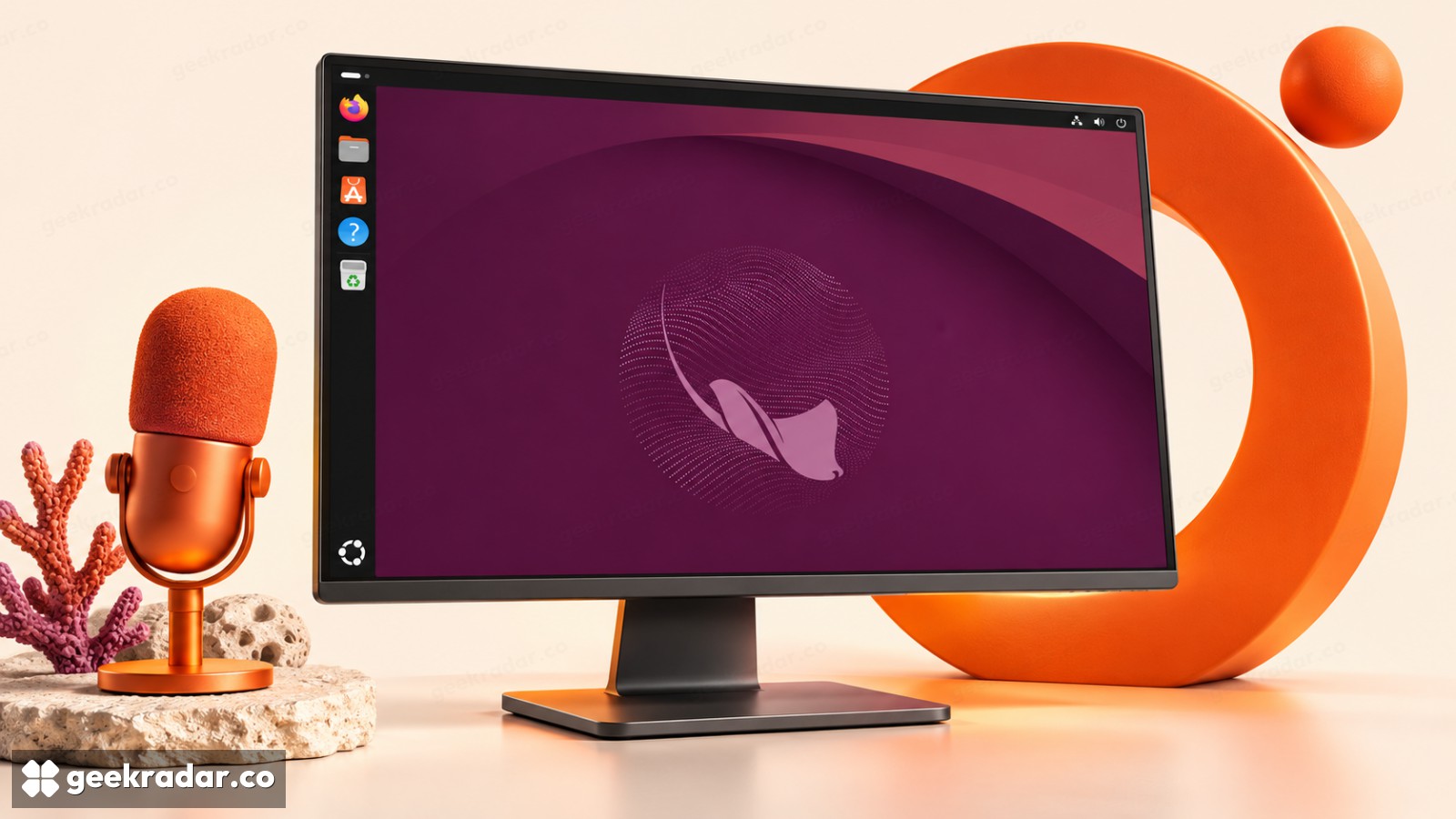
Ubuntu 26.10 arrives with local dictation and a nine-month support window
Myna begins as an optional preview; the release also changes foundational software and documents a limitation for encrypted-system upgrades.
Ubuntu 26.10 is available, bringing an optional local dictation preview, GNOME 51 and a further shift toward Rust-based system components. The release, named Stonking Stingray, arrived on 15 October. Its first decision for users is less glamorous than the new features: this is an interim release with nine months of support, ending in July 2027. Canonical's announcement and the release notes establish that scope.
That shorter lifecycle is part of the product. Someone installing it on a daily work machine is accepting another upgrade decision within months. A newer desktop can be worth that maintenance, but it should be a deliberate trade rather than an accidental consequence of choosing the largest version number.
Myna starts with dictation
The new speech feature, Myna, is a technology preview that is not preinstalled. The release notes describe holding a configurable key to dictate into the focused application, with transcription performed locally and no audio sent to a network service for that task. That is a specific, useful workflow: turning speech into text where the user is already working.
It should not be expanded into a claim that Ubuntu now ships a general-purpose autonomous desktop assistant. Canonical's announcement discusses a longer-term direction involving more ambitious interactions. An example of what a future system might do is not a feature that has necessarily arrived in this release.
Local processing changes one important boundary. The transcription service does not need the recording to leave the device. It does not control what happens after the text reaches a destination application. Dictating into a cloud document, for example, still places the resulting words into that document's normal synchronization workflow. The privacy property belongs to the transcription stage, not automatically to every subsequent use of the text.
For accessibility, this distinction between a bounded tool and a grand assistant narrative is helpful. A predictable way to enter text can be valuable without controlling the whole desktop. Reliability, clear feedback and compatibility with the application in focus are the immediate tasks.
Rust changes the implementation, not the need to validate
Canonical says 26.10 completes its rollout of the Rust-based uutils coreutils and introduces post-quantum-ready package-signing changes. Both concern foundational software that many people rarely see directly. They affect the machinery under routine commands and software installation, rather than adding another visible app.
A change of implementation can reduce certain classes of memory-safety problem while still leaving other kinds of defect possible. A command can handle memory correctly and still produce an unexpected exit status, parse an unusual filename differently or behave incompatibly with a script. This is why functional compatibility remains relevant alongside the programming language used.
The package-signing work belongs to a similarly incremental transition. Our coverage of NIST's post-quantum standards explains the standards backdrop. It would be too broad to describe an entire computer as “quantum-proof” because one distribution changes part of its signature-verification system. Applications, protocols and stored data have their own migration requirements.
Check the upgrade path before the feature list
One release-note limitation deserves attention: systems using TPM-backed full-disk encryption cannot upgrade from Ubuntu 26.04 LTS to 26.10 at release. Canonical anticipates enabling that path during the release's lifecycle. Anticipated support is not present support.
For affected systems, the restriction is a reason to follow the documented path rather than improvise around it. For other users, the practical assessment is whether the newer desktop and hardware support justify the interim maintenance cycle. A production machine and a spare development laptop can reasonably reach different answers.
Our Security coverage often concerns changes people must make before a threat becomes immediate. Ubuntu 26.10 makes several such changes tangible, while Myna offers a modest first use for local AI. The release is most persuasive when judged at that concrete scale: an opt-in dictation experiment, documented system changes and a clearly bounded support window.