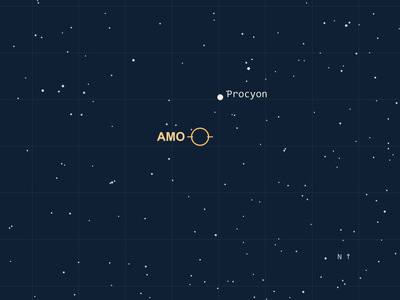
A planet search found a hidden white dwarf 28 light-years away
The faint star in Welopōʻai outweighs its brighter neighbour. Their nearly ten-year orbit leaves astronomers with a puzzle about how the pair survived.
For years, the light from a red dwarf 28 light-years away kept shifting in wavelength. Astronomers looking for planets had chosen an instrument sensitive enough to pick up a very small wobble. What they got was a swing of some 16 kilometres per second. A planet couldn't plausibly pull the star around that fast. Something substantial was hiding beside it.
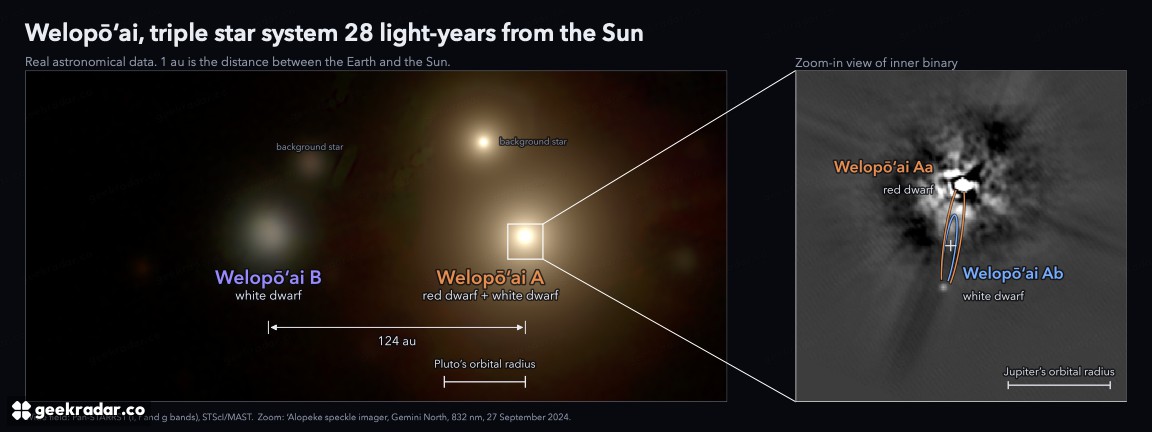
In a study published in Astronomy & Astrophysics, Étienne Artigau and colleagues identify that companion as a white dwarf, the dense core left over when a star sheds its outer layers. Another white dwarf was already known farther out. The discovery makes Welopōʻai the closest known triple system with two such remnants. And the star that had escaped detection turns out to outweigh the red dwarf whose light gave it away.
Two ways to watch an orbit
The first clue came from SPIRou, an infrared instrument on the Canada-France-Hawaii Telescope. As an orbiting star moves towards or away from Earth, features in its spectrum shift towards shorter or longer wavelengths. The swing between the two extremes tells astronomers how much the star’s speed changes along our line of sight. It leaves open how much motion is taking place sideways.
That missing dimension matters. Picture watching a pair of dancers from a balcony directly overhead. Their circling is easy to follow, but neither approaches the balcony by much. From the edge of the dance floor, the same movement alternately brings each dancer towards you and takes them away. The size of a spectroscopic signal depends on which view the sky gives us.
Gemini North supplied the complementary view. Its ‘Alopeke camera separated a faint point of light from the glare of the red dwarf. The researchers could now track where the companion sat on the sky as well as how the brighter star moved towards and away from Earth. By fitting those measurements together, the team derived masses of about 0.419 Suns for the red dwarf and 0.618 for its dim companion. The latter figure has an uncertainty of just 0.7%. An orbit can weigh a star even when its light makes it easy to overlook.
A companion that had room to survive
The inner pair takes 9.83 years to complete an orbit. Its semimajor axis, a measure of the orbit’s size, is about 4.64 times the distance between Earth and the Sun. The outer white dwarf appears nearly 124 Earth–Sun distances from the pair when projected onto the sky. Its true separation can be greater. The researchers estimate that one circuit out there takes more than a millennium.
Before the inner white dwarf became so compact, its predecessor swelled into a giant. A companion that ploughs through the giant’s outer gas can lose orbital energy and spiral inwards. Astronomers have even caught evidence of two stars merging in Andromeda. Here the red dwarf survived, and the two stars still take almost a decade to circle one another. That is a remarkably roomy outcome for a pair that may once have grazed the same stellar envelope.
The discovery team is investigating whether the distant third star helped reshape the inner orbit. Old photographic plates offer a way to narrow the possibilities. Although nobody can watch the outer star complete a thousand-year circuit, its position decades ago extends the short arc astronomers can measure today. A sharper estimate of the angle between the two orbits would give any account of the red dwarf’s escape one more piece of evidence to explain.