NASA caught two Leonids 37 seconds apart. How far back can it trace them?
Two cameras put the first meteor nearly 99 kilometres above Earth when its trail faded. The same observations leave a striking uncertainty at the far end of its orbit.
At 06:31:48 UTC on November 18, two cameras in NASA’s US fireball network caught a Leonid moving at about 73 kilometres per second. Thirty-seven seconds later the network logged another, almost as fast. The first trail ended nearly 99 kilometres above the ground. The cameras could place it there with enough confidence to reconstruct a path through the atmosphere. Working out how far the same grain had once travelled from the Sun was a much harder problem.
Both events appear in NASA’s observation log for November 18. The archive includes earlier dates as well, so the timestamps beside the individual recordings matter. These are two separate arrivals from the same meteor shower. The interval between them tells us when the cameras saw them. It would be a poor way to estimate how many shooting stars someone could have counted that night.
Two Leonids in the camera log
| Time on November 18 (UTC) | Speed | Height at first detection | Height at last detection |
|---|---|---|---|
| 06:31:48 | 72.9 km/s | 114.6 km | 98.9 km |
| 06:32:25 | 72.0 km/s | 110.3 km | 92.3 km |
Start with the first row. A single camera gives you a direction to each bright point along the trail. A nearby grain and a much more distant one can both draw a line across the same patch of stars. The recordings from stations 01A and 03A give two different sightlines. Combine the camera positions with those directions and the timing, and the streak acquires a height, a track and a speed. The two heights in the table mark the visible part of its flight. Subtracting one from the other gives the vertical drop; a grain crossing the sky at an angle travels farther than that.
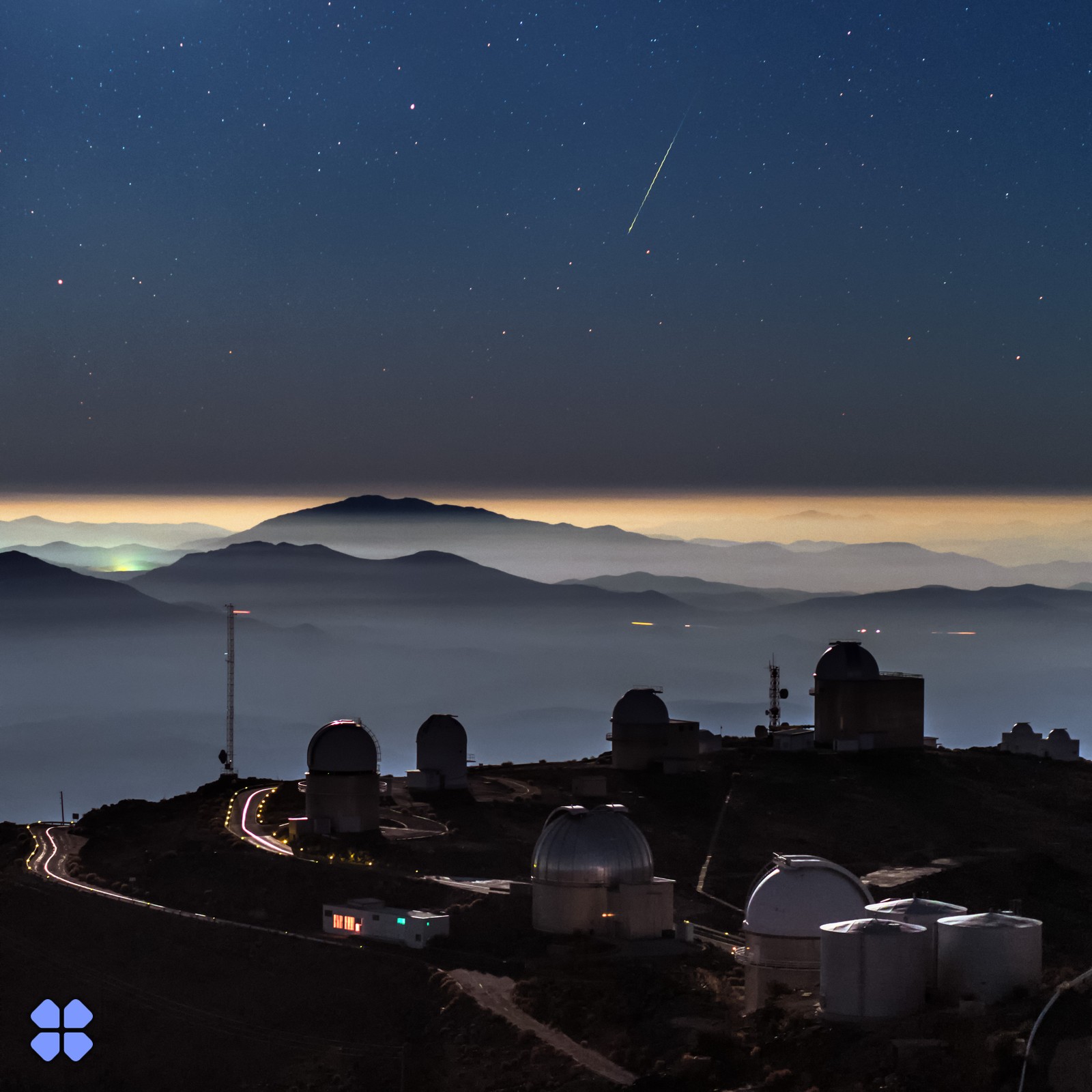
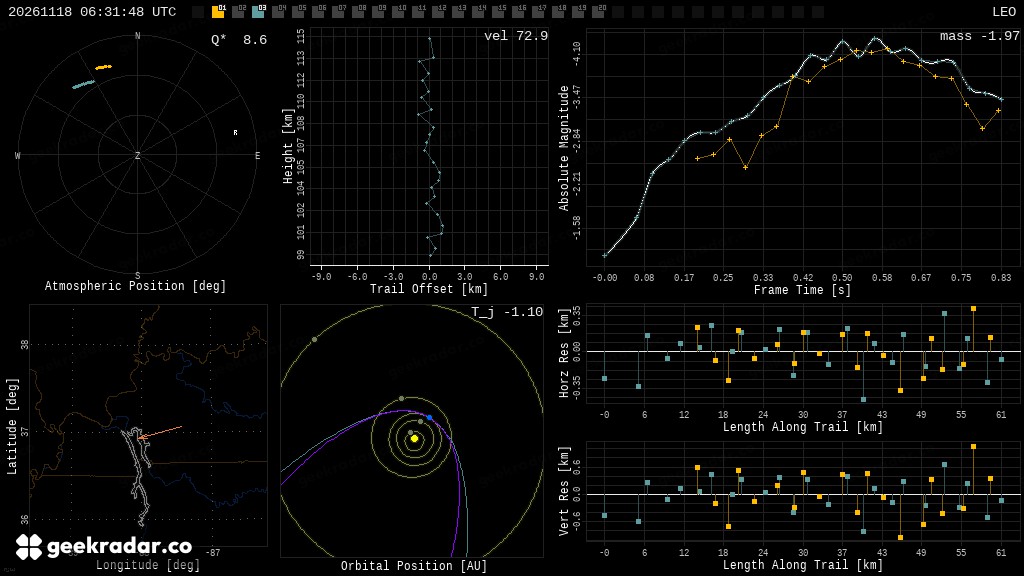
The network assigns both events the code LEO. The Leonids come from debris shed by comet 55P/Tempel-Tuttle. Earth meets grains on similar paths, so when you trace their incoming directions back across the sky, the tracks appear to converge in Leo. That common direction gives the shower its name. It is also why the bright streak in a photograph can be well away from the constellation. The archival photograph from La Silla above illustrates what one sightline looks like. Photo credit: ESO/B. Tafreshi (twanight.org), CC BY 4.0. The chart below belongs to the actual November 18 event.
Where the orbit starts to blur
Open the orbital solution for the first fireball and two numbers tell very different stories. The estimated closest approach to the Sun is 0.983 astronomical units, with a quoted uncertainty of 0.006. One astronomical unit is roughly the distance between Earth and the Sun. For a speck that crossed Earth’s path, that end of the orbit is relatively well pinned down. For the far end, the calculation returns about 130 astronomical units with an uncertainty exceeding 1,300. Quoting 130 alone would give a short flash in the atmosphere a travel history the observations cannot establish.
That disparity makes physical sense. The cameras caught the grain near Earth and measured its incoming motion over a fraction of a second. Carry a small change in that speed through a calculation of a long, elongated orbit and the distant turning point can move enormously. The two camera views can agree on where a grain lit up over Earth and still leave its farthest excursion an open question.
NASA’s network is designed for meteors brighter than Venus. Fainter streaks seen by people out for the predawn shower fall outside that observing goal. What makes these two detections valuable is the detail attached to each one. The first fireball has a measured speed and two camera views anyone can inspect. Just as importantly, its orbit file shows exactly where the evidence runs out.