Roman’s first science images arrive December 7. Why did its first stars look like rings?
NASA’s September test frame lets you follow one star across a 300-megapixel camera. Here’s how to read it before the December broadcast.
NASA will unveil the first science images from the Nancy Grace Roman Space Telescope on December 7 at 20:30 UTC. There’s already a Roman image you can inspect, and it makes a good companion to the broadcast. Zoom in on one star in the September engineering frame and it looks like a luminous ring. That was exactly what the team expected the camera to see at the time.
The public release at the American Geophysical Union meeting starts at 12:30 p.m. in San Francisco, or 3:30 p.m. on the US East Coast. NASA Live will carry it, and the agency says it will publish the images online at the same time. The earlier briefing on the conference schedule is a preview for registered media.
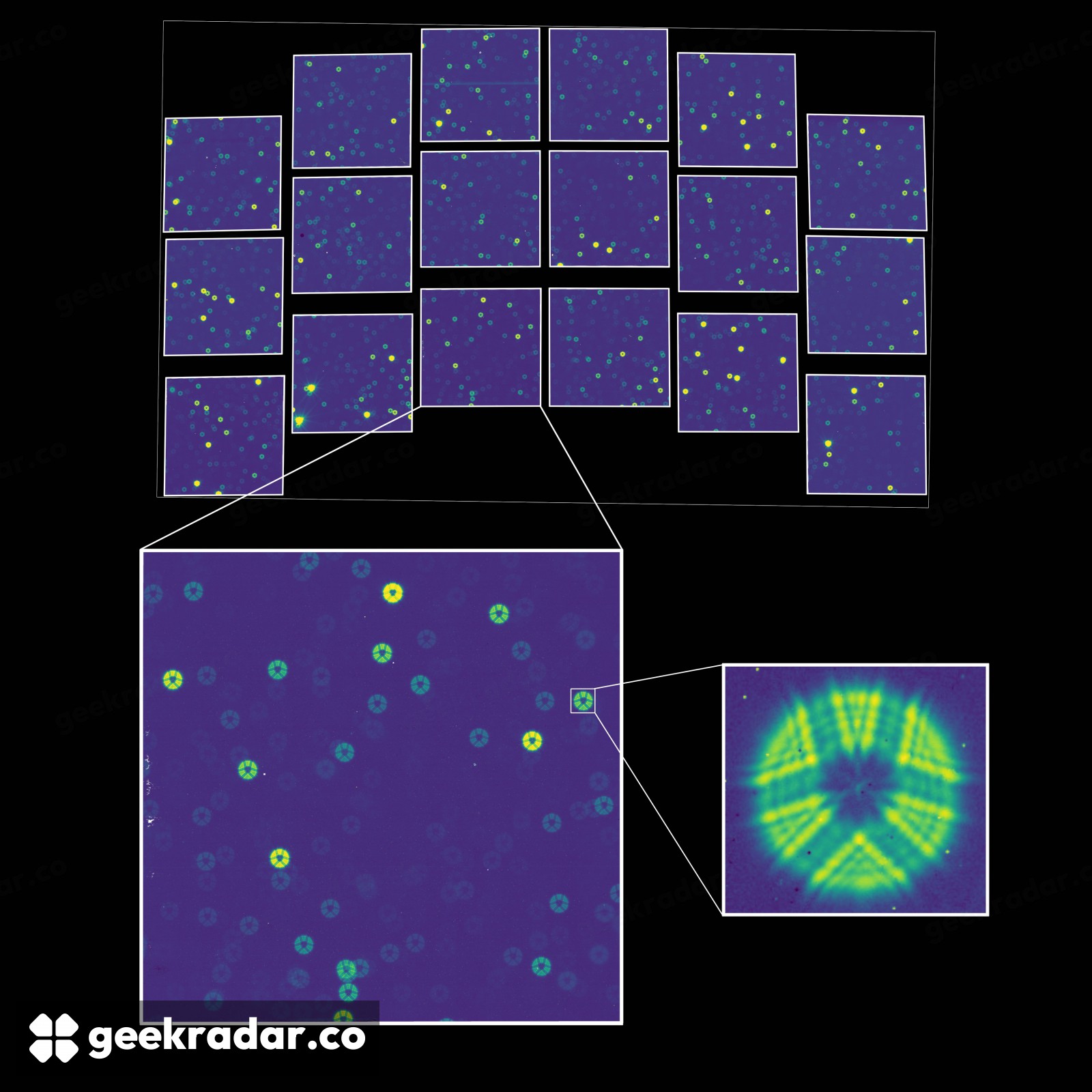
How to read the engineering image
Start with the patchwork at the top. Those 18 panels are the detectors in Roman’s Wide Field Instrument, a 300-megapixel infrared camera. Follow the lines from the bottom-left part of the array: the first enlargement shows several stars, then a second isolates one. The apparently broad green object at the end of that trail is what a single point of starlight looked like to an instrument still far from focus.
When engineers made the exposure, the detector array was still in its launch position. Light from one star spread across thousands of pixels. As NASA’s instrument team explained in September, the frame gave them a starting point for aligning the optics and tuning the focus. A star made a useful test precisely because its light should eventually concentrate in a tight spot. The width of the ring told the team about its instrument. Reading it as the width of the star would give an entirely different, and mistaken, answer.
Why the whole frame matters
In the December images, it will be tempting to go straight for the smallest detail. Try stepping back afterward. According to NASA, the camera covers a patch of sky larger than the apparent full Moon in one shot. Being able to distinguish individual sources is especially valuable when their neighbours are in the same exposure: an astronomer can examine an object and the population around it at the same time.
Webb’s first public images offered several ways to read the output of a new observatory. Roman’s September frame offers a very particular one. Pick out that single blurry star, then trace the lines back out to all 18 detectors. The focus work explains why the point should get smaller. The reason to build Roman is how much sky stays around it.