How one exploding star can slow a simulation of the Milky Way
PHEASANT ran a galaxy model with 5.4 trillion particles on Frontier. Its trick was knowing which hundred-year steps it could skip around an exploding star.
A single exploding star can slow a simulation of an entire galaxy. Gas racing away from the explosion changes so quickly that a computer must take much shorter steps through time to follow it. At this week’s SC26 supercomputing conference, the PHEASANT collaboration showed how to keep that local clock from setting the pace for the whole Milky Way. Its largest calculation on the Frontier supercomputer used 5.4 trillion particles, enough to represent individual stars alongside the gas around them. The team’s conference results report runs on three different supercomputers.
The difference one star makes to its neighbours
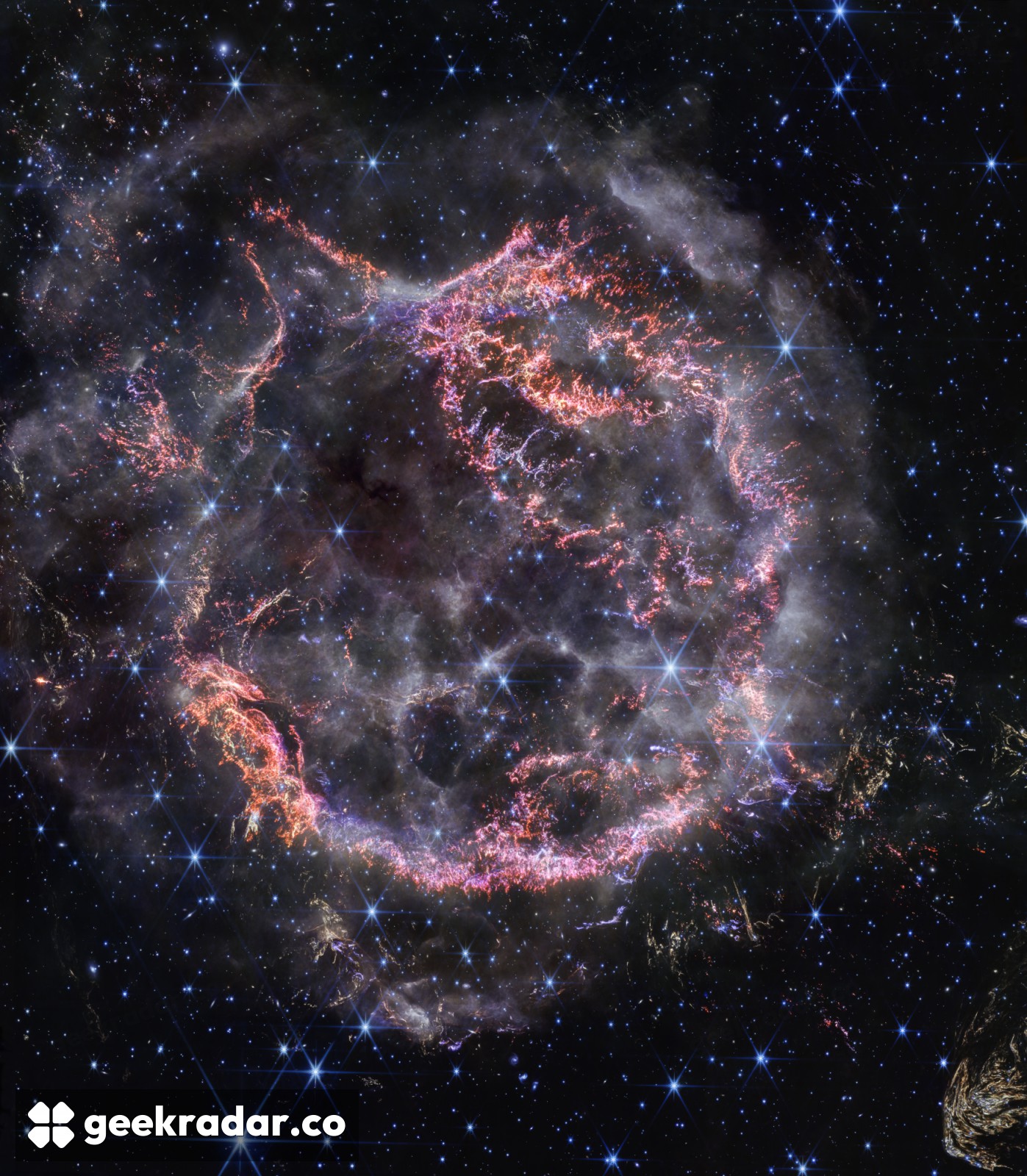
Look at Webb’s image of Cassiopeia A. The pink and orange knots in its inner shell contain debris from a star that exploded. Near the edge, that material has run into gas the star shed earlier. A telescope can tell us where those structures are now. A model lets astronomers ask what happens to the gas next, particularly if a second star explodes nearby.
For that question, grouping stars together to save memory comes at a cost. Two massive stars born near one another can explode into the same patch of gas. The second explosion then encounters an environment the first one has already changed. Spreading the same energy evenly across a larger region can erase that sequence. The distinction matters to the next generation of stars, which need cold gas to form, and to material that can escape the galactic disk through expanding hot bubbles. The University of Tokyo’s account of the research explains why the group wanted to follow individual explosions.
PHEASANT reserves a shortcut for the calculation that needs it. Keiya Hirashima’s team trained a model to predict how gas around a supernova will be distributed 100,000 years later. A direct calculation of this phase would ordinarily advance by roughly a century at a time. The shortcut supplies the larger simulation with a new gas distribution while gravity and other processes continue to be calculated. Those two time intervals describe the prediction being made. Dividing one by the other would give a misleading estimate of how much faster the entire program runs.
Three machines, three different measurements
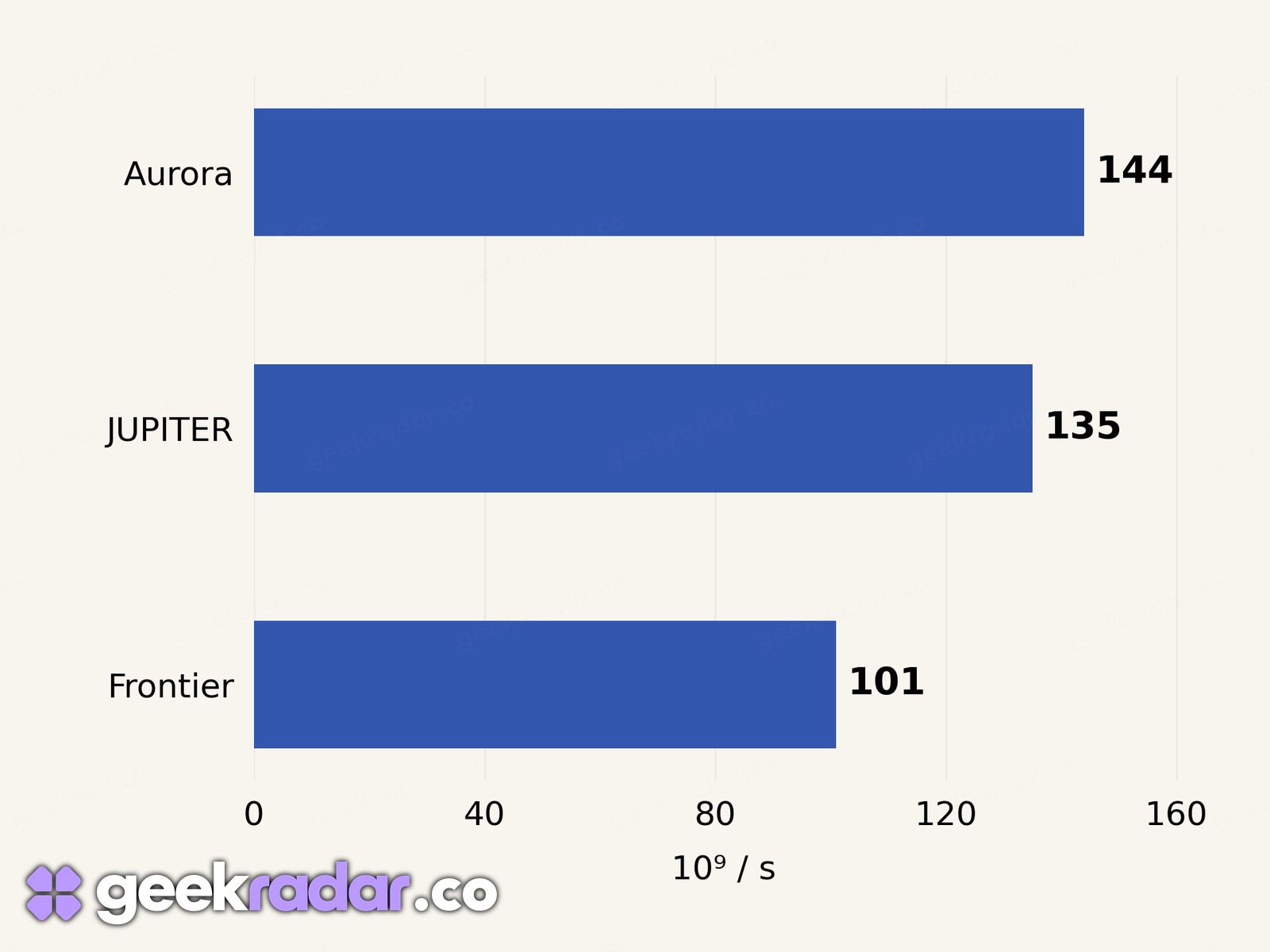
Frontier had the memory for the biggest run. At its finest mass resolution, one computational particle represented 0.22 times the mass of the Sun. The tally of 5.4 trillion includes gas and dark matter as well as stars. It is entirely possible to build a galaxy with the mass of the Milky Way at that resolution without identifying a counterpart for the Sun, or for any particular star in our sky. The team publishes views of the simulated galaxy at several scales.
Aurora delivered the highest reported throughput, 144 billion particles processed per second in its run. The researchers still used CPUs for gas dynamics and several other calculations, making the balance of work between CPUs and graphics processors important. JUPITER in Germany ran the same framework with a third hardware configuration. Each machine used a different number of processors. As with comparing supercomputers by speed and energy efficiency, the question determines which figure belongs at the top of the page. Argonne’s technical account separates the largest run from the fastest one.
The next test is astronomical. The researchers want to add more of what massive stars do before they explode, including the effects of their radiation on nearby gas. That changes the starting conditions for the first blast as surely as the blast changes conditions for the second. For an astronomer studying a cavity in the Milky Way, the payoff would be a model in which the stars that excavated it leave a recognizable trace in its walls.