Why Hayabusa2 is trading an asteroid rendezvous for a single flyby
A 24 m/s course change puts a fast-spinning asteroid within reach in April 2028. The harder part may be spotting it in time to take a sharp picture.
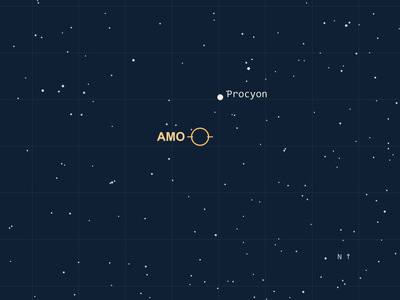
Japan’s Hayabusa2 will give up its planned 2031 rendezvous with asteroid 1998 KY26. Its new destination is 2015 BM510, a small asteroid that turns once in about 49 minutes. The Japanese space agency JAXA is aiming for a single flyby in April 2028. The decisive number in its November 17 mission briefing is 24 metres per second. That is the estimated change in velocity needed to put the spacecraft on the new course. It will pass the asteroid about 250 times faster than that.
An engine that works for now
Hayabusa2 has already brought pieces of an asteroid home. It collected samples at Ryugu in 2019 and delivered the capsule to Earth in December 2020. The spacecraft carried on flying. Its extended mission was to bring it alongside 1998 KY26, close enough to study a body roughly 11 metres across over an extended period.
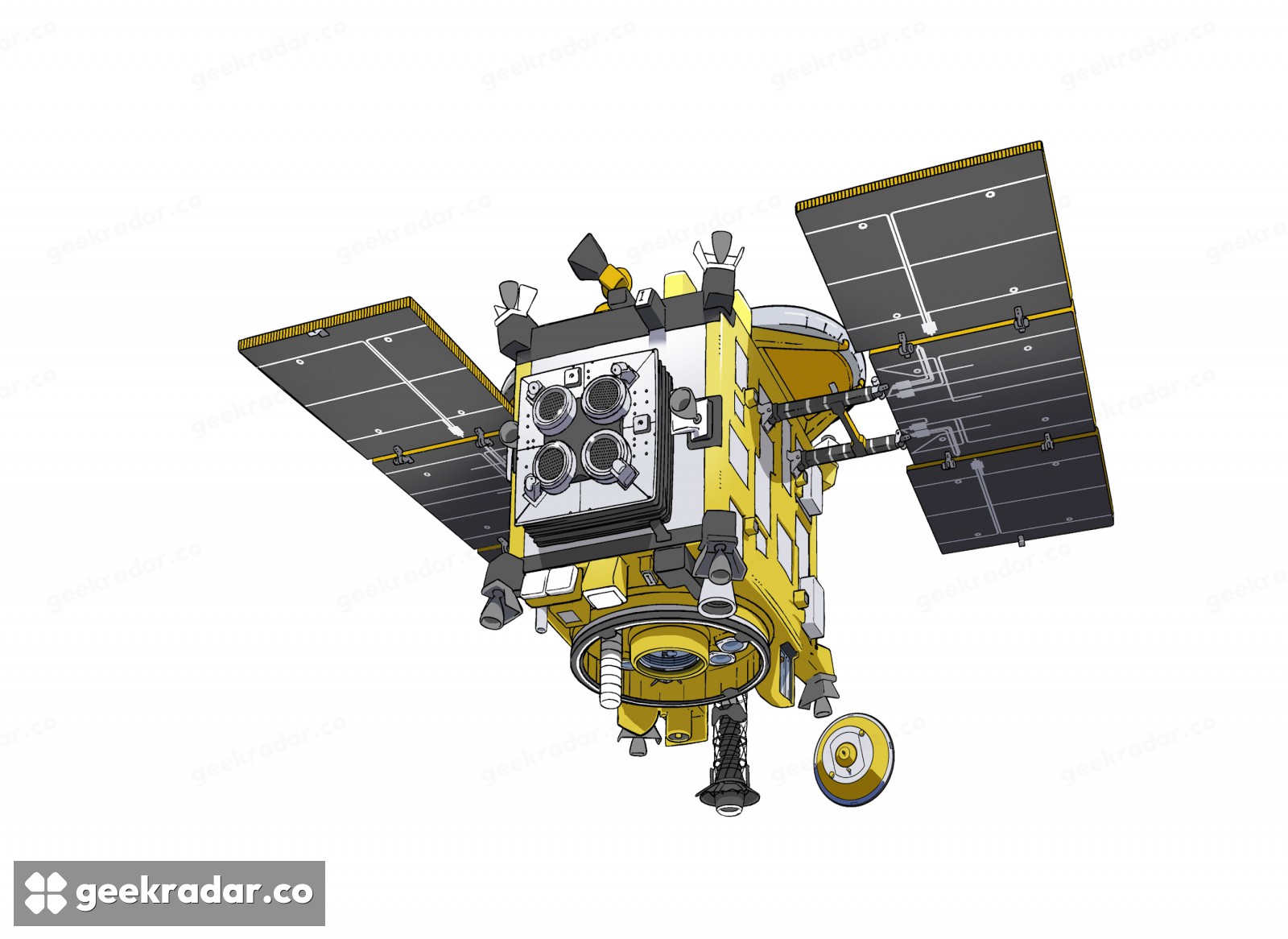
An ion-engine malfunction in August made the planned journey hard to justify. The team found it could pair the ion source from engine D with the neutralizer from engine B. The first component sends charged particles out of the spacecraft to produce thrust. The second supplies electrons to keep the spacecraft from building up an electrical charge. Engineers demonstrated that the combination worked. Predicting how many hours it would keep working was another matter.
The old route needed about 650 metres per second of cumulative velocity change after the Torifune encounter, representing more than 10,000 hours of ion-engine operation. Even reaching the planned 2027 Earth gravity assist would take around 200 metres per second. Engineers therefore looked for an asteroid they could reach without that swing past Earth. Their chemical thrusters could reliably supply about 30 metres per second. At an estimated 24, the route to BM510 fit.
The camera may have only ten hours to find it
A rendezvous lets a spacecraft match an asteroid’s motion and observe it repeatedly. A flyby gives the camera one approach and one departure. For BM510, JAXA estimates a diameter of 17 to 74 metres. The target is also dark. The team expects its telescopic navigation camera to pick it up only about ten hours before the encounter. At Torifune, the camera had about fourteen days.
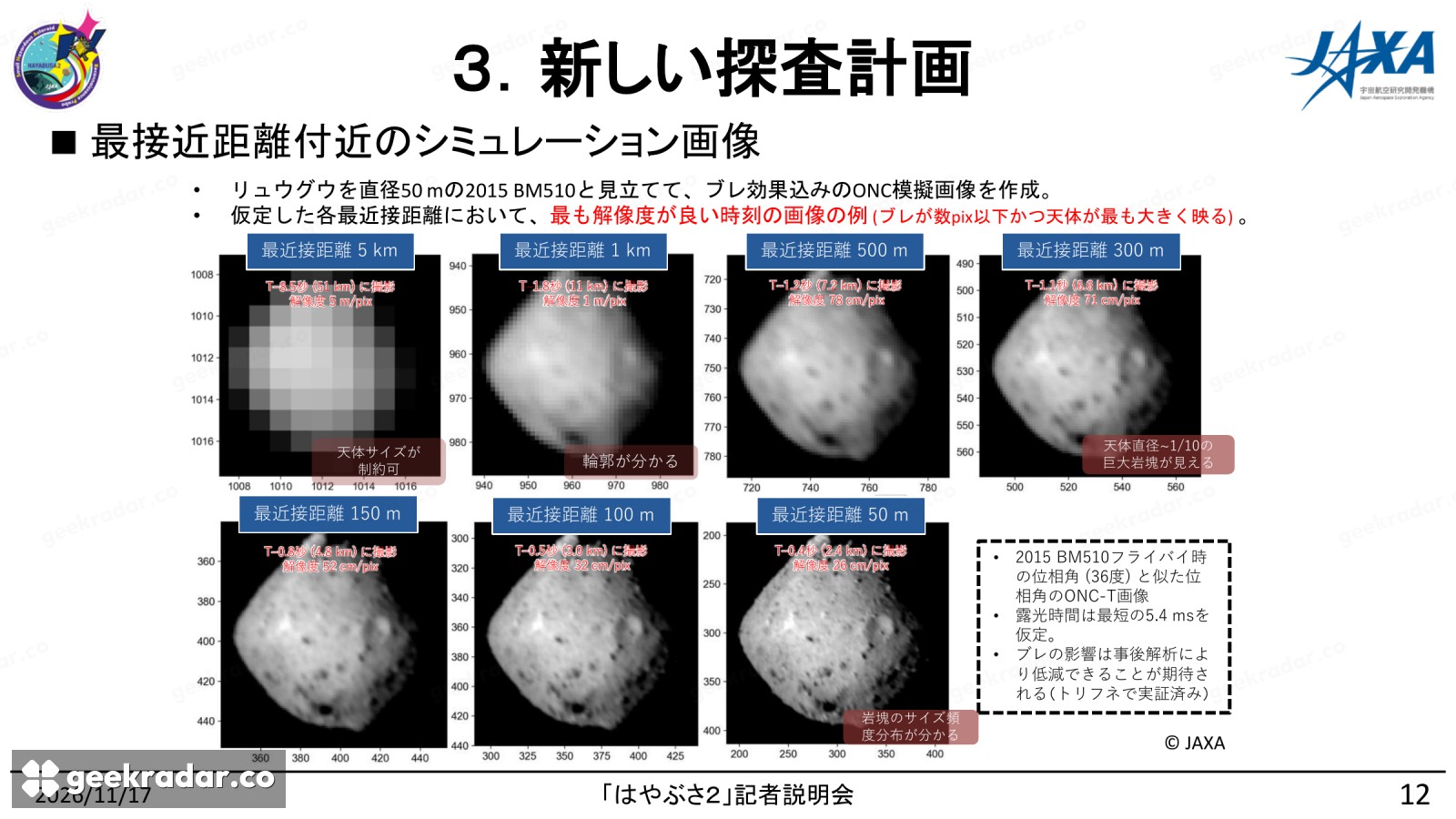
To test what a close pass might reveal, JAXA used images of Ryugu as a stand-in for a 50-metre asteroid. The simulations in its briefing show how the view changes with distance and motion blur. They give engineers a way to choose exposures before anyone knows what BM510 actually looks like. In a different mission, Hera used separate views to resolve a ridge on Didymos. Hayabusa2 must gather its useful angles as the target rushes past.
There is a reason to spend the remaining steering capacity on this particular speck. BM510’s spectrum puts it in the dark D-type class, and its short rotation period raises a physical question: what holds such a small body together as it spins? The shape and surface structure could help narrow the possibilities. The revised flight plan trades years of uncertain engine operation for a few seconds when a sharp frame could tell researchers more than another distant point of light.