Cloudflare Workers gets a spending brake that can also stop your production app
Account-wide controls can block usage, but metering delays and excluded charges mean the chosen threshold is not an absolute invoice cap.
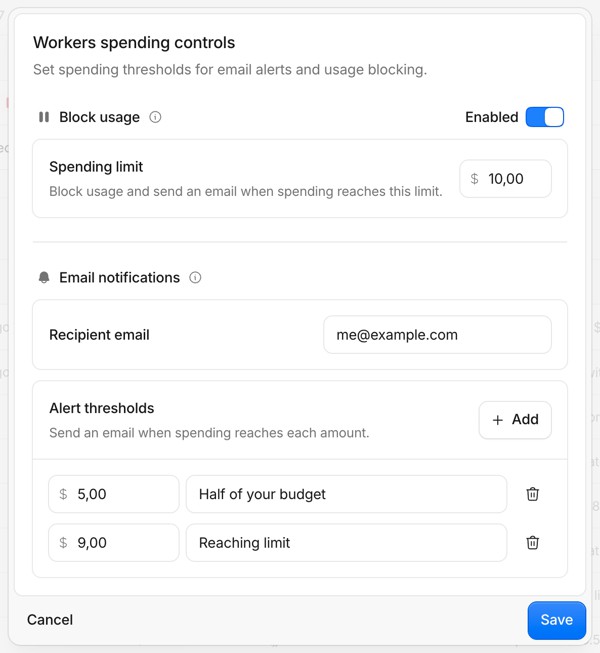
Cloudflare now lets customers stop supported Workers and Durable Objects operations when product spending reaches a chosen threshold. That is a meaningful addition to email-only budget alerts, but it comes with two consequences worth understanding before switching it on: the limit applies across an account, and it is not a guaranteed maximum bill.
The November 13 announcement introduces separate controls for the two products. An alert can warn the owner while the application continues running; usage blocking can interrupt service. Choosing between them is therefore an availability decision as well as a financial one.
The whole account shares the brake
For Workers, the limit counts request and CPU usage charges after the included allowance. It excludes the subscription fee and other products’ charges. Cloudflare’s Workers documentation explicitly warns that a test Worker can consume the shared allowance and interrupt a production Worker in the same account.
That is easy to miss when an organization thinks in terms of individual projects. A small experiment and a customer-facing application may have separate repositories, owners and deployment pipelines, yet share the spending control. The limit follows the billing account, not those organizational boundaries.
Once enforced, new invocations are rejected, including HTTP requests, scheduled triggers and queue consumers. Static assets that do not run Worker code can remain available; a page that requires a Worker may fail. Visitors can see error 1103, but that error has other causes too. A billing check is more informative than assuming every occurrence means the budget was exhausted.
Why the invoice can still exceed the threshold
Cloudflare’s billing guide explains that metering delays, work already in progress and enforcement failures can allow spending beyond the selected amount. Some charges continue during a pause. Durable Objects stored data, for example, is excluded from its usage limit; pausing operations does not delete the data or cancel the subscription.
The practical interpretation is a circuit breaker with a response time. Setting it to exactly the last dollar an organization can afford leaves no room for that response time or excluded costs. An earlier alert gives the owner a chance to diagnose unusual usage before the stronger action interrupts readers or customers.
There is another timing trap: a new limit includes spending already recorded in the current subscription period. Setting a threshold below that existing spend can trigger a pause when evaluated. It does not create a fresh budget beginning at the moment the setting is saved.

Recovery needs an owner
To lift the block, Cloudflare allows raising the threshold above current spending, turning it off or removing it. Changes can take a few minutes. Usage also resumes at the next subscription billing period, with an enabled limit retained for that new period. That renewal date need not be the first day of the calendar month.
Before enabling blocking, decide who receives alerts and who can change the limit during an incident. Also identify dependencies: an application may fail because a Worker it calls is paused even when another service remains healthy. The control is useful precisely because it can stop work; treating that interruption as an impossible side effect defeats its purpose.
For a hobby project, accepting downtime may be the right trade. For a production checkout, warning first may be more appropriate. Cloudflare has supplied a stronger brake. The operator still has to choose where applying it does less harm than allowing the spending to continue.