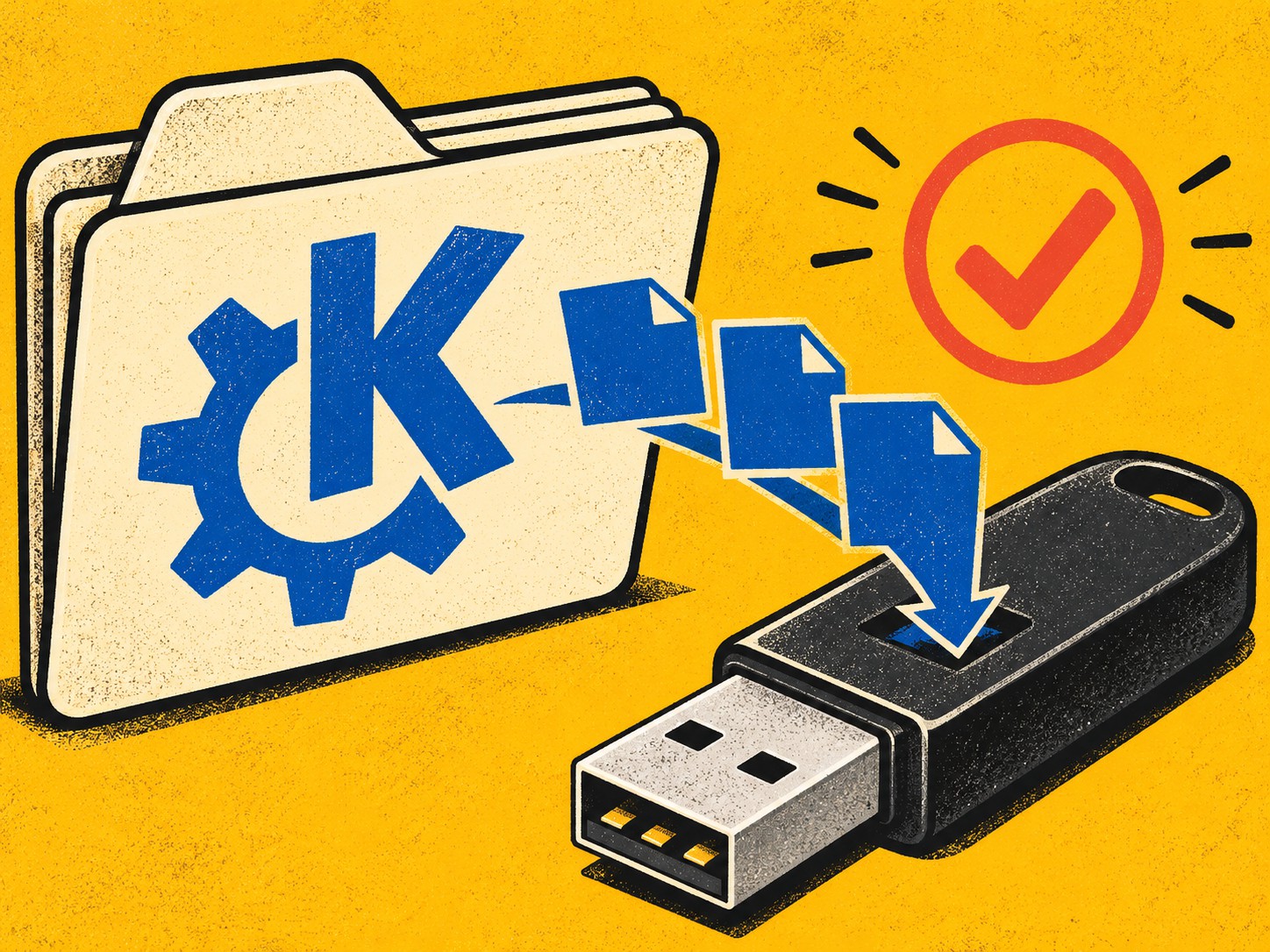
KDE’s file-copy fix changes when it is safe to trust “finished”
KIO waits for buffered writes to reach the destination before declaring success or removing a moved source.
KDE Frameworks 6.32 changes an easily overlooked promise in a file manager: when a copy to removable storage is reported as complete, the data should already have been written out. The November 13 release notes list a coordinated set of KIO changes around flushing removable devices, including delaying deletion of moved source files until that flush has happened.
This is less conspicuous than a new desktop theme, but it addresses a moment when an interface’s wording can affect someone’s files. A progress bar reaching its end is interpreted as permission to move on. The underlying storage system may still have work to do, especially when a fast computer is feeding a slower removable device.
Finishing the transfer and finishing the write
Software commonly buffers data rather than waiting for each individual write to reach its destination immediately. Buffering can improve efficiency, but it separates the apparent completion of a transfer from the point at which pending data has been pushed through the storage stack. KIO is the framework layer used for file operations across KDE software.
The 6.32 changelog explicitly records writing a copy to a removable device before reporting success, flushing large files copied to removable devices, and writing back copies to slow destinations as they proceed. The last point matters for the shape of the wait: distributing writeback work can reduce the mismatch between visible progress and a large final batch of pending writes. The release notes do not provide a benchmark, so a specific speedup would be an unsupported claim.
Moving a file adds another consequence. Unlike copying, a successful move normally removes the source. KDE now lists deletion of moved sources after the removable device has been flushed. That ordering preserves the original for longer while the destination is still being committed, rather than treating the two operations as unrelated interface updates.
Failure and cancellation need a defined ending too
The update also flushes removable storage when a copy fails or is cancelled. Cancellation does not erase writes that have already been issued; there can still be buffered data to finish dealing with. KIO’s changes cover that less tidy path alongside the successful one.
For users, the practical improvement is clearer correspondence between a reported state and the work underneath it. For applications, a shared framework fix is valuable because file-handling behavior need not be reimplemented independently in every program using the relevant facilities. It remains important to distinguish those applications from software that uses its own transfer implementation.
The release contains other changes, including expanded search scoping in Baloo and archive filename handling. Those are separate improvements; Frameworks 6.32 is a set of libraries, not a new numbered Plasma desktop release. A distribution’s packaging determines when its users actually receive the updated components.
What to expect on an installed desktop
An existing KDE desktop does not necessarily gain this behavior simply because the upstream release has been announced. The relevant framework packages must arrive through the distribution’s update process, and applications must use the affected KIO operations. The announcement is evidence of the upstream fix, not a statement that every Linux installation has already changed.
There is no need to turn a routine file transfer into a ritual of manual storage commands. Install the supported distribution updates and keep using safe removal. The worthwhile change is that the software takes more responsibility for the meaning of “finished”: the last visible step should correspond more closely to the state of the files a person is about to carry away.