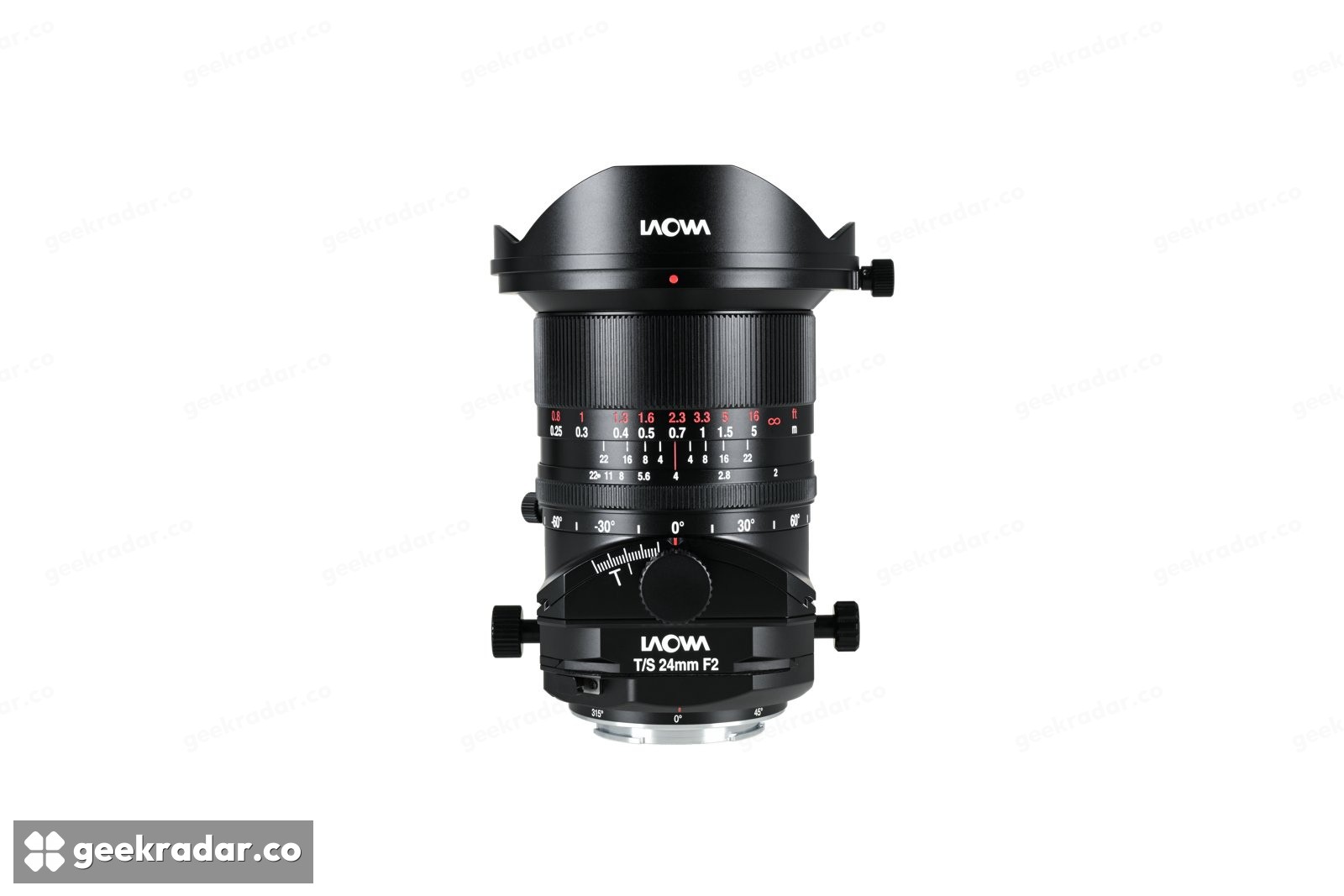
Laowa’s 24mm f/2 tilt-shift lens has a bright aperture and limits worth reading
Maximum tilt and shift depend on focus distance and mount. The compatibility table matters as much as the headline specification.
Laowa's 24mm f/2 Zero-D Tilt-Shift combines a bright aperture with movements that change how a camera frames buildings and places focus across a scene. The unusual specification is attractive, but its most useful detail sits below the headline: maximum tilt and maximum shift are not freely available together at every focus distance.
The manufacturer's product page lists Sony E, Nikon Z, Canon RF, L, Fujifilm GFX and Hasselblad XCD mounts, with a direct-store price of $1,249. The announced limits deserve checking before buying for a specific architectural or landscape setup, especially when the subject will be near infinity rather than close to the camera.
Shift changes framing while the camera stays level
A photographer pointing a camera upwards at a tall building usually sees vertical lines converge. Shift provides another way to frame the top: keep the camera level and move the lens relative to the sensor. It is a compositional tool, allowing perspective to be managed during capture rather than relying entirely on later correction and cropping.
Tilt serves a different purpose. It changes the orientation of the focus plane, which can help align sharpness with a receding surface or create selective focus. It does not simply add more depth of field everywhere. The desired effect depends on the subject's geometry and careful adjustment.
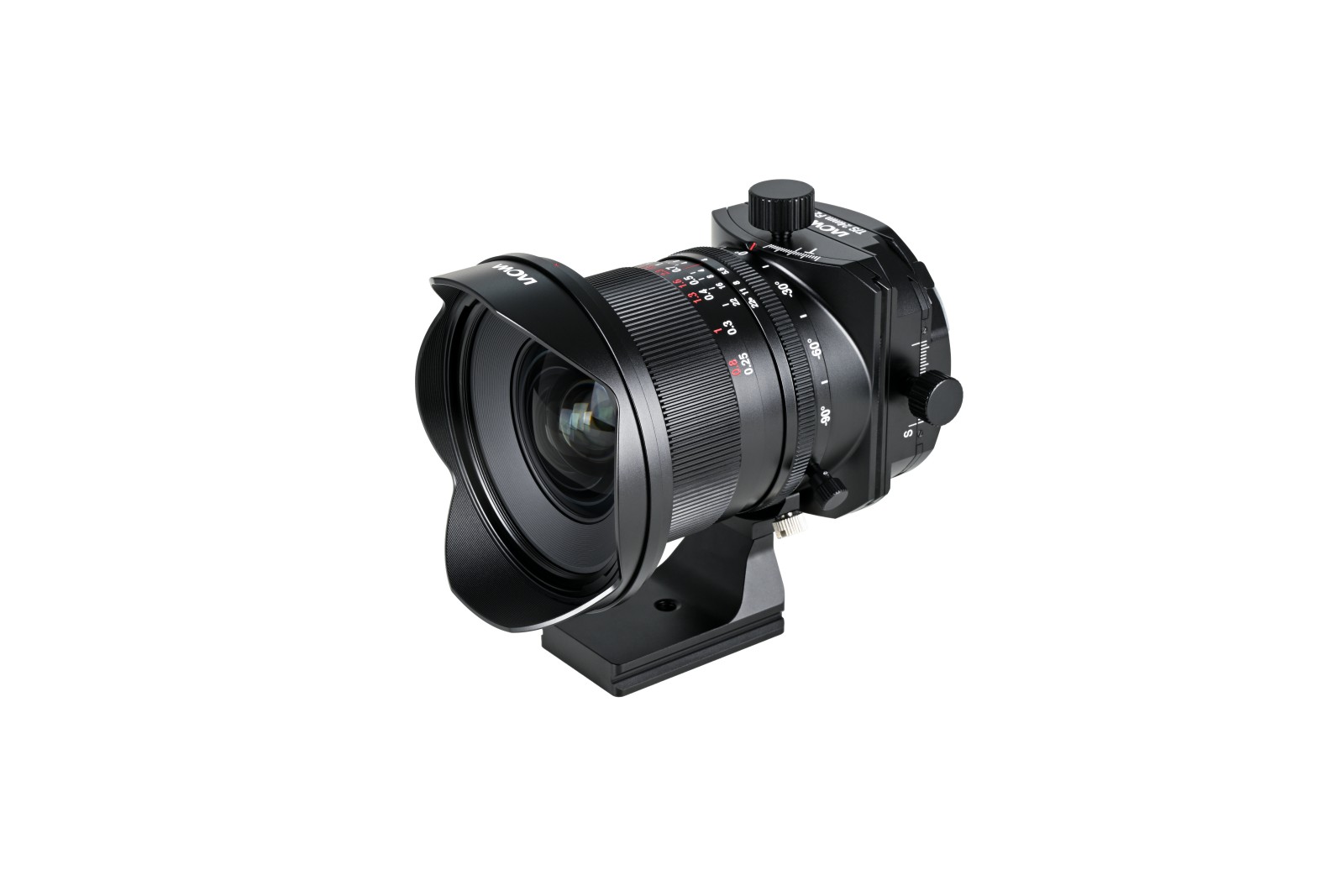
Laowa specifies up to ±12mm shift and ±10° tilt, plus 360° mount rotation. Manual focus and physical movements make this a deliberate tool rather than a substitute for a general-purpose autofocus wide-angle lens.
The limitations table matters more than the maximum
At infinity to five metres, the manufacturer's table for E, Z, RF and L mounts pairs ±12mm shift with ±3° tilt. Increasing tilt to ±4° reduces the listed shift to ±6mm. At close distances of 0.4–0.25 metres, the table allows both headline maxima.
The GFX and XCD versions have their own limits, including a different infinity pairing. A buyer should therefore use the table for the actual mount and distance rather than treat a product-family headline as an unrestricted operating envelope.
| Full-frame mount group | Tilt | Shift |
|---|---|---|
| Infinity–5m, maximum-shift pairing | ±3° | ±12mm |
| Infinity–5m, greater-tilt pairing | ±4° | ±6mm |
| 0.4–0.25m | ±10° | ±12mm |
These are manufacturer-specified combinations, not measurements from a GeekRadar test. They explain why a close-up demonstration does not necessarily establish the movements available while photographing a distant building.
f/2 is useful without proving edge quality
The wider aperture offers more light for dim interiors or night scenes and more flexibility for selective focus. It cannot establish sharpness at the edge of a heavily shifted frame. Laowa's Zero-D branding similarly describes its low-distortion design target; it is not a substitute for independent optical measurements in every configuration.
The lens weighs a stated 860g, accepts 77mm filters and focuses down to 25cm. Those details influence how it fits a working kit. A filter thread is convenient, but the combination of lens weight, adjustment controls and careful framing still makes a stable setup valuable.
Compatibility needs more than matching the mount name. Laowa explicitly excludes several Panasonic bodies from the L-mount version, listing S5 II, S5 IIX, S1 II, S1 IIE and S1R II using abbreviated model labels on its page. Owners should check the exact body before ordering rather than assume L-mount alone settles the question.
This lens is most compelling when a photographer already knows which problem the movements will solve. Its f/2 aperture expands the situations in which that tool may be useful. The decision should still begin with the required framing and focus plane, then work backwards through the limits table to see whether the lens can actually deliver them together.