Fujifilm wants five times more tape shipments, not five times more data per cartridge
A ¥10 billion factory expansion and the 40TB LTO cartridge solve different parts of the long-term storage problem.
Fujifilm plans to spend about ¥10 billion over fiscal years 2026–2028 to expand magnetic-tape production at its Odawara site in Japan. Its target is five times the shipment capacity of fiscal 2025. That is a manufacturing expansion, not an announcement that each cartridge suddenly holds five times as much data.
The distinction is essential to the October 29 announcement. Demand for archival storage can rise even while much of the public discussion concentrates on faster processors and memory. Data that is expensive to produce can remain worth keeping long after it stops needing immediate access.
Capacity has two meanings in this story
Fujifilm’s investment concerns facilities, equipment and people, with LTO Ultrium 10 among the principal products involved. The fivefold target describes what the operation can ship relative to its baseline. It does not say that output has already reached that level, or that every generation of tape will receive the same increase.
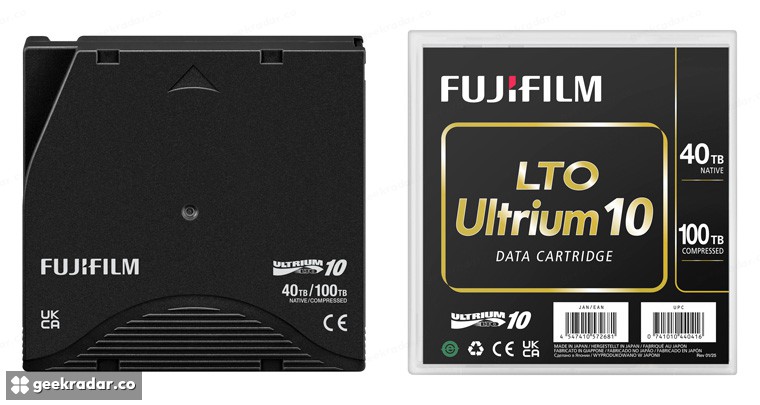
The company separately sells an LTO Ultrium 10 cartridge with 40TB of native capacity. Its 100TB compressed figure is a different measure and depends on compression. Data that is already compressed cannot be assumed to shrink enough to achieve that headline value.
Conflating those figures would obscure the actual business decision. Fujifilm is committing to supply more archival media, while improvements to the medium itself follow their own materials and engineering path.
The extra length is part of the storage technology
The 40TB product is an evolution of the earlier 30TB LTO-10 cartridge. Fujifilm attributes the increase to magnetic-particle technology and a thinner layer structure using aramid film, allowing about 30 percent more tape length inside the cartridge. It says the cartridge works with the same LTO-10 drive hardware as the 30TB version.
That is a useful reminder that a storage advance is not always a change in electronics. The amount of usable recording material, its thickness and the density at which data can be recorded all contribute to what fits in the same physical format.
Compatibility also has a specific scope. “The same LTO-10 drive hardware” does not mean any tape drive from any generation can read the cartridge. The generation and the actual drive support still matter when planning a library.
Why an archive is not just a slower working drive
An active dataset and an archive have different jobs. The first must be available when software asks for it; the second must remain recoverable over a longer period, often at much lower access frequency. Treating both as the same purchase can hide the costs of keeping rarely used data on more immediately accessible infrastructure.
Tape also offers the possibility of physical separation from the network. That can be valuable in a backup strategy, but it is an operational choice rather than an automatic security property of owning a cartridge. A copy must actually be isolated, retained and recoverable. Its usefulness depends on a working restore process as well as a label on a shelf.
For readers following data-storage developments, Fujifilm’s expansion is evidence that the less visible part of the data economy still needs substantial industrial investment. Faster systems make data easier to create and process. Someone still has to decide which of that data should survive, and provide a medium capable of carrying it beyond the next upgrade cycle.