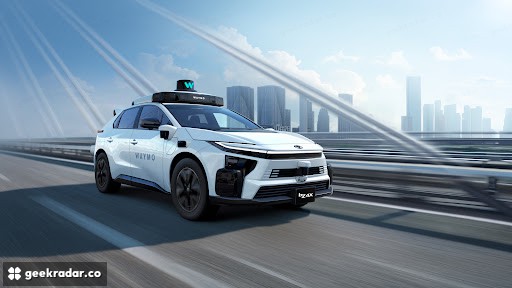
Toyota and Waymo put the bZ4X robotaxi on a factory-to-fleet path
Japan testing is planned for 2027, with later UK deployment. Building the car and integrating its autonomous hardware at one plant is the concrete shift.
Toyota will build a Waymo-equipped bZ4X fleet for testing and validation in Japan in 2027, with the United Kingdom and other Waymo markets planned for later years. The significant manufacturing detail is that Toyota intends to assemble the vehicle and integrate the autonomous-driving hardware at the same Takaoka plant.
The October 30 joint announcement advances the companies’ April 2025 preliminary agreement. It does not announce an on-sale driverless Toyota for private buyers, nor say that passengers can book the new vehicle today.
Building the car and the autonomous fleet together
A robotaxi is more than a production car with a software subscription. Sensors and other driving hardware must become part of a vehicle that can be manufactured, maintained and operated consistently. Integrating that equipment alongside assembly brings the fleet’s physical production closer to the automaker’s existing processes.
Toyota says the work will take place at Takaoka in Toyota City, Aichi Prefecture. The vehicle is also being adapted for passengers, with automatic doors, a powered liftgate and interior features intended to improve entry, exit and comfort. Those details matter because a service without a driver cannot rely on that person to perform every small task around a ride.
The announcement describes Level 4 autonomous vehicles. That should not be translated into an ability to drive anywhere under every condition. The relevant product is a vehicle operating within the conditions and service area for which its autonomous system is deployed.
Japan’s testing phase is still a phase
Waymo’s Japan information page says it is not currently serving riders in Tokyo. Its local work involves Nihon Kotsu and GO, with trained crew members behind the wheel during validation. The site also describes preparations for an unmanned commercial service in 2027.
These are related plans, but they should not be collapsed into one guaranteed launch date. The October announcement gives 2027 for initial bZ4X testing and validation. A fleet manufacturing milestone, a completed validation program and an open passenger service are different events.
The distinction is especially relevant when the same brand supplies ordinary privately owned cars. A Waymo-equipped fleet vehicle does not establish that a dealership bZ4X will receive equivalent driving capabilities through an update.
Scaling hardware does not settle the safety question
The partners present manufacturing scale and road safety as linked goals. Their release includes Waymo’s comparison with human drivers for serious crash injuries, but a headline ratio alone does not explain the operating areas, exposure or comparison method. It is not a substitute for examining the evidence relevant to a new service environment.
What this agreement establishes more concretely is an industrial route: a known vehicle platform, a named factory and an initial market. That gives the collaboration more substance than a broad memorandum about future autonomy, while leaving deployment performance to be demonstrated.
For riders, the eventual test is ordinary: whether the vehicle can complete a useful trip, admit passengers comfortably and operate reliably where the service is offered. Toyota’s factory can help produce the fleet. It cannot, by itself, turn a test operation into a service a passenger can summon.