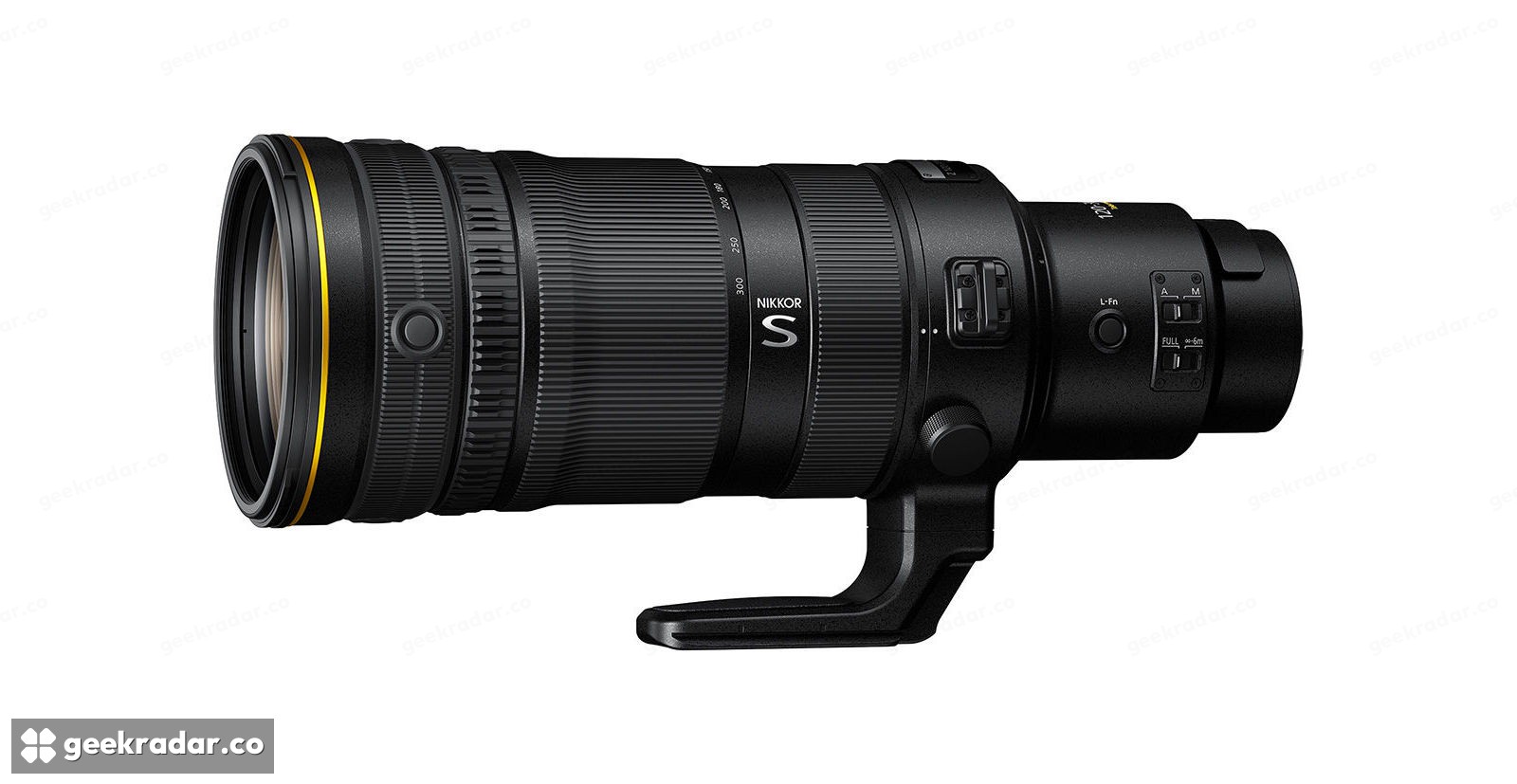
Nikon’s 120–300mm keeps the teleconverter inside, and the light tradeoff visible
A switch extends the reach to 420mm at f/4. The practical gain is less interruption while photographing sport.
Nikon’s new NIKKOR Z 120–300mm f/2.8 TC VR S puts an important sports-photography decision under one switch: stay at f/2.8, or engage the built-in 1.4× teleconverter and extend the long end to 420mm at f/4. The extra reach costs a stop of light, but it does not require removing the lens while the action continues.
That tradeoff is the heart of the October 29 announcement. A photographer covering play from a fixed position cannot always move closer. Switching an external teleconverter involves handling equipment and interrupting shooting; a built-in converter reduces that interruption. It does not make the optical compromise disappear.
Two ranges, two light budgets
Without the converter, the lens maintains a maximum aperture of f/2.8 throughout its 120–300mm range. Engaging the 1.4× converter produces a calculated 168–420mm range at f/4. At the same shutter speed, that one-stop reduction means an equivalent exposure needs roughly twice the ISO, assuming other conditions remain unchanged.
For sport, the shutter-speed condition matters. A slower exposure may recover brightness but blur a fast-moving subject. The useful choice is therefore between tighter framing and the amount of light available to freeze motion. In a well-lit outdoor venue, extra reach may be particularly attractive; inside a darker arena, retaining f/2.8 can be more valuable.
| Configuration | Focal-length range | Maximum aperture |
|---|---|---|
| Converter disengaged | 120–300mm | f/2.8 |
| Built-in 1.4× converter engaged | 168–420mm | f/4 |
The converted short end is calculated from Nikon’s stated multiplier. These are optical specifications, not measurements of image quality. Nikon’s claims about prime-like rendering and autofocus performance still require testing across subjects, distances and lighting conditions.
Lighter does not mean lightweight
Nikon lists a mass of approximately 2,735g, about 515g below its 2020 F-mount 120–300mm f/2.8. That is a meaningful reduction for carrying the lens or repositioning a supported camera, but the new model remains a substantial piece of equipment. The comparison should not turn it into a casual handheld travel zoom.
Internal focusing and zooming keep its overall length constant during operation. That helps explain the handling proposition alongside the integrated converter: several frequent adjustments can happen without changing the lens’s external footprint. Nikon also specifies an Arca-Swiss-compatible tripod foot, with an important qualification that screw-type clamps should be used rather than lever-type clamps which may not secure it firmly.
Stabilization cannot stop an athlete
The advertised 6.5-stop stabilization figure has specific conditions: Nikon’s test uses the Z6III, Synchro VR, the telephoto end, Normal mode and the converter disengaged, under the CIPA 2024 standard. It is not a universal promise for every body and configuration.
More fundamentally, stabilization compensates for camera movement. It cannot freeze a player’s sprint or a swinging racket. A sharp background with a blurred athlete can still result if exposure time is too long. The lens’s bright aperture and stabilization address different problems, even when both contribute to a usable photograph.
The built-in converter is most persuasive when viewed as a way to keep photographing through a change in distance. The event will not pause while equipment is rearranged. Nikon has shortened one interruption; the photographer still has to decide whether the next frame needs more reach or more light.