Nvidia’s Nemotron 3.5 Transcribe lets the instruction shape the transcript
Open weights, speaker labels and word timestamps broaden the workflow. The fastest published runtime is not yet in the open release.
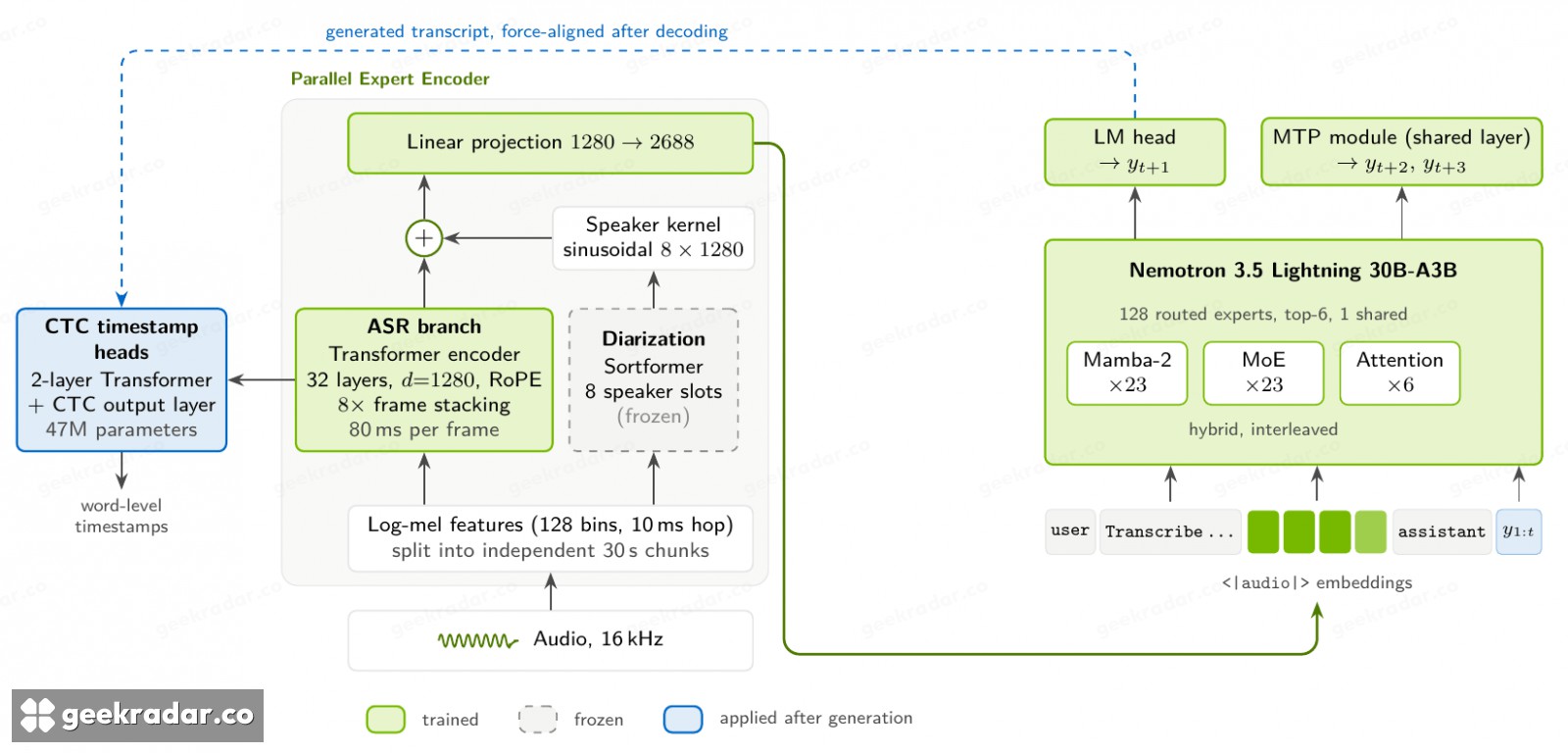
Nvidia’s Nemotron 3.5 Transcribe can take a recording and an instruction about how to render it: preserve hesitations, produce cleaner written text, recognize specialist vocabulary or attach speaker labels. The interesting change is that transcription style becomes part of the task, rather than a cleanup operation bolted onto the result.
The October 28 release is an open-weight speech model for offline processing in 40 languages, with recordings up to an hour. “Offline” describes processing recordings rather than providing a live streaming recognizer. It does not mean the full model fits comfortably on an ordinary laptop.
A transcript is not always the same product
A searchable interview, a subtitle track and a linguistic research record have different requirements. Removing repeated words may improve readability while destroying evidence about how someone spoke. Speaker labels can make a meeting navigable, but they identify voices within the recording, not verified people in the outside world.
Nemotron’s instruction-controlled approach lets a developer specify these distinctions. Optional context can also supply terminology for a technical discussion. That is useful when a recognizer encounters a product name that sounds like an ordinary word, although providing the expected vocabulary is not proof the model heard it correctly.
Nvidia’s model card separates transcription, translation, speaker attribution and audio understanding. Its 40-language headline should not be read as identical capability across every task and language. The card says audio understanding and reasoning were evaluated only in English; its language matrix lists additional differences in speaker and translation support.
The headline speed has a particular runtime behind it
Nvidia reports up to 2,238 seconds of audio processed per second on one RTX PRO 6000 Blackwell Server Edition GPU, using its optimized NIM implementation, NVFP4 precision and speculative decoding. That is a throughput claim under a specified serving setup, not the time any user should expect after downloading the weights.
The model card supplies a consequential qualification: those serving optimizations are not yet in the open-source release. Nvidia expects the release-day NeMo Speech integration to be roughly twice as slow. The documented FP8 quick start also uses a 96GB professional GPU. An open download lowers the access barrier to the model; it does not erase the hardware and deployment work.
Precision adds another tradeoff. Nvidia publishes BF16, FP8 and NVFP4 versions, but the benchmark table in the FP8 card reports BF16 results. It separately says FP8’s average transcription error is 1% higher in relative terms. That is not a one-percentage-point increase, and it should not be silently mixed with the BF16 scores.
Control is useful only if the output remains auditable
Word timestamps and speaker-attributed text can make checking a long recording much easier. A reviewer can return to the relevant passage instead of searching through an hour of audio. That is a more practical benefit than treating a leaderboard position as a guarantee for every accent, microphone or specialist conversation.
The weights are offered under OpenMDW 1.1, with the terms and component notices linked from the model card. Organizations still need to choose a suitable deployment, handle permission to process recordings and test the language and task they actually use.
The most promising feature is therefore the explicit contract between instruction and transcript. A system that knows whether to preserve a hesitation or remove it can serve different workflows. The recording remains the reference when a polished sentence sounds more certain than the speaker did.