DirectX’s new ray-tracing preview tackles the cost of rebuilding a world
Clusters and partitioned scene structures target repeated geometry work. Real sample images show the approach—and its limits.
Microsoft’s latest DirectX Raytracing preview tackles a cost that is easy to miss when discussing realistic lighting: before a GPU can trace rays through a changing world, it needs an efficient representation of that world. Rebuilding that representation can consume time and memory before a reflection or shadow is calculated.
The new Clustered Geometry and Partitioned Top-Level Acceleration Structures features aim to reduce repeated work at two different scales. One reorganizes the small pieces of geometry inside objects; the other limits rebuilding across a large scene. They are developer features in Agility SDK 1.722, not a graphics option that automatically accelerates existing games.
Why the visible object and its reflection can disagree
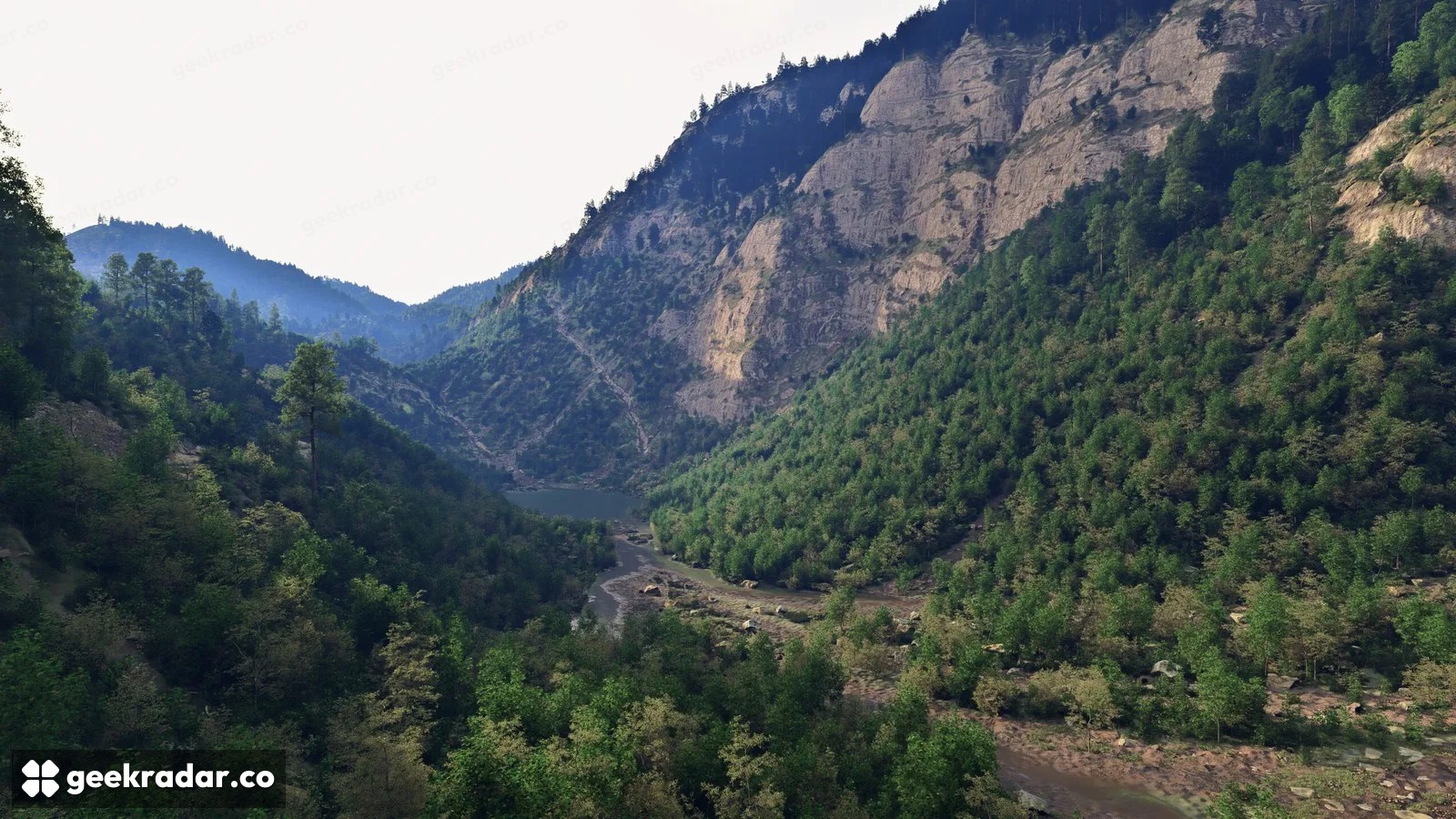
Games can display very detailed geometry while tracing rays against a simpler substitute. That saves work, but the proxy may not exactly match the surface on screen. A reflection or shadow can therefore describe a less detailed object than the one the player sees.
Microsoft’s explanation presents clustered geometry as a way to make full-detail ray-traced geometry more practical. Instead of repeatedly organizing a large, unstructured set of triangles, a renderer can build reusable clusters and assemble them into larger acceleration structures. Each cluster can contain up to 256 triangles and 256 vertices.
Reusability matters when the world changes. Different levels of detail can use different collections of existing clusters. For animation, cluster templates preserve work associated with the way vertices connect, while the positions themselves change. The renderer still has work to do; it is avoiding parts that need not be solved from scratch.
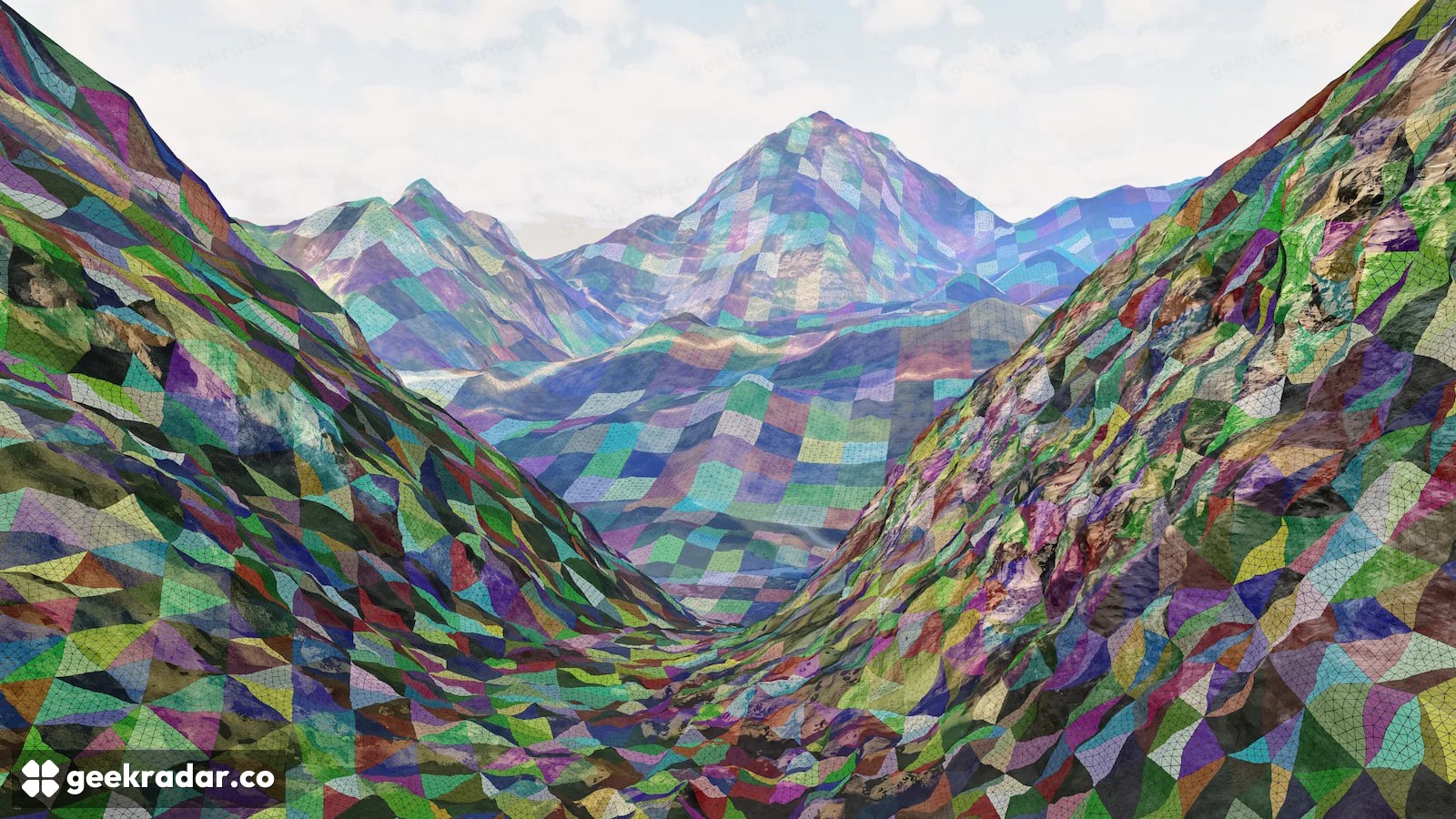
In Nvidia’s accompanying technical overview, a terrain example uses a limited set of recurring triangle patterns at different distances. Reusing those patterns helps keep detail distributed according to what occupies screen space. The colored terrain image illustrates the grouping; its colors are a diagnostic view, not the final game appearance.
A large world does not change everywhere at once
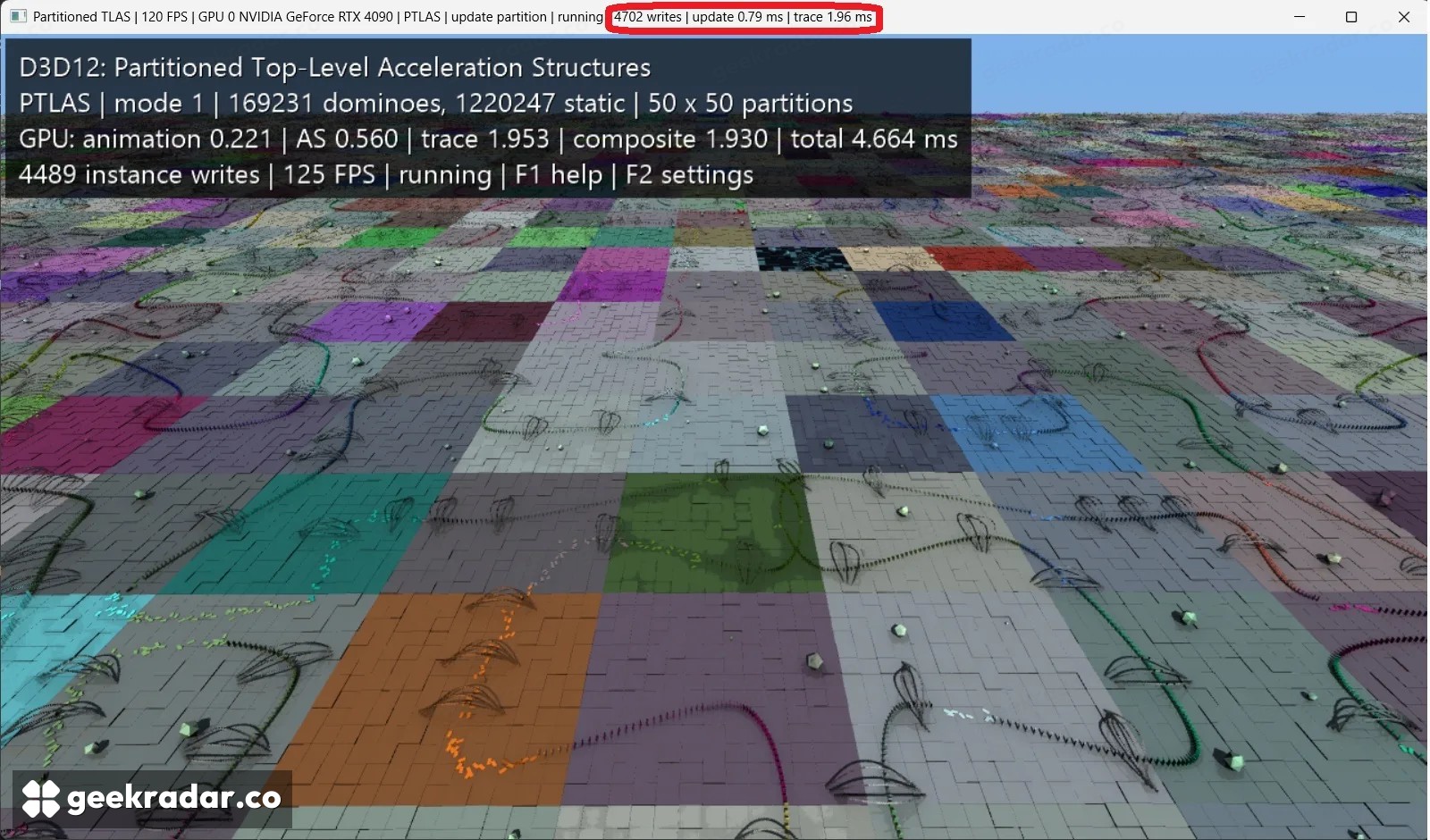
Partitioned top-level acceleration structures address a different scale. A scene may contain many objects, yet only some move during a given frame. Dividing the scene into partitions allows unchanged regions to retain their existing structures while changed regions are updated.
The domino sample makes the idea tangible. Falling pieces change locally; the entire distant layout does not need equivalent reconstruction. A special global partition handles frequently moving instances individually. Developers still need to choose sensible groupings, because overlapping partitions and extra traversal work can offset some savings.
These features can be used separately. The difference between a graphics API and a performance result remains important: exposing an efficient operation gives developers an opportunity, rather than proving every engine will benefit equally.
Support is specific, and the benchmarks are demonstrations
The preview lists support for all Nvidia RTX GPUs, AMD Radeon RX 9000 graphics, Intel Arc B-series and specified Core Ultra families, with the relevant drivers. Qualcomm targets Snapdragon X2 support in the first half of 2027. Microsoft explicitly leaves some older ray-tracing hardware undecided; existing ray-tracing capability is not a guarantee that a vendor will expose these features on every generation.
Microsoft also publishes dramatic results from its synthetic clustered-geometry playground, while warning readers not to extrapolate their magnitude to games. That warning belongs beside the numbers. A deliberately demanding structure-rebuild workload can show a very large gain without representing the total workload of a shipped title. Temporary build memory, tracing time and scene-update time can move in different directions.
For players, the promising consequence is more faithful lighting on the geometry already being drawn, particularly in dense or animated worlds. The route there runs through engine integration, drivers and measured frame budgets. A more realistic reflection should eventually look like the object beside it; a preview benchmark cannot tell us when a particular game will achieve that.