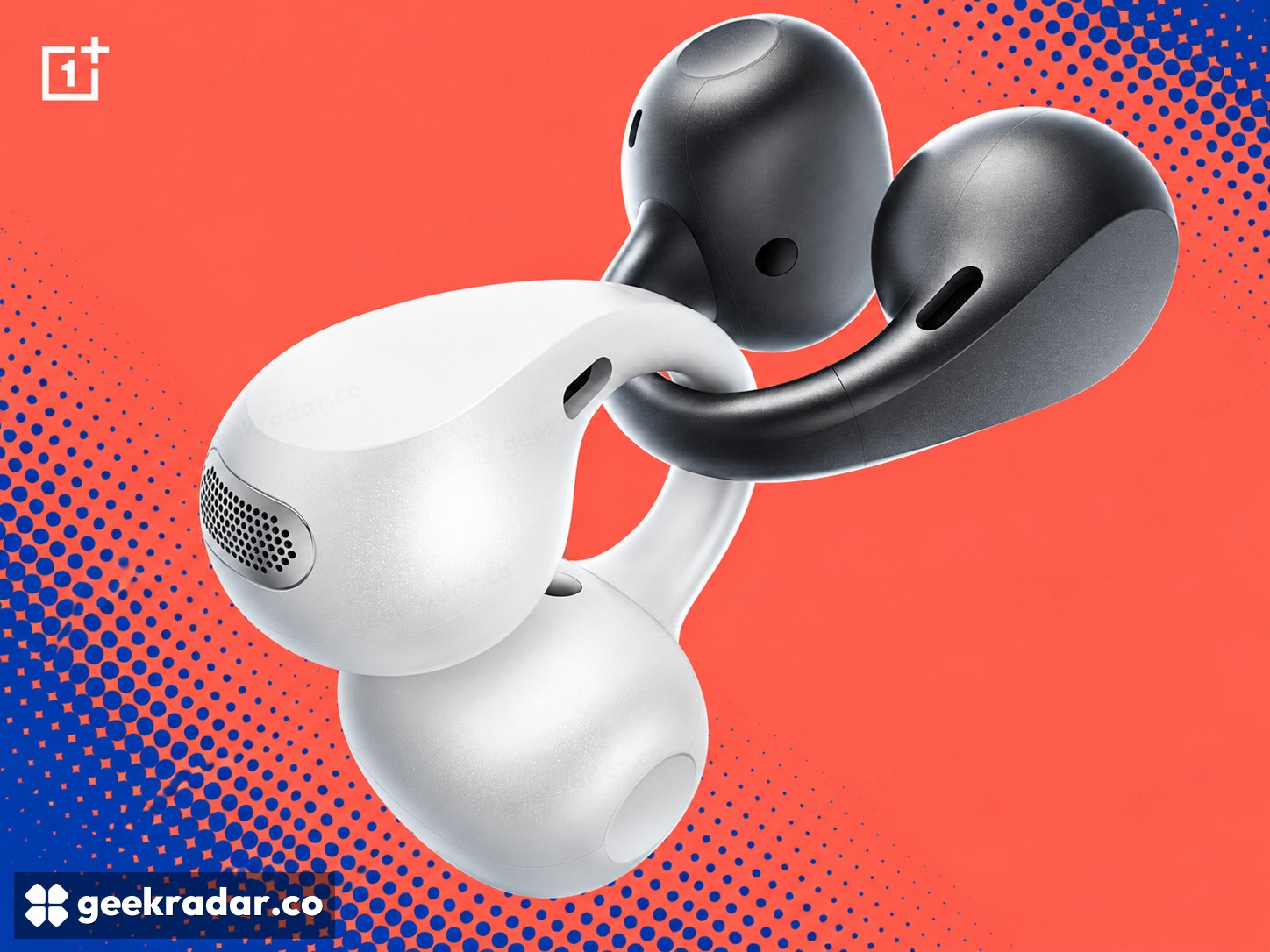
OnePlus Buds Clip split the sound between two drivers, while leaving the ear open
An 11mm woofer and 9mm tweeter are unusual in clip-on earbuds. Their practical tradeoff still starts with the absence of an acoustic seal.
OnePlus is putting two separate drivers into an earbud that leaves the ear canal open. The newly announced Buds Clip combines an 11mm woofer, a 9mm tweeter and separate digital-to-analogue converters with a flexible clip rather than a sealing silicone tip. It is a particularly revealing addition to the expanding open-ear category: the engineering challenge is to deliver convincing music while deliberately leaving a route for the outside world.
The official product page describes a 5.2g earbud connected by a nickel-titanium arc, with a broader rear contact area intended to distribute pressure. Those details matter more to this design than another layer of audio branding. An open earbud can avoid the plugged-ear sensation of an in-ear model, but it still has to grip an ear whose shape varies considerably between people.
Two drivers cannot replace an acoustic seal
Splitting the frequency range between a woofer and a tweeter gives OnePlus different components to work with for bass and treble. Separate converters give each driver its own signal path. Dynaudio has collaborated on the tuning, and the specification includes high-resolution audio support. None of those ingredients, individually, establishes how the finished earbuds sound in a busy street.
An in-ear seal helps keep external sound out and bass energy in. The Clip deliberately gives that up. Its appeal is that a conversation, an announcement or surrounding activity need not disappear behind an ear tip. The corresponding limitation is that environmental noise competes with music rather than being physically blocked. Raising the volume is not a substitute for isolation.
OnePlus also describes a dipole sound-field system intended to reduce leakage. That is a useful distinction from promising complete privacy: shaping the sound around the ear is not the same as making nearby listeners unable to hear it. Actual fit, playback level and background noise will all influence the result.
The small print changes the headline features
The advertised battery figure is up to 40 hours including the charging case, not 40 uninterrupted hours from the earbuds. The IP55 rating applies to the earbuds; the case is not covered by that rating. OnePlus also warns against charging wet earbuds and says protection can diminish with wear. These are everyday distinctions for an accessory likely to be used outdoors.
Dual-device connectivity is more broadly useful than the headline AI features. Compatible OnePlus phones expose the controls through their earbud settings; other supported Android and iOS devices can use HeyMelody. OnePlus cautions that switching behaviour varies between connected devices, particularly laptops. A phone-and-computer setup therefore deserves its own check rather than assuming that every source switches instantly.
Translation has a narrower boundary. The company specifies selected OnePlus devices running OxygenOS 15.0.1 or later and directs buyers to the app for supported languages. Bluetooth compatibility with a phone does not automatically bring that feature with it. Nor does a language appearing in an app establish how accurately a conversation will be translated.
The distinction complements our Sony and Bose headphone comparison: comfort, isolation and controls solve different listening problems.
An announcement still needs a buying decision
GSMArena's launch coverage places the Buds Clip in the current wave of open-ear releases. The product is listed in Pearl White, Pebble Gray and Twilight Rose, but the launch materials checked for this report do not establish a universal price or on-sale date. Availability should be read market by market.
The interesting choice is less about whether two drivers beat one on a specification sheet than whether open listening suits the hours in which you actually wear earbuds. For someone who repeatedly removes an ear tip to hear a colleague, the shape could be the feature that earns its place. For someone trying to escape a noisy commute, keeping the world audible is a compromise that no extra driver can erase. More Gear coverage follows that same distinction between a new component and a useful change.