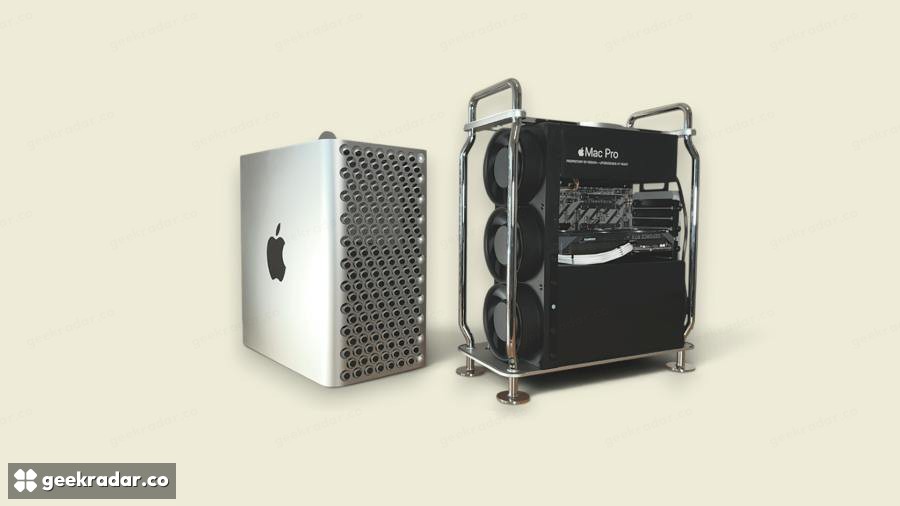
A proposed Mac Pro conversion kit preserves the case, not the computer inside
The A1991 project adapts Apple’s enclosure for ATX hardware. Fit, cooling and campaign status matter before a donor machine becomes a plan.
The most durable part of a workstation can be the part that does no computing. A proposed conversion kit from Practical Prototyping would let owners of the 2019 Mac Pro keep its aluminum enclosure while replacing the proprietary internal platform with standard PC components. It is an enthusiast reuse project, not an Apple upgrade kit or a complete $500 computer.
The project's Kickstarter campaign targets the Mac Pro 7,1 A1991 tower. In Hackster's account of creator Stefan Bond's design, the conversion is intended to be reversible, retaining the enclosure's character and original front fans. Those are project claims at the crowdfunding stage, rather than results from a production kit tested here.
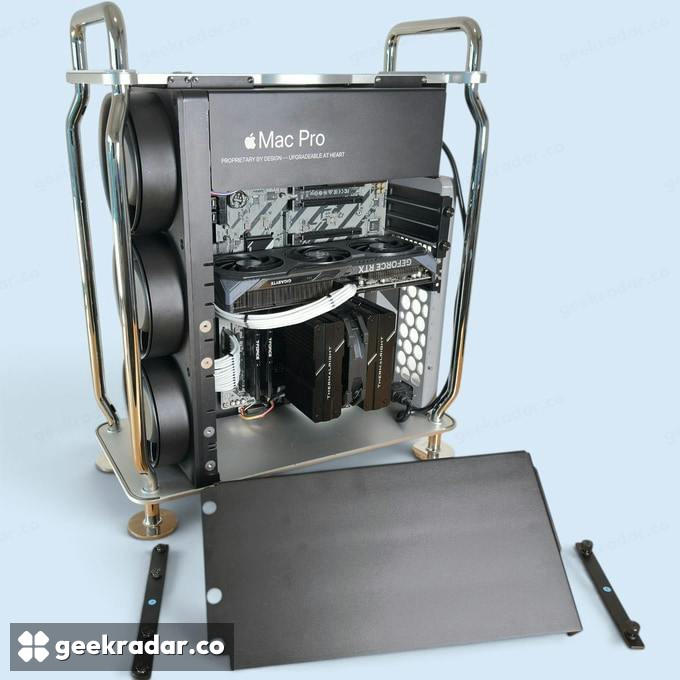
Keeping the case means adapting more than screw holes
A conventional PC motherboard expects standardized mounting points, rear connections and expansion-card positions. A proprietary workstation can arrange those elements differently. The useful work in a conversion kit is therefore the mechanical and electrical bridge between the two designs: mounting plates, brackets and interfaces for components such as the original fans and power button.
That is why the apparently empty case is not equivalent to a standard ATX enclosure. Its exterior volume does not guarantee that every large graphics card or cooler will fit after the new mounting system is installed. The proposed limits include a 308mm-long, 140mm-tall graphics card and a 140mm-high air cooler, with an accessory for a 240mm liquid-cooling radiator. These constraints should be checked against the exact component, including the space needed for its cables.
The kit price is only the beginning
The quoted contribution is roughly US$500, before the other costs of a build. The owner must supply the case and the PC hardware: motherboard, processor, memory, graphics card where needed, power supply, storage and cooling. Someone starting without the enclosure faces a different calculation from an owner with a suitable damaged or unused tower.
The work also requires dismantling the original machine. Reversibility means preserving the removed hardware and knowing how the original assembly fits together; it does not make the conversion a quick external accessory. A builder should compare the project's instructions and support arrangements with their own experience before choosing parts around it.
Reuse can be valuable without being the cheapest route
For a purely functional PC build, a standard case may be simpler, cheaper and less restrictive. The conversion has a different appeal: retaining an enclosure whose materials and design still have value after the original platform no longer suits its owner.
Crowdfunding adds a separate uncertainty. A proposed shipping estimate is not stock on a shelf, and funding does not guarantee a finished product. The sensible reason to follow the project is the engineering approach, not an assumption that a familiar Apple shell makes the campaign safer. If the kit succeeds, its achievement will be modest and worthwhile: letting a well-made case outlive the computer it was originally designed to contain.