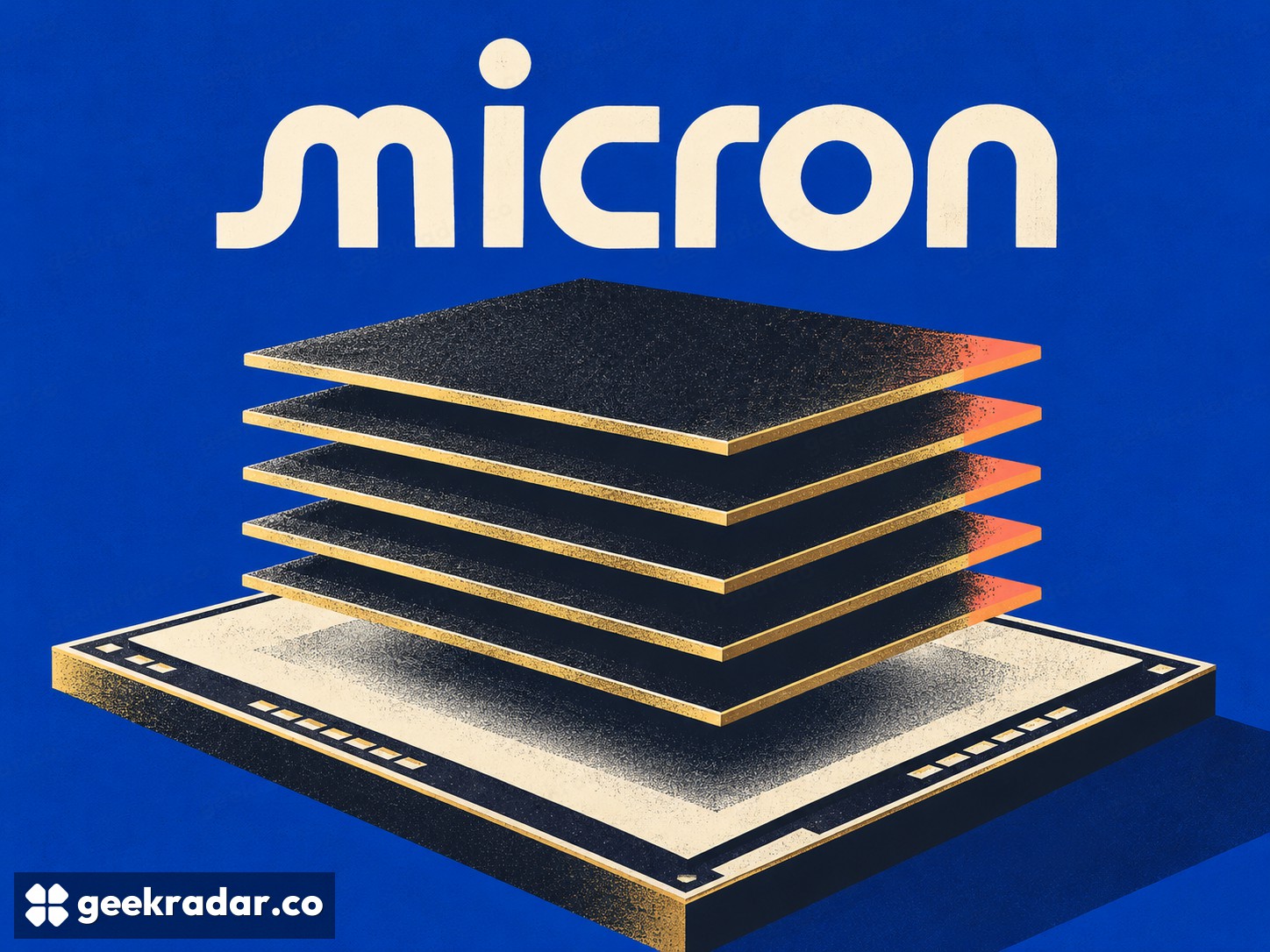
Micron’s vertical-memory roadmap brings data closer—and makes heat harder to escape
Vertical HBM, DDR6 and 1TB modules solve different bottlenecks. The roadmap describes engineering targets, not a shopping list of available upgrades.
Micron's latest technology roadmap points toward memory sitting directly above the processor it serves, alongside faster server DRAM and denser future storage. The common problem is data movement: an expensive processor cannot do useful work on information that has not reached it yet, and moving that information consumes power of its own.
The company's October 21 technology webinar, led by Scott DeBoer, set out several approaches to that problem. Its presentation and spoken explanation are a roadmap, not a catalogue of parts all shipping today. That is particularly important for claims involving DDR6, vertical HBM and 1TB memory modules.
Bandwidth and capacity are different constraints
Capacity determines how much information can be held in memory. Bandwidth determines how quickly it can be moved. Increasing one does not automatically remove a limit imposed by the other.
Imagine a workload that repeatedly needs a large collection of data. More capacity can reduce the need to fetch material from a slower storage tier. But if the processor still spends much of its time waiting for the next portion to arrive, a wider or more efficient connection can matter independently of how much is stored.
That is why AI infrastructure creates several memory requirements rather than one universal demand for “more RAM.” Training, serving a model and maintaining the intermediate information associated with many requests place different pressures on the system. Our server CPU analysis made the related point that useful AI throughput depends on the surrounding machine, not just the accelerator's headline compute figure.
Moving HBM above compute changes the heat problem
HBM, or high-bandwidth memory, already uses stacked memory dies. Micron's vertical-HBM direction concerns the relationship between that memory and the compute chip: placing memory above compute rather than only beside it within a package.
A shorter, denser connection can help move more information efficiently. It also puts demanding components into a more tightly coupled thermal arrangement. DeBoer explicitly discussed thermal management and co-design with customers as requirements, not details that could be added after the architecture was finished.
The distinction between an elegant diagram and a manufacturable product lives here. A proposed connection can look excellent on a slide while its packaging, heat removal, yield and integration still determine whether it is practical at scale. None of those constraints disappears because the intended workload is valuable.
Micron also distinguishes vertical edge-inference memory from the bandwidth-focused HBM approach. Devices operating under tighter power limits do not necessarily need the same optimization as a data-center accelerator. Similar packaging ideas can serve different priorities rather than producing one interchangeable memory product.
Read the targets before reading a release date into them
The roadmap includes server DDR6 targeting more than twice DDR5's bandwidth and a 1TB RDIMM capacity goal. A target is a design direction, not a verified specification for a retail kit. It does not establish motherboard compatibility, a consumer launch date or the price of an upgrade.
The same caution applies to manufacturing milestones. A new process entering production and a finished device becoming broadly available are separate events. Qualification, controller support, platform integration and the economics of different products sit between them.
For buyers following semiconductors, this makes the roadmap useful without making it a reason to postpone every purchase. A current machine should be selected for its actual workload and platform. A server-memory ambition does not make an existing desktop memory standard obsolete overnight.
The deeper change is architectural. Memory is increasingly part of how the processor must be designed, cooled and packaged, rather than a capacity figure chosen afterward. Micron's roadmap is compelling where it shows those dependencies honestly: bringing the data closer can save a journey, but it also gives the heat fewer places to go.