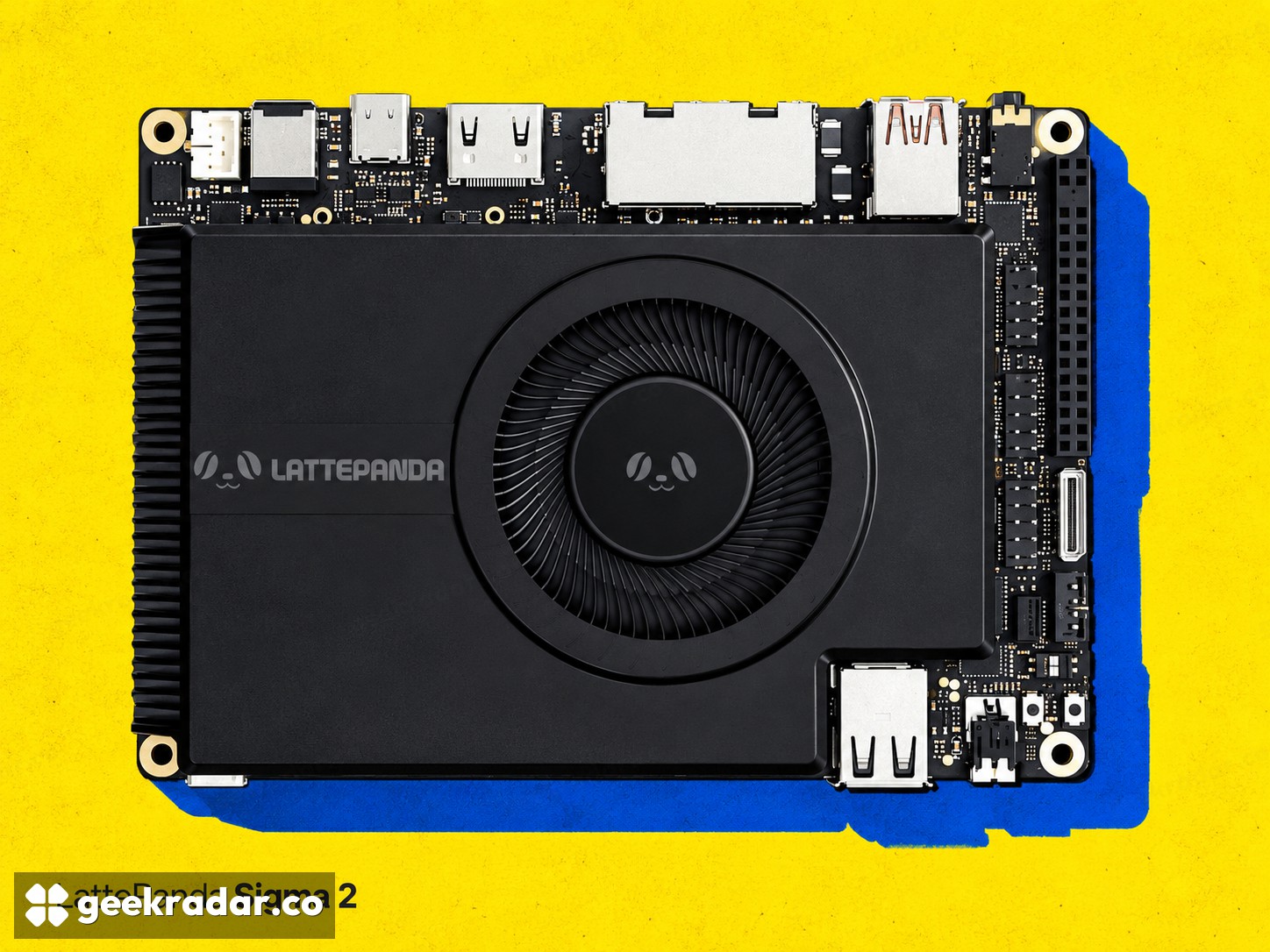
LattePanda Sigma 2 makes local AI a question of memory, ports and integration
The compact board’s 180 TOPS headline needs software context. Its expansion links are the more practical starting point.
LattePanda's Sigma 2 packs a substantial local-computing platform into a 146 × 102 mm board. Its most revealing specifications are the memory and connections: up to 64GB of LPDDR5X, two 10Gb Ethernet ports and several expansion paths. Those determine what a developer can put around a model, not just how impressive the AI number looks on the box.
The October 22 launch announcement lists a $2,599 promotional presale price through mid-November, rising to $2,799 afterward. This is a compact integration platform with a serious price, rather than a low-cost hobby board. The dollar figure should not be mistaken for a delivered, tax-inclusive price in every market.
What 180 TOPS actually adds together
Sigma 2 uses Intel's Core Ultra X7 358H. On its product page, LattePanda breaks the advertised 180 INT8 TOPS into CPU, GPU and NPU contributions. That total describes peak arithmetic across different processors. It does not mean one application can automatically use the whole sum, or that a language model will generate a particular number of tokens per second.
Software must support the chosen processor, model format and precision. Memory capacity determines whether a workload fits; memory bandwidth and execution efficiency help determine how quickly it runs. A larger memory pool can therefore be useful even when the highest theoretical operation count is not the limiting factor.
LattePanda supplies a more concrete example: its own comparison reports 32 tokens per second at 38W for a specified Qwen3.5-4B INT4 workload using OpenVINO GenAI 2026.4 on the integrated GPU, against 17 tokens per second at 35W on the original Sigma. The page specifies input/output lengths and average DC input power. Those conditions make the claim interpretable; they do not turn it into an independent test or a result for every model.
The board is also an integration problem
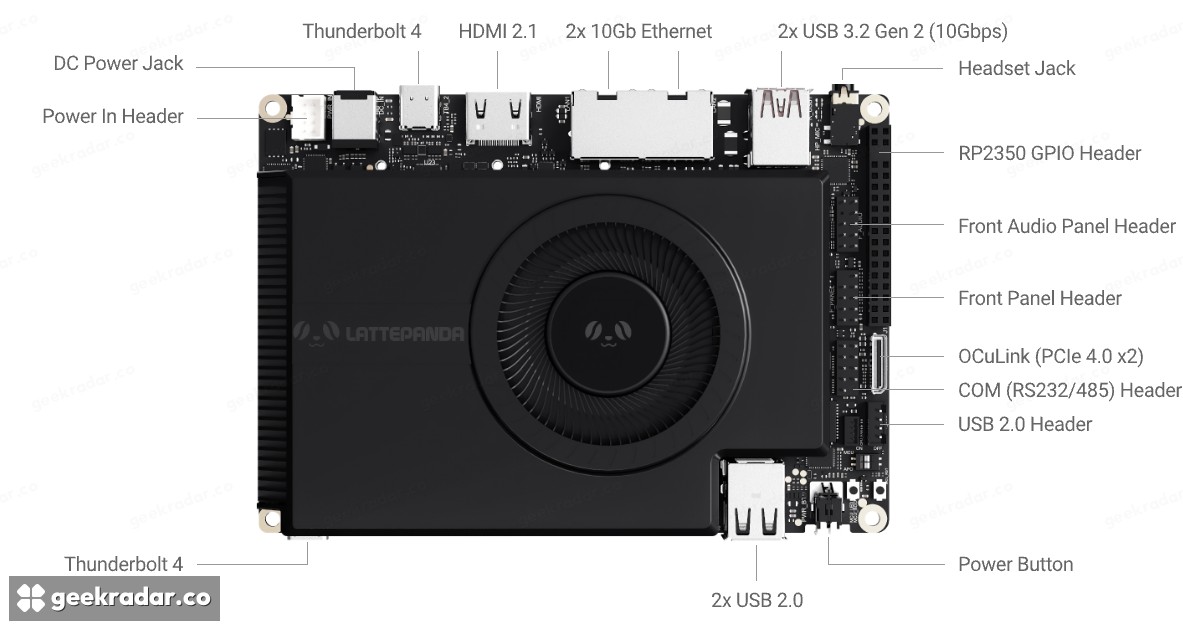
The port layout is where Sigma 2 becomes more distinctive. Dual 10GbE can connect a compact system to fast storage or separate network segments. Thunderbolt and M.2 expansion let a builder add devices without treating the board as a sealed appliance. The onboard RP2350 microcontroller supplies a separate route to sensors and actuators.
Those options need to be read individually. The specification lists different PCIe lane allocations for the three M.2 M-Key slots; the OCuLink connection is PCIe 4.0 x2. A matching connector shape does not imply identical bandwidth. A build combining storage, an accelerator and external graphics needs a plan for the actual links it will use.
This is the smaller-scale counterpart to the issue in our analysis of CPUs around AI servers: feeding data, moving results and coordinating other devices are part of the workload. A useful local AI machine is more than the processor executing the model.
Buy the system you can finish
LattePanda lists Windows 11 and Ubuntu support and describes the platform as suitable for embedded deployment. That is an invitation to integrate cooling, power, storage, software maintenance and an enclosure, not evidence that all of those decisions disappear.
For someone building a private appliance or instrument, the attraction is concentrating compute, memory, networking and physical control in a small space. For someone who simply wants to try a chatbot, much of that capability may go unused. Sigma 2 makes the most sense when its connectors solve a real design problem; otherwise, the smallest part of the computer could become its most expensive distraction.