FSR 4.1 reaches the ROG Ally preview channel—with model and timing caveats
ASUS describes a smaller reconstruction model and a driver override for supported games. Its page contains conflicting rollout details worth checking.
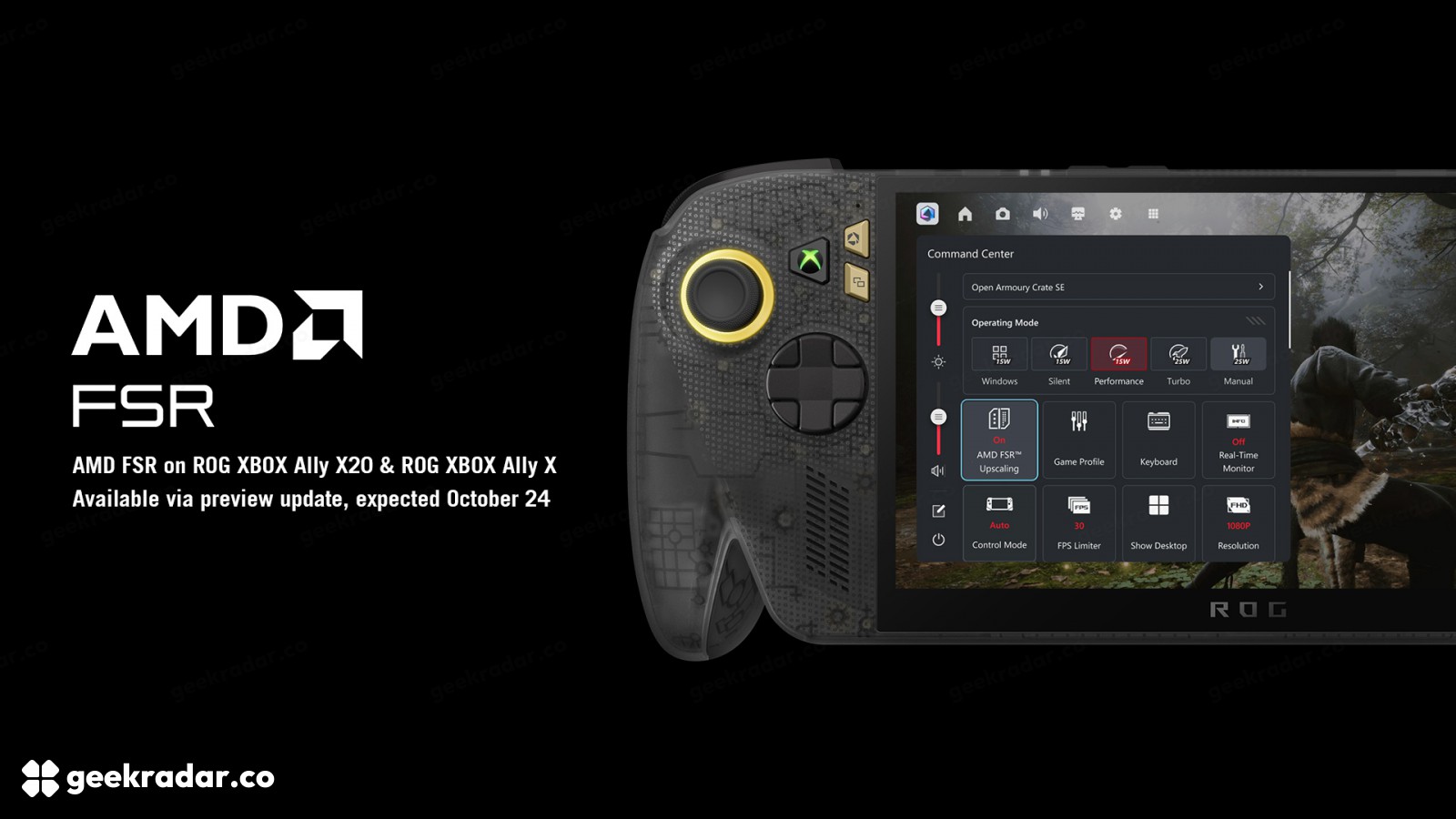
ASUS has announced a new route for the ROG Xbox Ally X and Ally X20 to AMD’s machine-learning upscaling: an FSR Upscaling 4.1 preview driver. ASUS’s installation announcement dates the preview to October 23 and places it in Armoury Crate SE’s Preview Updates channel. That last detail matters as much as the version number. This is an optional early driver, rather than a finished update every owner needs to install immediately.
ASUS’s timing is inconsistent: the written instructions specify October 23, while its promotional graphic says October 24. Check the package actually offered in Preview Updates rather than assuming the date guarantees access. There is also a model discrepancy in the page. Its summary includes the base ROG Xbox Ally, while the opening says that model’s GPU update is coming later; the detailed installation passage names the X and X20. Owners of the base model should check the update actually offered for their device instead of treating the summary as confirmation of a universal rollout.
Image: ASUS.
Reconstructing pixels within a handheld’s budget
Upscaling starts with fewer rendered pixels and reconstructs an image for the display. That can leave more of the machine’s limited graphics budget for other work. The benefit depends on the game, input resolution, output target and reconstruction quality; a higher frame-rate counter does not settle whether moving edges, thin objects or fine textures look better.
ASUS says the X and X20 use a more efficient model, less than half the size of the original INT8 model. This is a claim about the reconstruction model, not a promise to halve total game memory use or double performance. The distinction is particularly important on a handheld, where the operating system, game and graphics workload share finite resources.
Our coverage of FSR 4.1 on older Radeon hardware examined a related compatibility question. The Ally preview is more specific: an integrated driver path and a control inside ASUS’s handheld software. Support on one product family should not be used as evidence that every device with a similar graphics architecture has the same update.
The toggle is only part of the chain
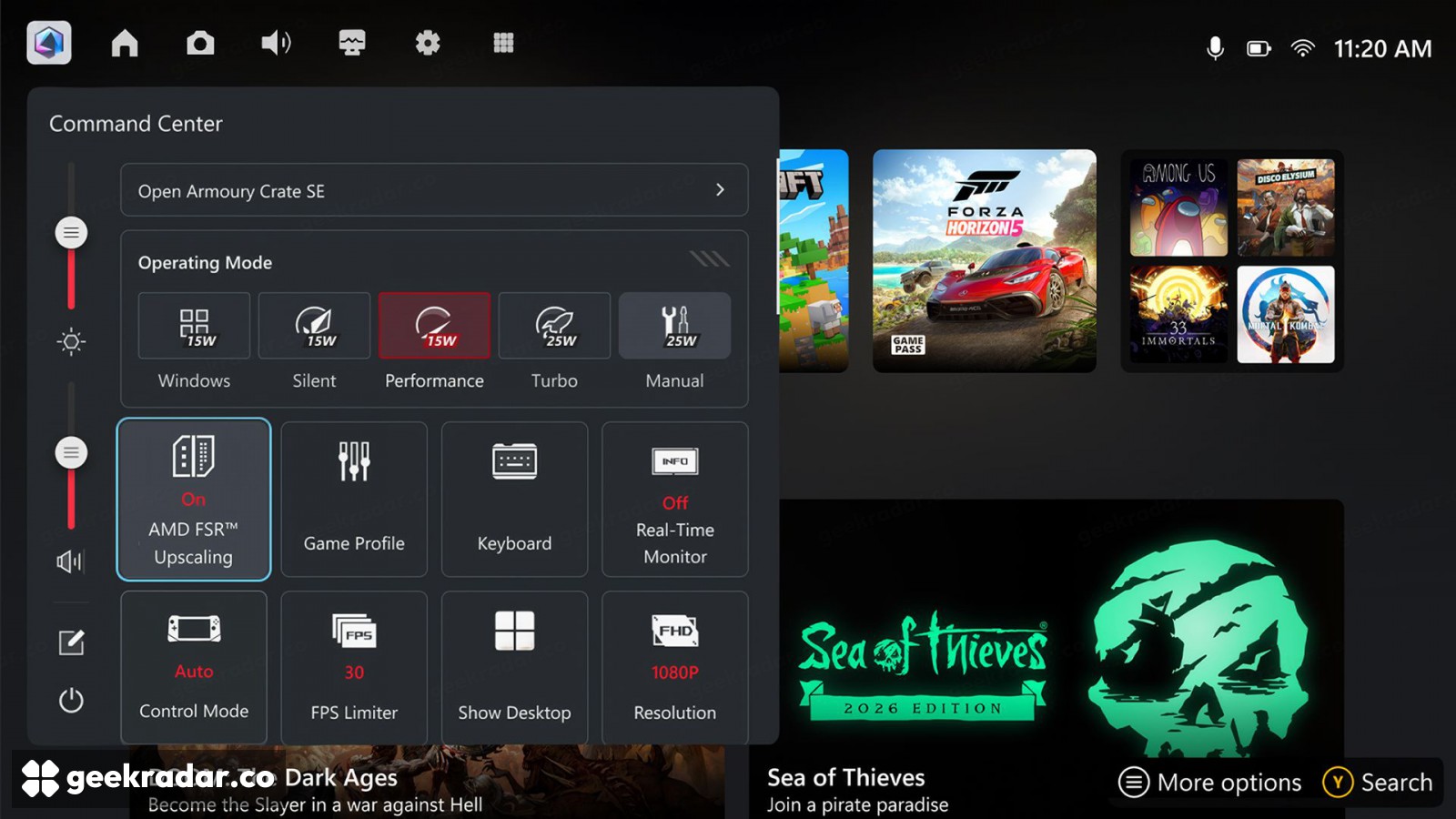
ASUS describes adding the FSR tile to Command Center, enabling it, then enabling FSR in a supported game. Its override can apply to compatible titles using FSR 3.1 or later. The company’s broad game-count claim should not replace checking the particular title and settings you use.
A separate trap is stacking upscalers. ASUS’s FSR, RSR and RIS guide explains why they are different tools. FSR has integration within the game; RSR operates at the system level. The new announcement advises against combining FSR with RSR. Adding another reconstruction pass can work against the reason you enabled the first one.
For owners in Italy, this is a software-compatibility question rather than a separate Italian hardware launch. Confirm the exact model, driver channel and supported game. Keep the settings of a familiar title unchanged while checking the new reconstruction path, so a simultaneous resolution or preset change does not obscure what the update did.
The useful outcome is a game that holds its chosen performance target while remaining readable in motion. A preview badge and a bigger version number are invitations to investigate that outcome, not evidence that it has already happened on your handheld.