Google’s Minecraft agents finished the task. Their 605 deaths matter too
Four coding agents used a programming interface to complete a shared survival run, making the result a test of planning and recovery.
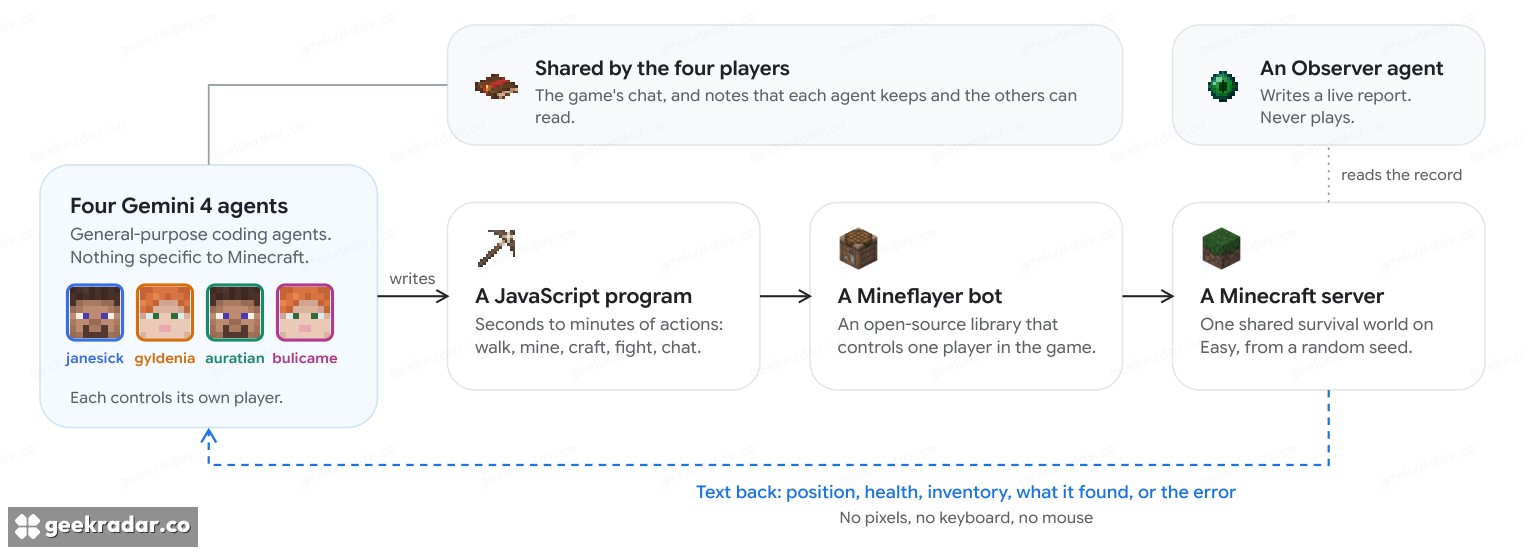
Four Google DeepMind coding agents completed Minecraft's dragon objective in a reported 27 hours and 14 minutes. The interesting qualification is how they played: by writing JavaScript through Mineflayer, rather than watching a screen and operating a keyboard. That makes the experiment a test of sustained programming and coordination, with a game supplying the consequences.
The research paper, posted October 15 and attracting renewed attention this week, describes a randomly generated survival world on Easy difficulty. The Gemini 4 Argon team produced 2,783 programs and accumulated 605 deaths. Those numbers sit together: reaching the goal was an achievement of persistence and recovery, not a clean demonstration of flawless play.
The interface changes what is being tested
Mineflayer is an established JavaScript library for Minecraft bots. It exposes information about blocks, entities, inventory and health, alongside actions such as movement, crafting and digging. Its ecosystem also includes pathfinding and visualization tools.
That gives a coding agent a different problem from a human player's. It can request structured information without first recognizing objects in pixels. The difficult part moves toward choosing a useful action, expressing it correctly and interpreting the result. This is a legitimate interface for an experiment, but it must travel with the headline whenever the result is compared with other systems.
A faster completion time across those routes would not, on its own, identify the more capable agent. One test may emphasize perception and motor control; the other may emphasize planning and code. Difficulty settings and the number of cooperating players add further differences.
Recovery is part of the result
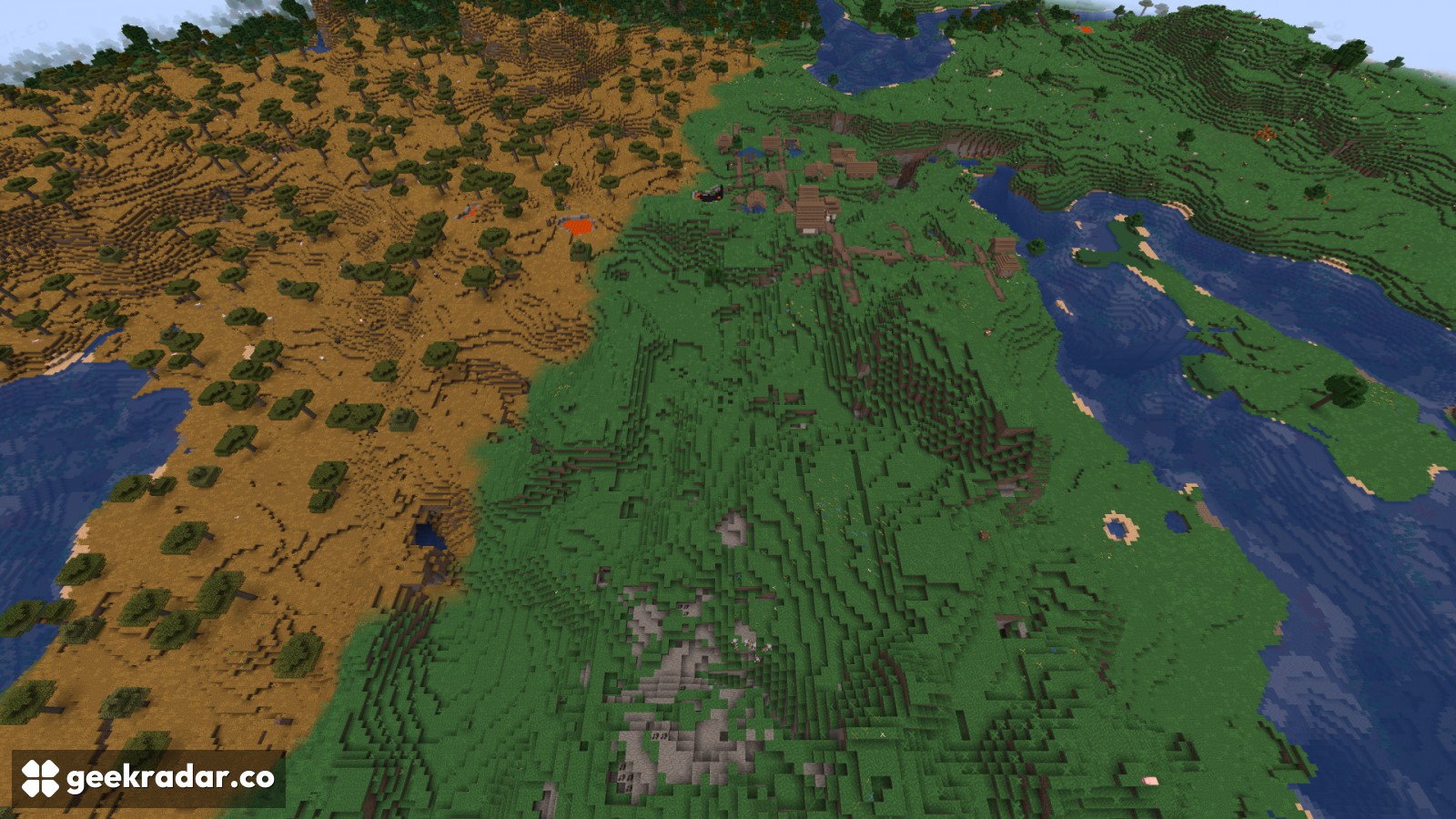
The diagram above and the cover's world rendering come from the researchers' paper, licensed CC BY 4.0. Their Pixel Perfection graphics credit XSSheep and Nova_Wostra under CC BY-SA 4.0.
The researchers report that the agents divided work, shared notes and recovered one another's items. No human assigned their roles or supplied a route. A separate observer monitored the run, while researchers retained the ability to stop it. The paper describes one successful run, rather than a statistically established success rate across many worlds.
This is where the example becomes useful beyond Minecraft. Consider a sequence in which one task depends on materials obtained by another. If the material is lost, repeating the next instruction is useless; the plan must account for the changed state. Long tasks create many opportunities for a small mistaken assumption to survive into later work.
The relevant engineering question is therefore whether a system can notice that reality has diverged from its plan and recover. A final success screen alone hides that process. Logs, intermediate states and explicit failures make it possible to investigate it.
A sandbox success has a boundary
Nothing in this result establishes that an agent can safely run a business workflow with equivalent reliability. A game offers a constrained world, a clear objective and recoverable mistakes. Real systems can involve irreversible actions and ambiguous goals. Our coverage of agent permissions addresses that separate deployment problem.
For readers following AI evaluation, the useful result is specific: a team sustained a coding loop long enough to finish a complex shared task. The 605 deaths keep the achievement honest. Persistence can overcome failure in a sandbox; outside it, the price of each failed attempt matters just as much as eventually reaching the goal.