
Microsoft’s agent-security pitch comes down to who is allowed to act
Project Perception targets agents inside the organization. Separate identities and enforced permissions matter more than an instruction asking a model to behave.
Microsoft is sharpening its argument that an AI agent deployed inside a company should be treated as a participant with limited authority, not automatically trusted because an employee launched it. Its 19 October security announcement extends Project Perception’s focus to agents operating within the organization, where access to documents, applications and tools can turn an incorrect decision into a real action.
The distinction is more useful than the dramatic idea of an AI “insider.” A model generates or interprets information. An agent combines that model with software that can invoke tools and act on resources. The permission to read a document, change a record or send data outward belongs to that surrounding system. It should not depend solely on the model deciding to behave.
A good intention is not an access-control policy
In Microsoft’s announcement, Hayete Gallot argues for continuous monitoring and constraints that change with the risk of an attempted action. The company positions Project Perception as a way to combine signals from identity, endpoints, cloud services and the execution environment.
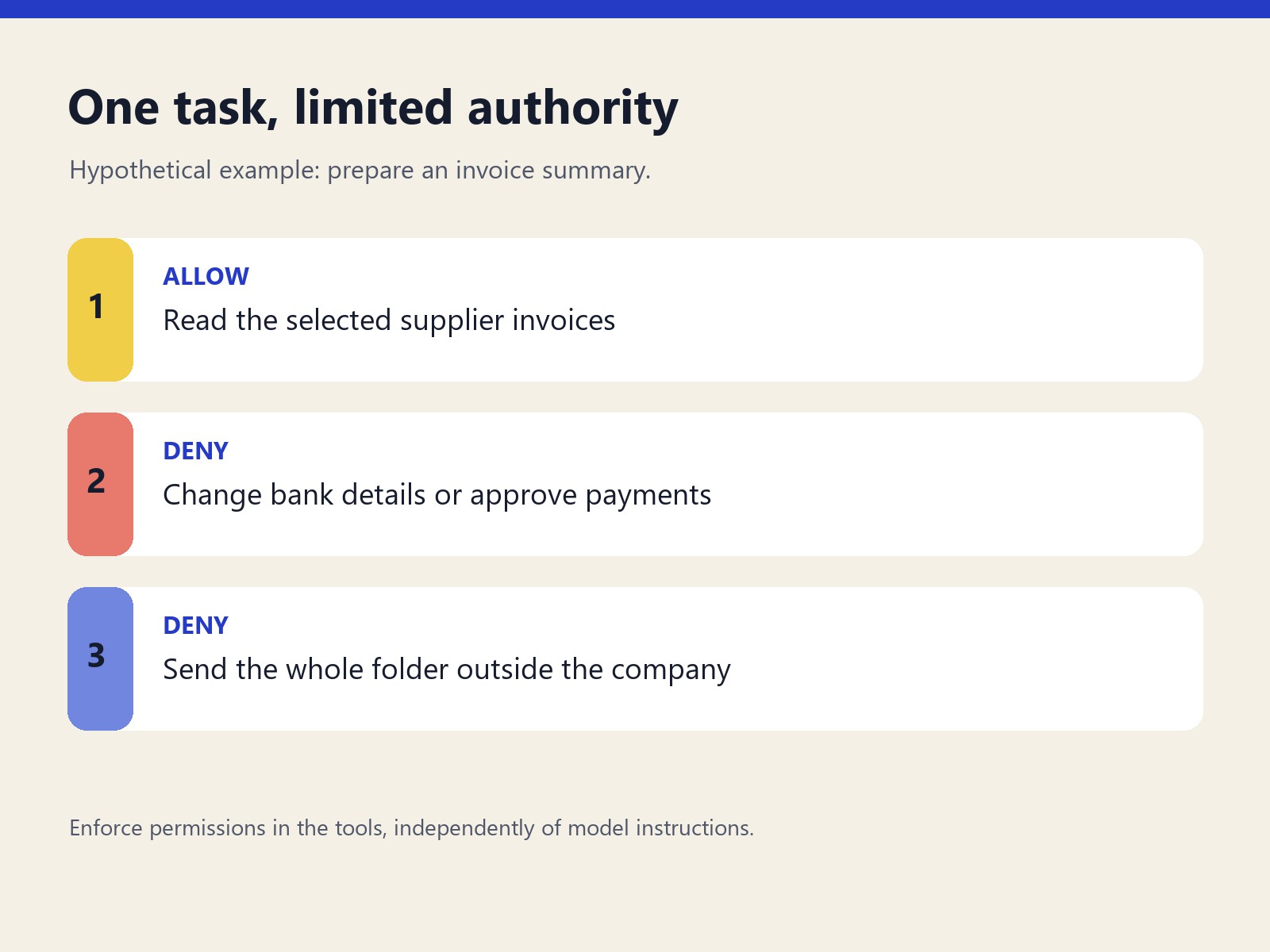
Consider a straightforward example: a tool that reads supplier invoices to prepare a summary. Reading those files does not require permission to change bank details, approve payments or email the entire folder outside the organization. Giving the agent every permission held by its operator would collapse several distinct decisions into one broad credential.
That example illustrates the design issue; it is not an incident reported against Microsoft’s system. The central question is where permission is enforced. A request written in a prompt can be misunderstood. A tool that refuses an unauthorized write supplies a separate boundary.
Finding agents is only the first step
The technical announcement says discovery is expanding by 35 types to cover 60 supported local agents. Microsoft also describes distinct agent identities, controlled execution environments and action-specific restrictions. These are claims about the product’s supported scope, not evidence that every agent in every enterprise can now be found and contained.
Identity makes a practical difference to an investigation. A shared user credential can obscure whether a person or an automated process performed an operation. An agent-specific identity can give policy and logging a more precise target. It still needs an accountable owner and a lifecycle: an abandoned automation should not retain permissions indefinitely.
Microsoft’s earlier Project Perception introduction describes specialized agents for finding possible attacks, assessing them and taking corrective action. Adding automated supervision creates its own permissions question. A supervising agent also needs bounded authority and an auditable path for intervention.
The useful test is a refused action
For Italian and other European organizations, this is a security architecture announcement, not a blanket statement that every capability is available under their existing license or deployment arrangement. Teams still need the applicable product documentation, supported integrations and local data-handling requirements.
There is a genuine operational tradeoff. Controls that block too broadly can make a useful assistant unusable; controls that approve everything offer little protection. A well-defined task makes that balance easier because the necessary actions can be described before the agent begins.
The next procurement conversation in AI security should therefore include a demonstration of what the system cannot do. A convincing answer is an unauthorized action that stays blocked, with a record explaining why. Intelligence may help complete the task; authority determines how far a mistake can travel.