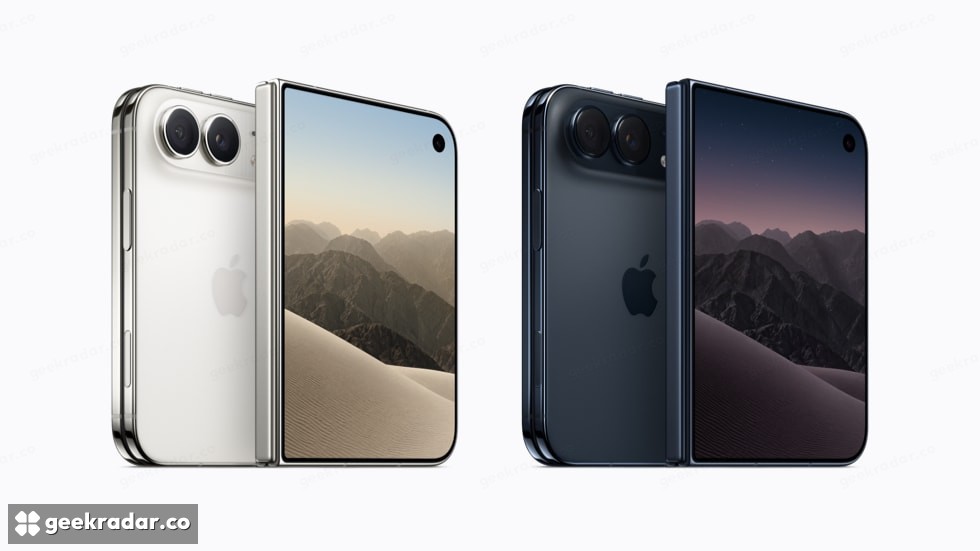
iPhone Duo’s first reviews disagree on the part you will notice every day
The folding display impresses, but reviewers differ on grip, typing and app layouts. That makes everyday handling the useful question before launch.
iPhone Duo's first reviews agree that Apple has built an impressive folding device. They disagree on something more consequential for a buyer: whether its unusual shape makes an ordinary day easier. That disagreement is more useful than a single verdict on the hinge, because a phone can be beautifully engineered and still be awkward in your particular hands.
Reviews published today arrive ahead of the October 23 release. Apple's announcement describes a 5.4-inch outer display and a 7.6-inch inner screen, with the same proportions on both. The result is a short, wide closed phone that unfolds into a substantially larger workspace. Our earlier preorder and Italian availability report covers the launch context; today's evidence concerns what that design feels like after sustained use.
Product images: Apple.
The disagreement starts before you unfold it
After a week with the phone, 9to5Mac's Chance Miller finds the shorter footprint easier to carry and hold than the iPhone 18 Pro Max, despite its weight. He describes the outer screen as useful in its own right, rather than something he only uses until he can open the phone. He also finds right-handed operation more comfortable than left-handed use. The review discloses sponsorship by productivity app Craft.
PetaPixel's Jaron Schneider reaches a different conclusion about handling. For his hands, the width makes one-handed operation uncomfortable; opening the phone improves the view, but the large keyboard can introduce another reach problem. He finds photo editing in Lightroom and Afterlight particularly rewarding on the inner display.
These observations need not cancel each other out. Reach depends on hand size, grip and the task being performed. Reading a document, selecting a small control and typing a long reply place different demands on the same rectangle. A review that praises the display's working area therefore does not settle whether the keyboard will suit you.
The meaningful demonstration is a familiar task. Type the kind of reply you actually send, reach for the controls with your usual hand, and move between standing and seated use. Opening and closing a shop display unit proves much less about living with it.
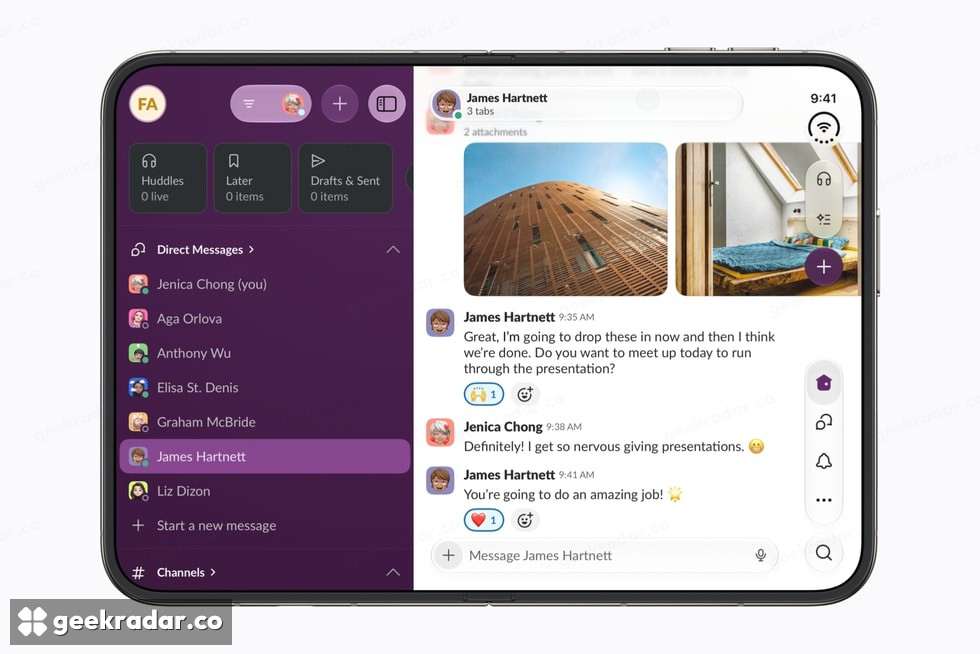
More space depends on what the app does with it
Apple's official Slack image shows the opportunity clearly: navigation and conversation can remain visible together. Its software supports Split View, including paired apps and two windows of the same app. That is a concrete benefit when the work involves referring to one thing while acting on another.
Both reviews also identify software friction. Miller wants more of the desktop-like browsing behavior associated with an iPad. Schneider distinguishes applications adapted for Duo from older layouts that leave much of the display poorly used. Their examples point to the same purchasing constraint: the value of the extra screen depends on the applications you need today.
A larger canvas is straightforward to advertise. A comfortable workflow involves more moving parts. If your main applications keep presenting a narrow phone layout, the hardware has not yet delivered the benefit that persuaded you to buy it.
The price buys the fold, not every Pro feature
The reviews also make clear that Apple's most expensive iPhone is not automatically its most complete camera phone. Duo uses Touch ID in its side button and lacks a dedicated telephoto camera. Those are everyday differences, not details that disappear because the display opens.
Early praise for construction should also remain separate from proof of years-long durability. A week of testing can reveal an awkward grip or a badly adapted app; it cannot establish how a folding screen will age across years of use. That limit applies even when the initial build quality is convincing.
For readers following our Apple coverage, the interesting change is that the buying decision has become less about choosing the largest specification number. Duo offers a different working shape. If opening it repeatedly saves you from reaching for a second device, that shape has a purpose. If it mainly makes familiar tasks require another hand, the hinge may be solving a problem you did not have.