iPhone vs Samsung Galaxy: features, trade-offs and the ecosystem decision
Compare the phone families through software, device connections, hardware choice and switching costs. The flagship's features are not a promise for every tier.
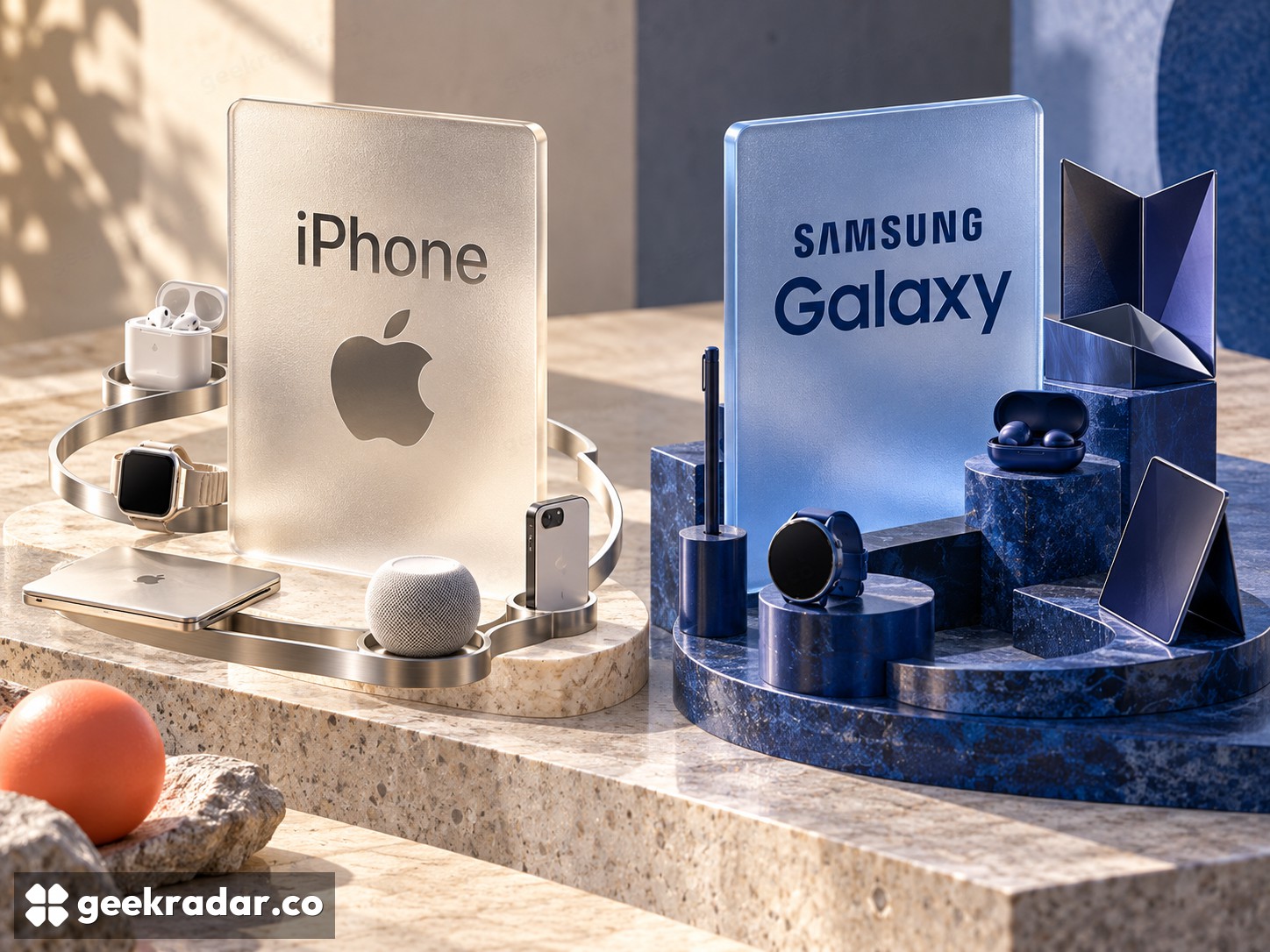
Choosing between iPhone and Samsung Galaxy is largely a choice about how much variety you want inside one phone family, and how closely that phone should work with the devices you already own. Apple offers a concentrated iOS experience. Samsung stretches Galaxy across more price bands and product ranges, with software that gives supported devices additional ways to work. Neither description means every model delivers the same features.
This is a comparison of those families, checked in October 2026. Camera rankings, battery endurance and the best current deal still require a comparison of particular phones at the same price.
What the family name buys you
iPhone's clearest advantage appears when the phone is part of a wider Apple setup. Continuity connects tasks such as copying content between nearby devices, transferring files with AirDrop and continuing supported work with Handoff. That can remove repeated small steps from a working day. It also makes the next Apple purchase easier to justify, even when a competing device would be attractive on its own.
Galaxy offers a different kind of flexibility. Samsung's catalogue includes conventional phones and folding formats; its software can serve people who want to arrange more of their workflow themselves. On selected DeX-compatible devices, an external display provides a desktop-style workspace. That is a meaningful option for presentations or document work, but it does not turn Android applications into their Windows equivalents. DeX is also not a promise attached to every Galaxy badge.
The practical distinction is between an integrated route and a wider set of routes. A person who values familiar operation across a household may prefer Apple's consistency. Someone who wants a particular multitasking layout or a lower entry price has more reasons to explore Galaxy's separate ranges.
Apple's current iPhone catalogue also includes the folding iPhone Duo, offered for preorder at the time checked. Folding is no longer a useful single-brand dividing line. Compare the formats and local availability that actually exist, rather than relying on an old iPhone-versus-Android shorthand.
Features, advantages and compromises
| Area | iPhone | Samsung Galaxy |
|---|---|---|
| Everyday software | One main operating-system family with a familiar route between generations | One UI across a broader hardware range, with capabilities that vary by tier |
| Hardware choice | Choose within Apple's available formats, sizes and tiers | More scope to choose a conventional or folding design and different price bands |
| Ecosystem benefit | Most persuasive alongside compatible Apple devices | Useful Samsung integrations and selected desktop-style features |
| Main buying risk | Paying for ecosystem benefits you will not use | Assuming a feature demonstrated on a flagship exists throughout Galaxy |
These are structural advantages and disadvantages, not a disguised camera score. A cheaper Galaxy can be the sensible purchase without being a substitute for an Ultra's cameras. Likewise, an iPhone does not become poor value simply because a more expensive Pro exists. Match the functions you need before comparing discounts.
Support and switching costs deserve their own budget
Samsung publishes a security-update scope by device. Read the relevant entry rather than applying a headline support promise to the entire brand. For either family, check the remaining supported life of the exact phone, battery replacement options and local service arrangements, especially when buying older stock or refurbished hardware.
Switching also has a cost that never appears on the price label. Check how you will move photos, passwords, paid applications and messaging history; whether your watch remains compatible; and which cloud-storage subscription you still need. Do not count the original price of equipment you will keep using as a new expense. Count the replacements that the switch actually forces.
For Italian buyers, use the Italian product and support pages to confirm payment, carrier and language-dependent features. An English-language demonstration of an assistant or call tool is not proof of Italian availability. Compare a local offer with the same storage and warranty conditions, rather than converting a US price.
Which direction is right for you?
Choose iPhone when its connections to your Mac, iPad or household routine save enough friction to matter. Choose Galaxy when a particular form factor, price band or supported workflow gives you something you will actually use. If neither ecosystem matters, the brand decision becomes much smaller: compare two affordable candidates on screen, cameras, support and total cost. The best ecosystem is the one that earns its place after you stop counting the logo.