
Faraway arrives November 5 with a line between beauty and survival
Steph Thirion’s constellation-drawing arcade combines endless runs with sixteen handcrafted puzzles. Steam confirms Italian text support.
Faraway has a release date: 5 November, with versions announced for PC, PlayStation 5, Xbox Series X|S, Nintendo Switch and Switch 2. After more than a decade of development by Steph Thirion, the game is arriving with a premise that fits in a sentence: keep a shooting star alive by connecting other stars into constellations.
The publisher’s announcement page describes an endless arcade game built around procedural generation and improving skill. That description places an important limit on the soothing imagery. Space is the setting; surviving a run and improving a score supply the pressure. Attractive colors alone do not establish that a game is effortless or purely relaxing.
Drawing is also a survival decision
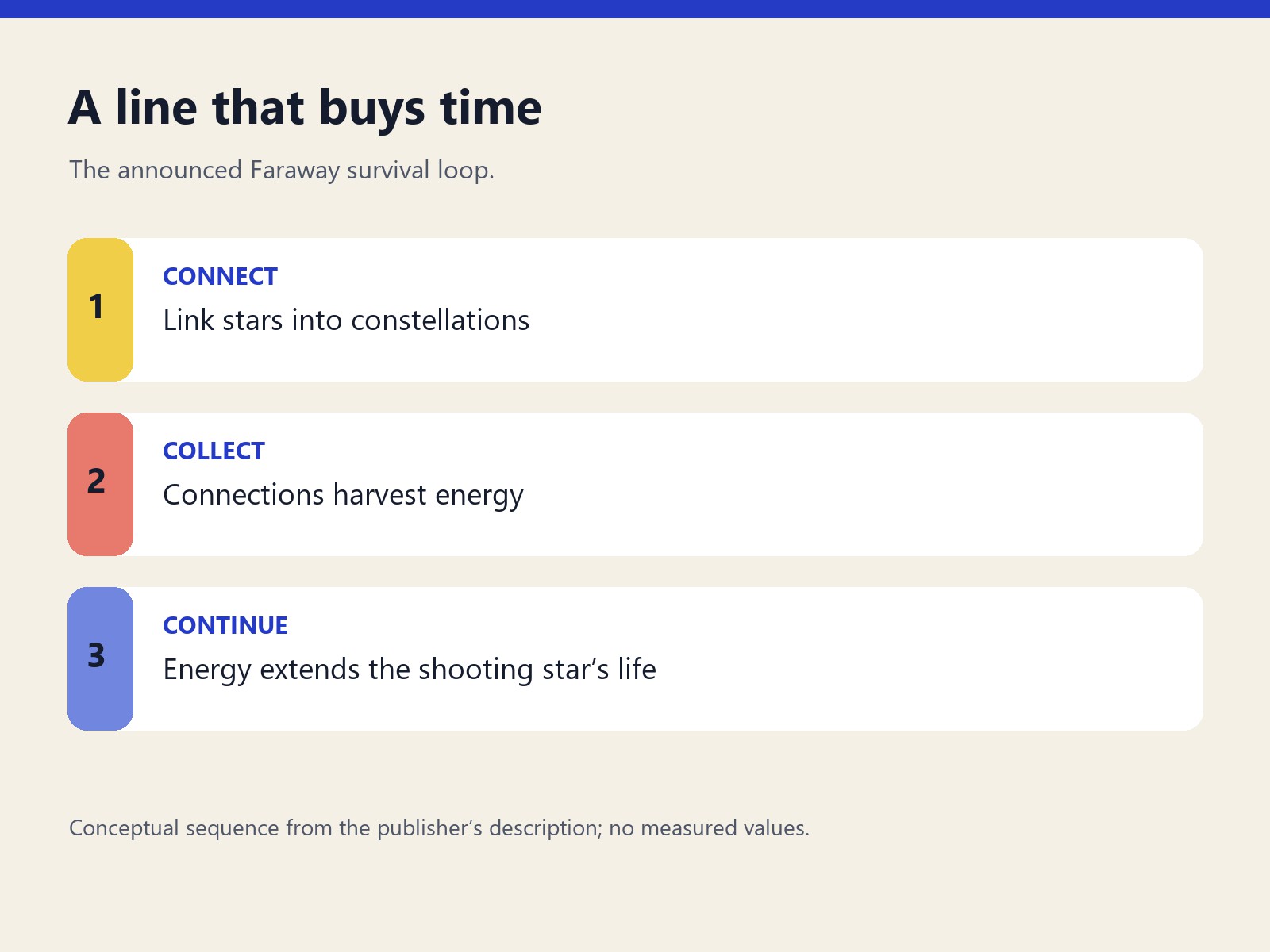
Annapurna says connections harvest energy, extending the shooting star’s life while building a score. More demanding techniques offer greater rewards. This turns the shape traced through the scene into a consequential choice: a route can be expressive while still being judged by the resources and time it consumes.
There is a useful difference between that design and a conventional sightseeing game. A picturesque route is not necessarily the safest route, and a scoring opportunity can compete with staying alive. The interest lies in how much room the rules allow a player to improvise. This is an interpretation of the announced design, not a verdict based on playing the finished release.
The developer’s commitment to a small set of rules also makes the screenshots more informative than a list of fictional equipment would be. They show a visual language of points, curves and connections. Reading that language should become part of learning the game, rather than an ornamental layer on top of unrelated mechanics.
Endless runs and authored puzzles teach different things
Alongside its core mode, Faraway includes sixteen handcrafted puzzle stages. The combination gives the design two useful settings: a changing space for repeated runs, and fixed problems where a player can concentrate on a particular relationship or technique.
Procedural generation does not mean the experience has no author. Someone still defines the possibilities, constraints and responses that generate a run. Conversely, a fixed puzzle does not automatically dictate one expressive route through it. The distinction is how the challenge is arranged, not whether creativity is allowed.
The Italian version has a clear PC foothold
The Steam listing confirms Italian interface and subtitle support, alongside the November date. It lists Steam Cloud, leaderboards and achievements, and specifies Windows requirements. Those are PC-store details; they should not be transferred wholesale to console versions without checking their listings.
The publisher includes both generations of Switch in its platform lineup. That establishes planned releases, not a free upgrade, cross-buy entitlement or identical performance. A player choosing a platform should inspect the exact edition rather than assume “Switch” covers every purchase arrangement.
Faraway joins a busy gaming calendar with unusually little equipment between its idea and the player. The appeal of the announcement is that every new line can do two jobs: make the sky more beautiful and buy the star a little more time. The finished game will have to make that tension worth another run.