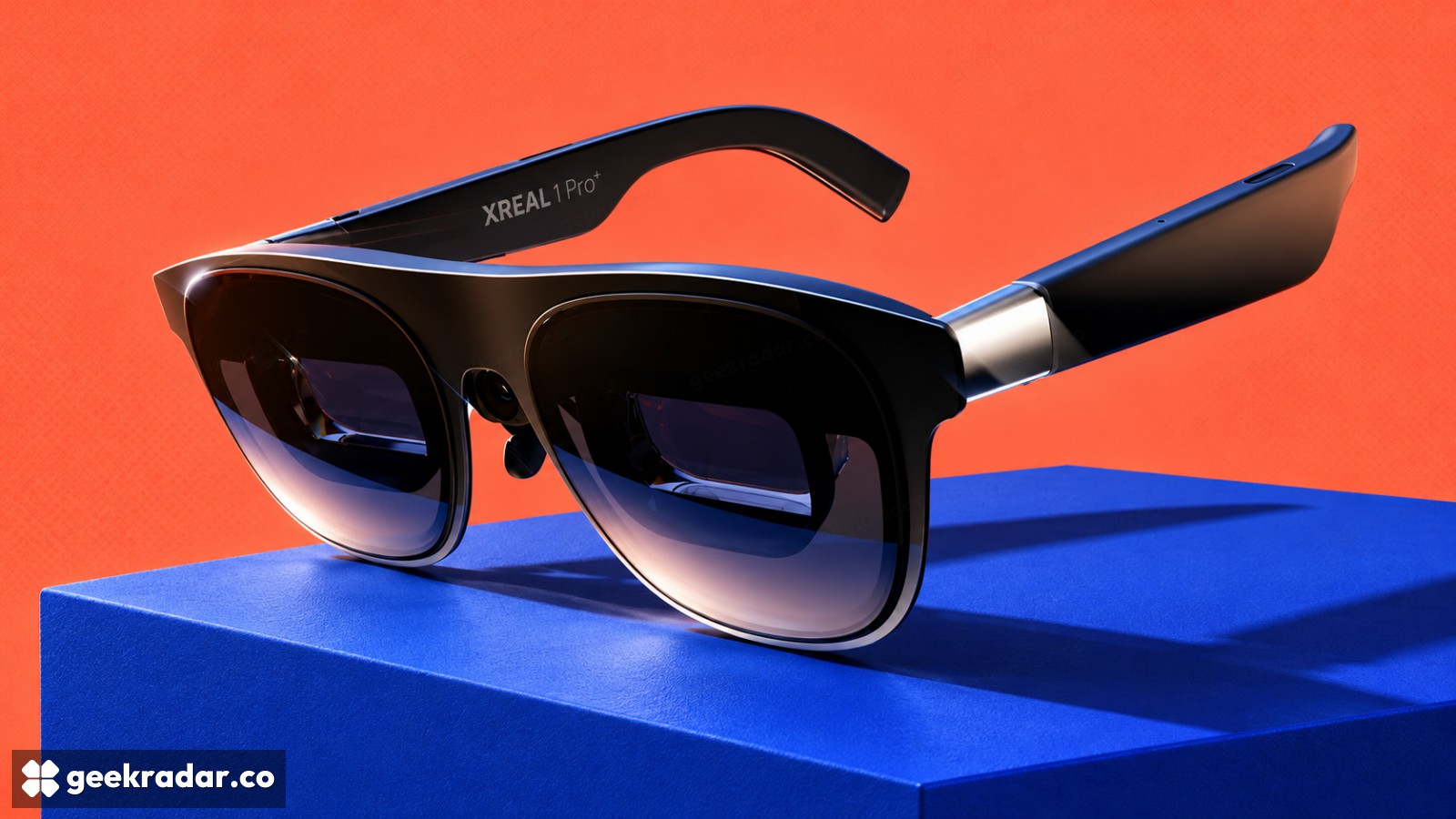
XREAL 1 Pro+ raises brightness and 3D conversion speed for $599
The new glasses retain the X1 chip and 57-degree field of view, with fit improvements and a separate accessory for positional tracking.
XREAL's new 1 Pro+ glasses put their upgrade budget into the experience of watching a screen: higher peak brightness, faster conversion of ordinary video into 3D and a revised nose pad. The company announced global availability from October 15 at $599 in the US, while retaining the X1 processor and 57-degree field of view of the One Pro.
The distinction is useful for anyone comparing wearable displays with more elaborate spatial computers. This is a refinement of XREAL's existing display-glasses platform. Its most consequential improvements concern whether an image remains comfortable and clear during a long session.
Brighter pictures, two different frame rates
In its launch announcement, XREAL specifies peak brightness of 1,200 nits and new Standard, Movie and Reading modes. AI HDR processing is also intended to improve the appearance of supported content. These are manufacturer specifications and descriptions, rather than independently measured performance in every viewing condition.
The company's Real 3D conversion now runs at up to 60 frames per second, compared with 30 previously. It estimates depth from conventional 2D material so that each eye receives a different view. The result is a transformed presentation of the original image; it does not turn a flat recording into a scene captured by two cameras.
That 60fps figure should also be kept separate from the glasses' 120Hz display refresh rate. Refresh rate describes how often the display can update. Conversion rate describes how quickly the processing can produce its depth-enhanced output. A 120Hz panel does not make every converted video a 120fps source, just as a fast monitor cannot make a game render frames its computer never produces.
Anchoring a screen has levels
The product specification lists native three-degrees-of-freedom tracking, usually shortened to 3DoF. This tracks head rotation: looking left, right, up or down. It allows a display to remain in a chosen direction as the wearer turns their head.
Six-degrees-of-freedom tracking adds movement through space. Leaning forward or shifting sideways can then change the view relative to an anchored object. For the 1 Pro+, XREAL advertises this through the separately sold XREAL Eye, with feature availability and compatibility qualifications. Buyers should not assume that the base glasses include every interaction shown on the product page.
These modes answer different needs. A viewer watching a film from one seat may chiefly want a stable screen. Someone moving around a workspace has a stronger reason to care about positional tracking. Listing both as “spatial” does not make their behavior interchangeable.
Fit is part of the optical system
XREAL has broadened the nose pad's contact area and provides adjustable temples and two interpupillary-distance sizes. Interpupillary distance is the spacing between the eyes; matching it helps align the viewer with the optics. The company also lists electrochromic lens dimming, which changes how much surrounding light reaches the wearer.
This is why comfort is more than padding. If a frame slides down the nose or sits at the wrong angle, the eyes move away from the intended viewing position. A nominally wide display can become harder to see at its edges. Better mechanical fit can therefore improve the usefulness of the same optical field of view without adding a single degree to the specification.
The $599 announcement is a dollar price, not a confirmed Italian checkout total. Regional pricing, taxes and any required connection accessories need to be checked for the intended source device.
For existing One Pro owners, the unchanged field of view and processor narrow the upgrade case to brightness, converted motion and fit. For first-time buyers, the central choice is whether a personal screen solves their problem. The 1 Pro+ offers a more polished version of that proposition, with positional interaction still an additional purchase.