LG’s FLiPP OLED targets laptops and monitors before the living room
A mask-free manufacturing process promises more useful emitting area. Customer specifications and mass-production work still separate it from a retail display.
LG Display's FLiPP process is being aimed first at laptops and monitors, giving its next OLED manufacturing approach a more specific destination. The useful news from the company's October 8 technology seminar is where development is heading—and how far that remains from a finished display you can buy.
In The Elec's published seminar discussion, LG Display distinguishes technology development from product development and mass production. Customer requirements still affect the path between them. A process announcement therefore supplies neither a retail launch date nor a reason to assume the next television will use it.
Removing the stencil changes the factory problem
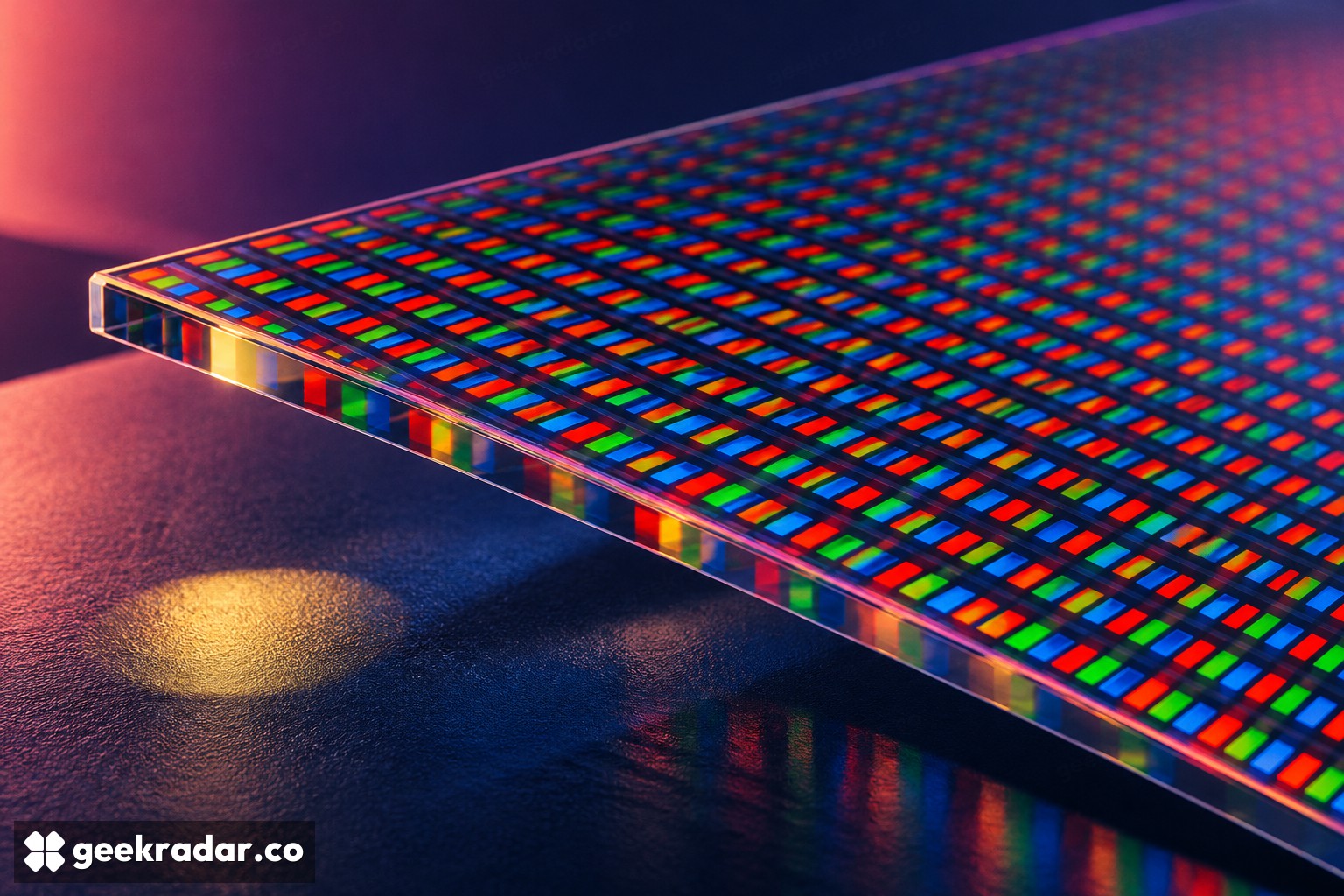
FLiPP stands for FMM-Less innovative Pixel Patterning. The FMM is a fine metal mask: a precision stencil involved in placing the light-emitting materials that form red, green and blue subpixels. LG's approach coats and secures the materials, then uses ultraviolet-based patterning rather than relying on that mask.
LG Display's August introduction describes the manufacturing attraction: avoiding mask limitations, including sagging, and working with large glass substrates without cutting them into smaller pieces first. The company also says the method can use infrastructure associated with its existing WOLED production.
Those details matter because a display process has to solve two problems together. It must produce a useful pixel structure, and it must repeat that structure economically across a large area. A beautiful small sample does not establish that the same method produces enough usable panels from every sheet of factory glass.
Consider cutting laptop panels from one substrate. Space consumed by process constraints cannot become a saleable screen. Improving usable area can change the output from the same starting sheet, even before the consumer sees any increase in brightness. It is a manufacturing gain whose eventual effect on retail prices still depends on costs, yields and product positioning.
More emitting area creates choices
LG says FLiPP increases the share of each pixel available to emit light. Its introductory comparisons claim benefits in brightness, lifetime and power consumption. These are manufacturer results tied to its comparison conditions, not independent measurements of a shipping laptop.
The seminar discussion makes the tradeoff clearer: a product designer can spend the available improvement in different ways. A brighter screen and a longer-lived screen need not use the opportunity identically. It would be misleading to collect every favorable percentage and promise that one future product will deliver all of them simultaneously.
For a laptop, lower display demand could be valuable within a constrained battery budget. A desktop monitor may prioritize a different balance. Neither implication establishes battery life or panel longevity without knowing how the finished device is configured and used. This is why manufacturing coverage belongs alongside the finished products in our Gear desk, rather than being treated as a substitute for testing them.
Why the first target matters more than a distant promise
Focusing on laptops and monitors gives the engineering work a more bounded set of customers and panel requirements. It also prevents a common reading error: assuming that because a process might span many screen sizes, every category is about to switch at once.
The open questions are consequently commercial as well as technical. Manufacturers need to choose specifications and qualify products; factories need to produce them consistently. Those steps can determine whether a promising process becomes an expensive showcase, a widely used panel or something between the two.
FLiPP's near-term significance is the combination of a different pixel-patterning method and a clearer initial market. The strongest evidence today concerns the manufacturing approach. A confirmed product, regional availability and independent display measurements will be separate milestones, and there is no verified Italian retail date to attach to this development yet.