Webb finds icy clues to Beta Pictoris’s past, rather than a direct age measurement
Water and carbon dioxide ice support an origin in very cold material. The spectrum reveals chemistry and structure, with limits on the history it can prove.
James Webb observations have identified water ice and carbon dioxide ice in the debris disk around Beta Pictoris. The striking possibility is that some of this material preserves a history older than the star’s planetary system. The measurement is a chemical and structural signature, however, not a direct age reading stamped onto an ice grain.
The study by Sarah Betti and colleagues, published in Science on November 12, finds predominantly amorphous water ice: its molecules lack the regular arrangement of a crystal. That structure, together with the way carbon dioxide is mixed into it, supports an origin in very cold material. The authors describe an interstellar origin as likely, rather than presenting it as an independently measured date.
The evidence is in the spectrum
The authors’ paper uses near-infrared observations of the disk. Different materials leave features at particular wavelengths, allowing the researchers to compare the light with models of ice and dust. They infer less than 7% crystallinity for the water ice and a carbon-dioxide-to-water ratio of about one to ten.
The distinction between seeing a disk and identifying its chemistry is central. A bright structure in an image can show where material is distributed; a spectrum helps establish what that material contains. Neither is a photograph of individual molecules. The conclusion comes from the pattern in the light and the models that can reproduce it.
That is the same broader transition from an attractive image to physical evidence explored in our account of Webb’s first results. The image draws attention to a place. The analysis asks which explanation survives the observations.
Why old material remains a plausible explanation
The mixture is consistent with formation in cold conditions before the material became part of the present debris system. That is a meaningful clue about inheritance: building a planetary system does not necessarily erase every earlier chemical arrangement.
But “consistent with” is doing real work. A material’s current state can reflect both how it formed and what happened to it later. The useful scientific claim is therefore narrower than the most dramatic headline: the observed ice supports a particular formation history, subject to the assumptions and alternatives considered in the study.
This is not a discovery of liquid water on a planet, and it does not establish habitability. Ice in a debris disk is evidence about the ingredients and processing of a system. A planet’s environment would require different observations and a different chain of reasoning.
A disk that keeps replenishing its dust
The team’s open research dataset includes spectra from the northeast and southwest sides and models for several ice mixtures. The researchers interpret the relatively uniform icy-dust distribution as requiring frequent collisions within the disk.
That makes the system an active environment rather than a sealed storage box. Larger bodies can protect material and collisions can expose it again. The light received by a telescope records the material currently visible, so understanding how it is supplied matters alongside identifying its composition.
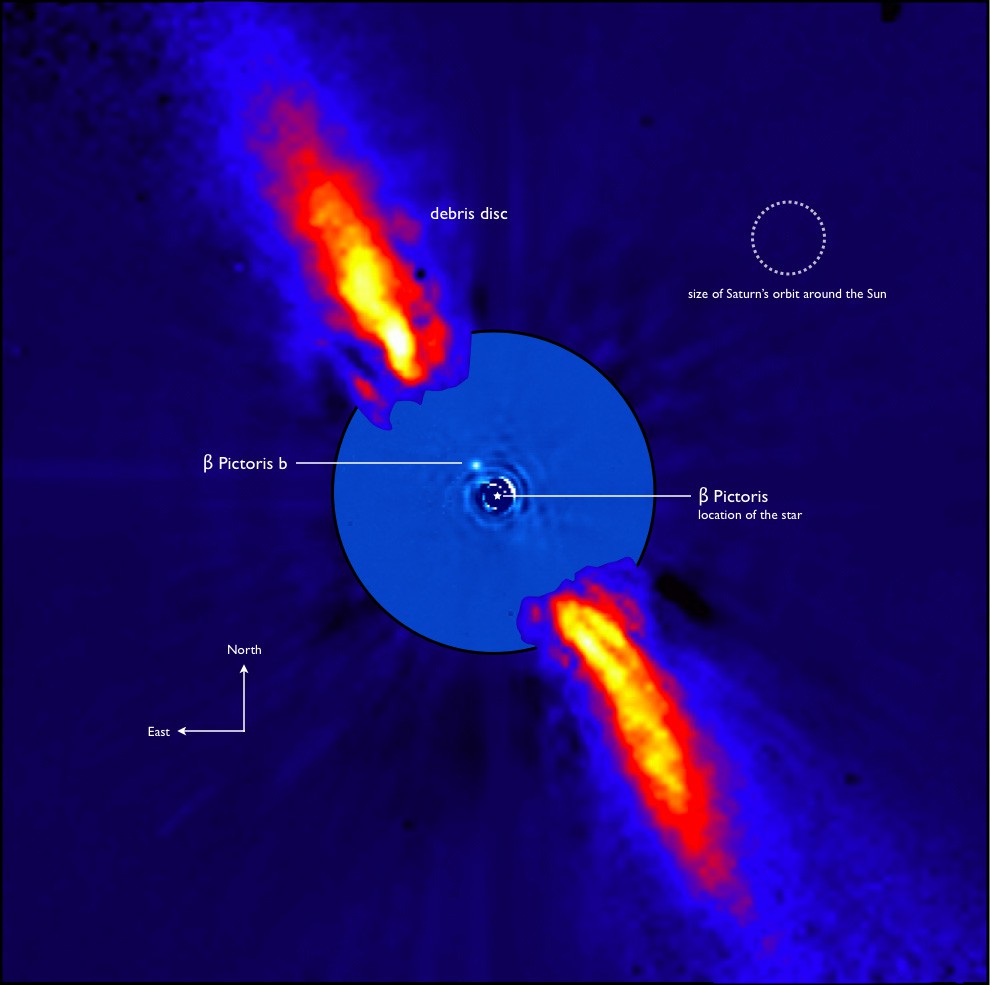
The accompanying ESO image is an older near-infrared view of the system, with the star’s bright light suppressed to reveal its surroundings. It provides spatial context; it is not the Webb spectrum used to establish the new chemical result. Keeping those roles distinct prevents a dramatic picture from carrying a claim it cannot demonstrate.
The finding is compelling without turning an inference into a timestamp. It suggests that some planetary building material can carry an older history through the formation of a star and its surrounding bodies. The important advance is learning to read that history from the light, while keeping clear which parts have actually been measured.