Euclid found 84 possible double lenses. What makes 11 of them stand out?
Two arcs can come from galaxies at the same distance. Euclid’s strongest candidates give astronomers a way to test whether they are seeing two distinct depths.
Two arcs of light around a galaxy can earn it a second look. They cannot, on their own, tell an astronomer how many galaxies made them. That distinction runs through a new analysis of data from ESA’s Euclid telescope. The team lists 84 places where a foreground galaxy appears to bend light from two galaxies at different distances behind it. Eighty are newly identified candidates. Only 11 make the team’s gold sample.
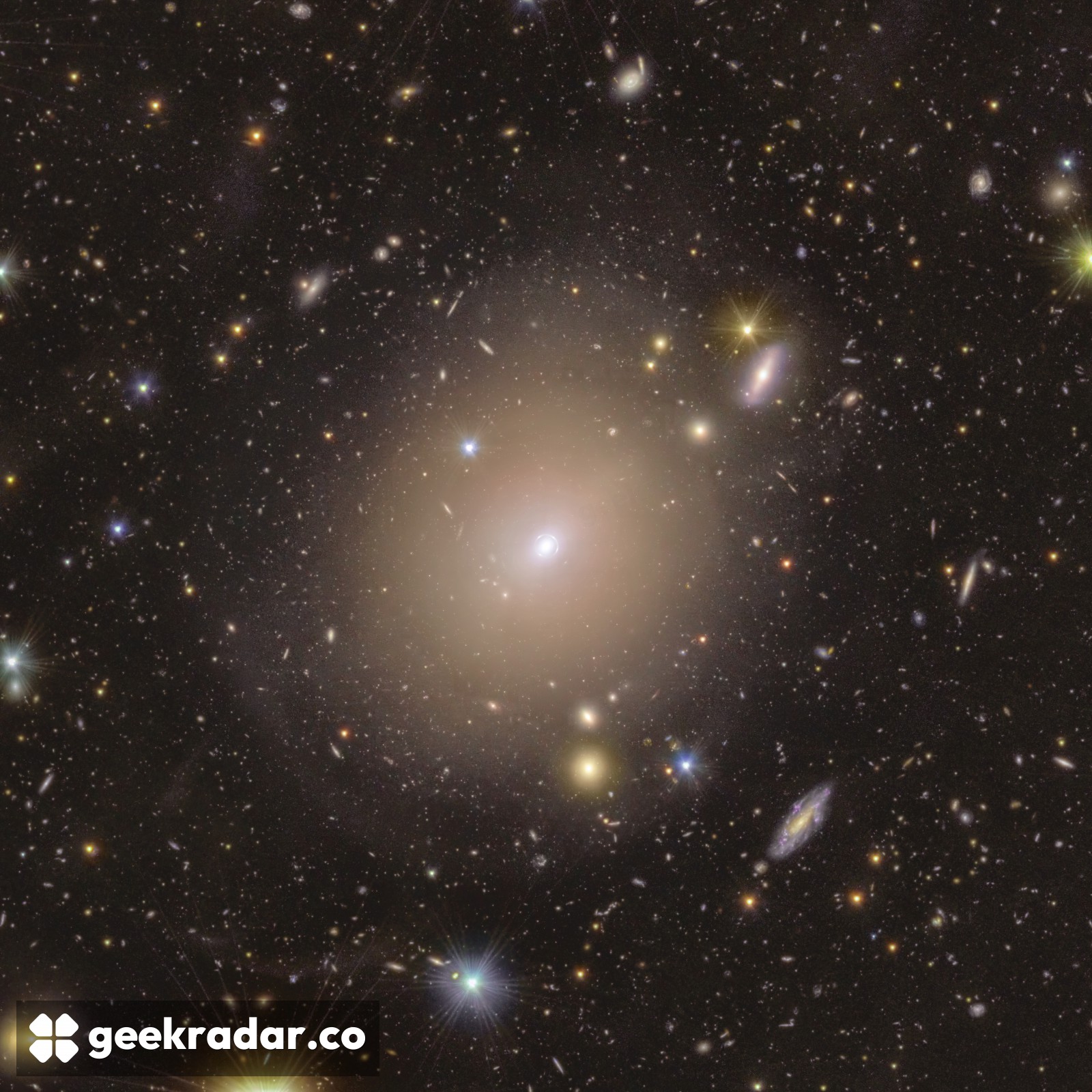
Look at the galaxy in the cover image for a simpler case. The bright centre belongs to NGC 6505. Zoom in and a thin ring appears around it. That light has travelled from a galaxy much farther away. Gravity bends its path around the intervening galaxy, and the alignment happens to be close enough to produce an almost complete circle. Several bright patches along that circle still belong to the same background source. Counting patches would give the wrong answer.
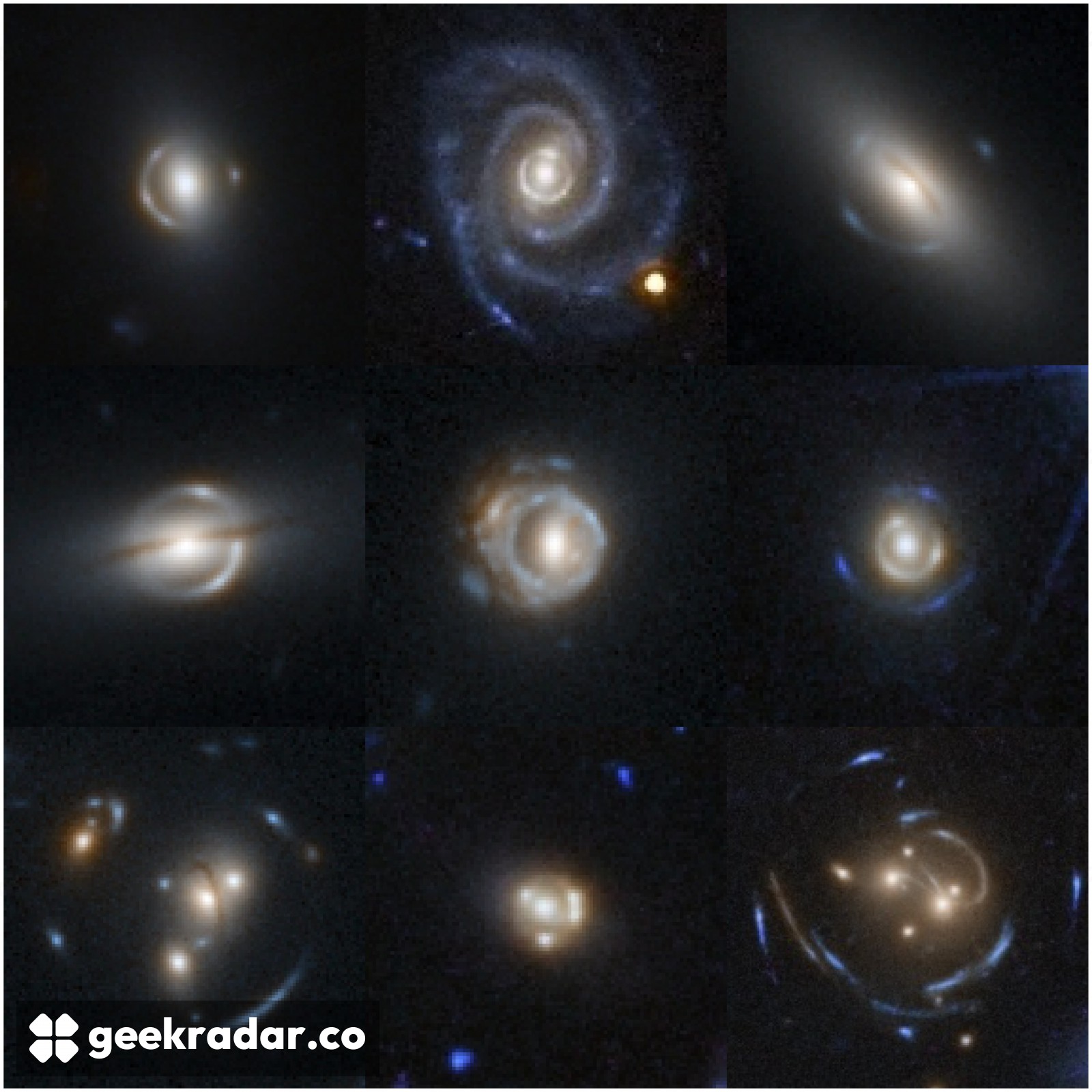
Reading the middle row
In ESA’s nine-panel montage, the example at the right of the middle row shows what the researchers are looking for. Follow the arcs around the bright central object and pay attention to how far each sits from its centre. A second background galaxy, farther along the same line of sight, can make another set of images at a different radius. Astronomers call this a double-source-plane lens. Here, “plane” is a way to distinguish two depths in space that the telescope projects onto one flat image.
The team started with a much larger search. Five machine-learning models, roughly 7,000 citizen scientists and 67 lensing specialists contributed to the parent catalogue. It contains 15,072 high-confidence strong-lens candidates. Identifying any convincing lens was the first task. Deciding whether a particular lens shows sources at two depths is a harder one.
What the other 73 can still tell us
Every silver candidate showed at least two arcs on inspection. In some, one arc has no identifiable partner. In others, two sources at essentially the same distance could account for the picture. Some systems still await modelling. Silver therefore covers several different reasons for uncertainty. Simply getting a sharper view would help in one case and might leave another almost as ambiguous.
A spectrum offers a different test. Familiar features in a galaxy’s light shift to longer wavelengths as the Universe expands. Measure that shift for each arc and astronomers can ask whether the two sources really lie at different depths. The logic is familiar from Webb’s first science images: a photograph can tell observers where to point an instrument that answers a different question.
Why pursue such rare alignments? The same foreground mass bends light from both sources. Comparing the apparent angular sizes of the two rings gives researchers a handle on the relative distances between the observer, lens and galaxies. With measured redshifts and a model of how mass is distributed in the foreground galaxy, those distances can test how cosmic expansion has changed. The researchers have assembled targets for that measurement. The most valuable next observation of some of them may be two faint spectral features that put the arcs at different depths.