Three in four new EU cars were electrified in October. How many could plug in?
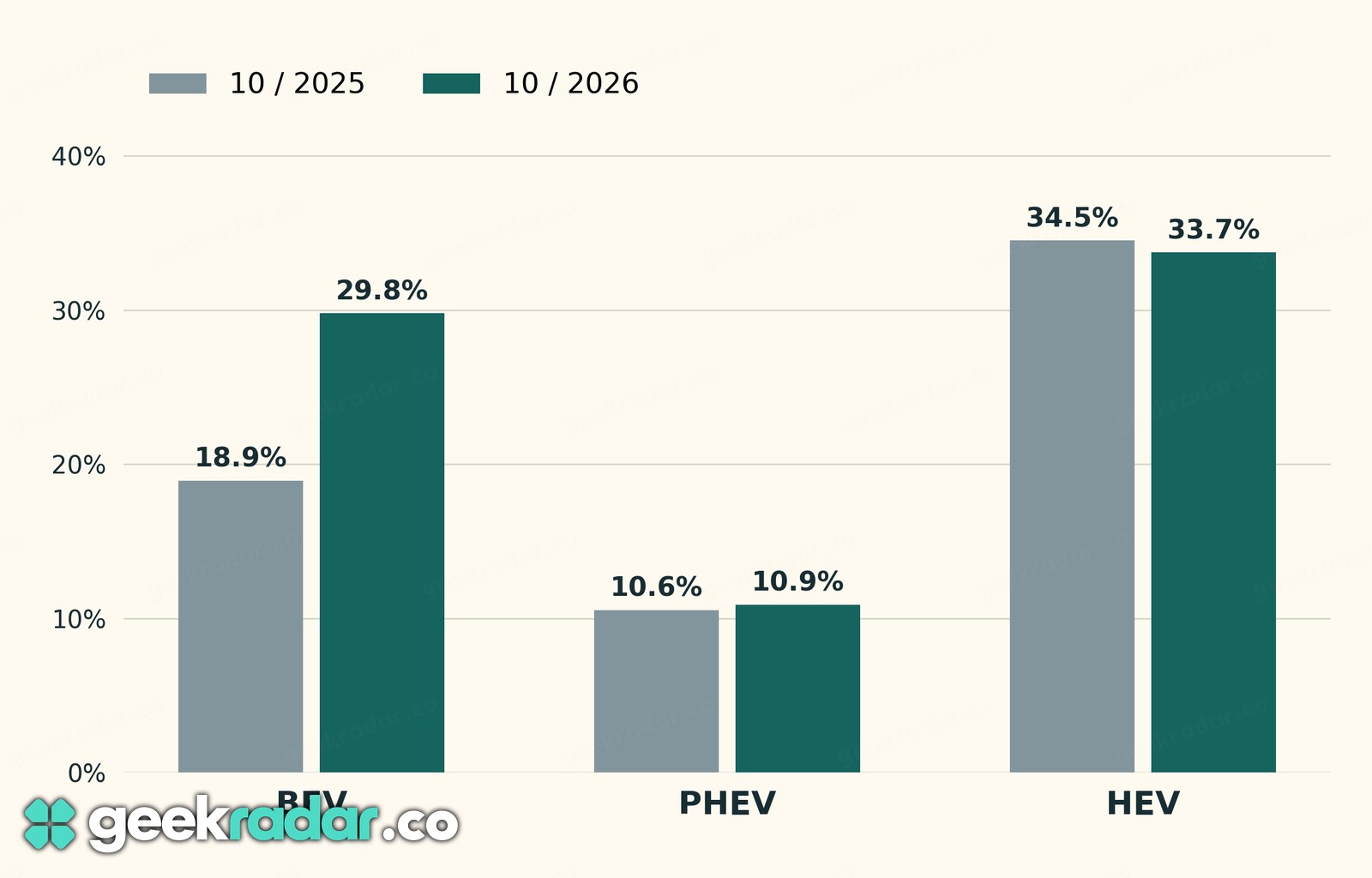
Battery-electric cars accounted for 29.8% of October registrations. Plug-in hybrids added another 10.9%, while ordinary hybrids remained the biggest category.
Of every 100 new passenger cars registered in the European Union in October, about 30 ran on batteries alone, 11 had both a charging socket and a combustion engine, and 34 were hybrids without a plug. All three use an electric motor. Only the first two can take electricity from the grid. That distinction turns a headline figure of nearly three-quarters electrified into a different, equally useful number: 40.7% of new cars could plug in.
The figures come from the October registration tables released on November 24 by ACEA, the European Automobile Manufacturers’ Association. They cover new passenger cars in the EU. Used cars changing hands, the millions of vehicles already on the road, and registrations in the UK fall outside that count.
Electric cars did more than keep pace with the market
In October 2025 the EU registered 173,309 battery-electric cars. This October the count was 279,799, an increase of 106,490 cars. Over the same period the entire new-car market grew by just 23,743, to 939,447. One category can add more cars than the market as a whole because others shrink: conventional petrol registrations fell by more than 67,000 and diesel by more than 22,000. Those totals show a change in the mix. They cannot tell us which car an individual buyer traded in.
October was a stronger month for battery-electric cars than the year so far. Their share reached 29.8% in October, up from 18.9% a year earlier. Across January to October it was 23.4%, or 2.21 million cars. A reader following the arrival of smaller battery-electric models can use those numbers to track the market they are entering. Neither figure identifies a winning model or establishes that lower prices caused the increase.
What a charging socket tells us
Hybrids without a plug still formed the largest group in October, at 316,940 cars. An ordinary hybrid can recover energy under braking and use it to help propel the car. Its owner never needs to find a public charger. A plug-in hybrid adds a battery that can be charged externally, while retaining an engine. ACEA counted 102,301 of those in October. Grouping the two types together throws away a distinction that matters to anyone deciding where to put charging points.
Even the plug-in count has a limit. Two owners can register the same plug-in hybrid on the same day. One charges at home and drives to work on electricity. The other rarely plugs in and buys fuel most weeks. Both registrations appear in precisely the same cell of ACEA’s table. The new-car figures tell us how many more drivers can use a socket. To learn how often they actually do, we need evidence from the road.