EE says London’s 5G downloads got 26% faster. The change was at the mast
Ericsson’s software picks a transmission rate as radio conditions change. EE reports that its London network can now carry more data over the same spectrum.
EE says its London 5G network now sends data to phones 26% faster on average, after changing the software that decides how much information to put into each radio transmission. Engineers installed it remotely on Ericsson equipment already in service. The phone at the other end can look exactly as it did yesterday, right down to the number of bars on its screen.
The November 26 announcement from Ericsson describes a commercial deployment across EE’s London network following a September trial in the north of the city. The comparison is with EE’s previous method of adapting the radio link. The partners also reported a gain of more than 13% in spectral efficiency. Those figures answer different questions about what happens between the mast and a handset.
How much can the next transmission carry?
Imagine watching a video as you walk around the corner of a building. The serving antenna may be the same one you were using a few seconds ago, but the signal reaching the phone has changed. A transmission rate that worked out in the open may now be too ambitious. Stay with it too long and data that the phone cannot decode may have to be sent again. Choose too cautious a rate and a phone with a clear signal spends longer receiving data that could have arrived sooner.
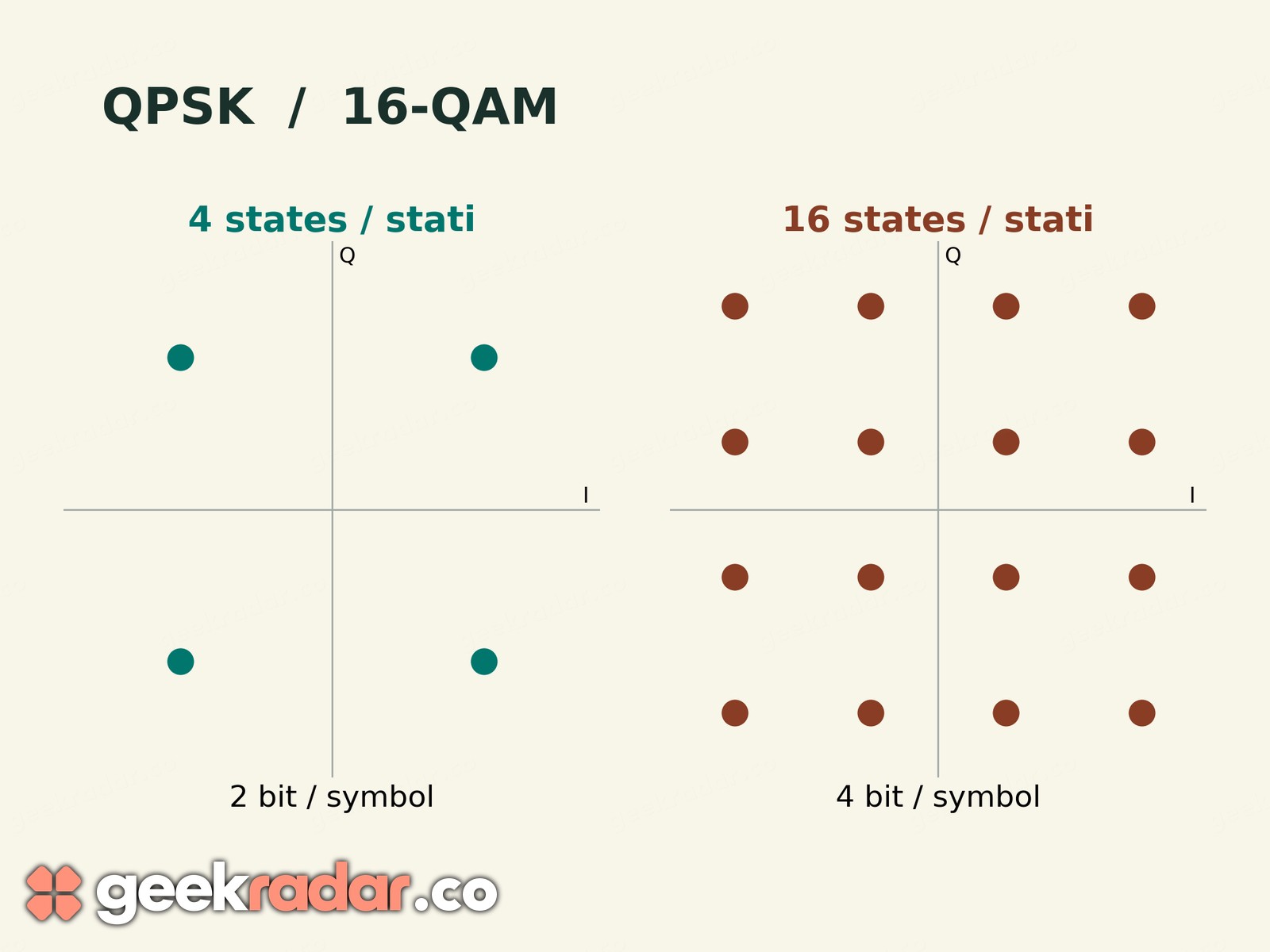
The diagram shows one of the choices available to a radio. A transmitter can encode two bits at a time by choosing between four distinguishable signal states. Sixteen states can carry four bits per symbol. Packing them more closely together makes it easier for noise to push a received signal nearer the wrong point. A second choice, the coding rate, determines how much redundancy the transmission carries to help the receiver recover the data. The network can vary both choices as conditions change.
That process, called link adaptation, was part of mobile networks long before this upgrade. What EE changed is how the network makes the decision. The operator says Ericsson’s model uses reports about the radio channel and other device data to predict a suitable downlink rate. The prediction runs in the network. It doesn’t require the person watching the video to choose an AI mode on their phone.
What a 26% gain can tell you
Download throughput describes how quickly data arrives. Spectral efficiency asks how much data the network can carry for a given amount of radio bandwidth. More efficient use of airtime can matter to the next person waiting to receive data from a busy cell, even if neither phone sets a speed record. The two percentages cannot be added to produce a larger speed gain.
The difference between an average and a best case shows up in SoftBank and Ericsson’s August trial in Japan. They reported roughly 10% higher downlink throughput on average across the locations evaluated, with gains of up to about 50%. Those figures belong to that network and trial. EE’s announcement gives no equivalent breakdown showing what London’s slowest connections gained.
For a commuter who streams over the same stretch of railway every day, the revealing figure would be the speed on the weak part of that journey, when the video usually stalls. London’s 26% says the network delivered more data per second on average. The next useful measurement is what arrived in those few difficult seconds.