Europe’s Greenland cable plan is as much about repair as connection
The Arctic strategy proposes a direct link and a cable hub. Neither is a live service or a promise of cheaper household broadband.
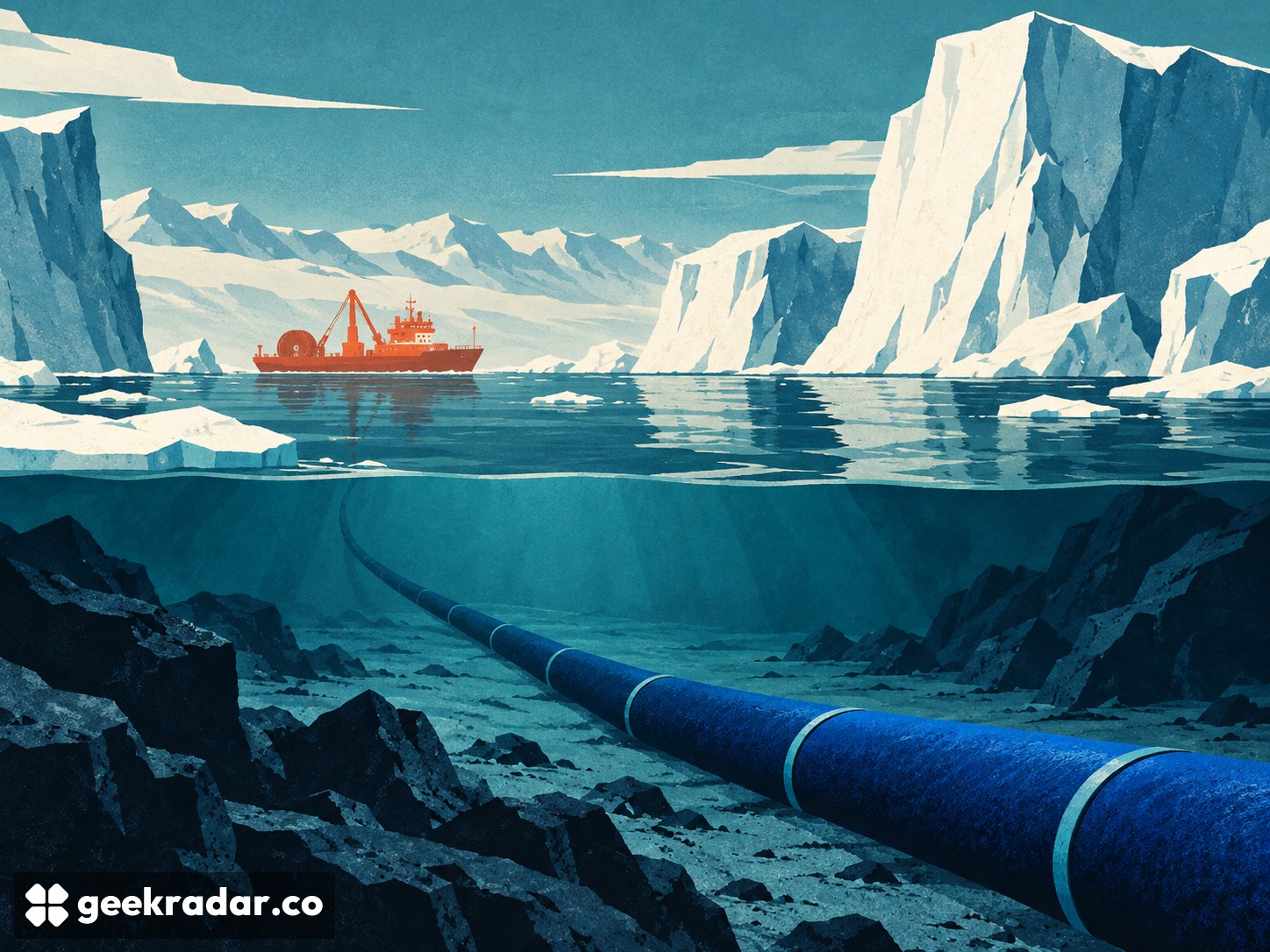
Europe’s proposed direct submarine cable to Greenland matters because a network’s resilience depends on where its connections run, not just how much data they carry. The European Commission’s new Arctic strategy puts that connection alongside cable monitoring, repair coordination and icebreaker capacity. It is an infrastructure plan, not an announcement that a new route is already carrying traffic.
The strategy published on October 20 has received renewed attention in this week’s technology coverage. Its Pan-Arctic Cable proposal would connect Greenland directly with Europe, with possible later extensions toward Canada and Japan. Those extensions are possibilities rather than contracted, dated services. The Commission’s overview supplies neither an operational launch date nor a retail broadband offer.
A second route needs more than a second line
An additional cable can create options when another route fails. But two connections that share a landing facility, power supply or vulnerable stretch of seabed can still fail together. A line on a map is therefore only the beginning of a resilience argument: physical routing, onward connections and the ability to switch traffic all influence the result.
The strategy acknowledges part of that wider problem through an Arctic Cable Hub. Its proposed responsibilities include monitoring, protecting and supporting repair of submarine cables across the North Atlantic and Arctic. That is a different job from constructing another cable. One adds a path; the other aims to keep paths usable and restore them when something goes wrong.
The Commission also proposes mapping European icebreaker capabilities and exploring shared resources and procurement. It does not say an icebreaker alone can repair a telecommunications cable. The connection is operational: Arctic infrastructure has to be reached, maintained and monitored under conditions that differ sharply from a coastal data centre.
The people at the landing points matter
There is a risk of discussing Greenland only as an intermediate point between larger economies. The strategy explicitly includes local communities and Indigenous Peoples, and commits to dialogue and the principle of free, prior and informed consent. A cable designed around long-distance transit does not automatically deliver affordable household service along its route.
For that to happen, the international link must connect with local networks and workable commercial arrangements. The published strategy does not establish those consumer outcomes yet. Nor does the proposed satellite component, IRIS² Arctic Connectivity, make the cable redundant: its stated government-communications role and a submarine connection are different parts of the plan.
The proposal belongs in the same conversation as the infrastructure covered by GeekRadar’s Internet desk, because physical geography still constrains digital services. Its most consequential test will be whether the eventual project creates genuinely distinct connections and dependable recovery, while benefiting the communities where the infrastructure comes ashore. More fibre is useful; a route that remains useful during a failure is the stronger achievement.