Amnezia Pulse opens its outage map—and explains why missing traffic is ambiguous
VPN observations can reveal a change without establishing its cause. The public launch also leaves a research API for a later stage.
Amnezia has opened its Pulse monitoring tool to the public, showing connection disruptions and slowdowns across regions and networks. Its most important qualification appears in the provider’s own explanation: a disappearance of VPN traffic can have more than one cause. A quiet graph can mean connectivity has been cut off, or that people no longer need the VPN because a restriction has ended.
The launch post describes measurements of connection speed and stability drawn from Amnezia users. In Russia, the tool follows the four major mobile operators and selected home providers; it also presents observations from other countries. This is a view through a particular measurement network, not a census of every internet connection.
A useful signal can still have competing explanations
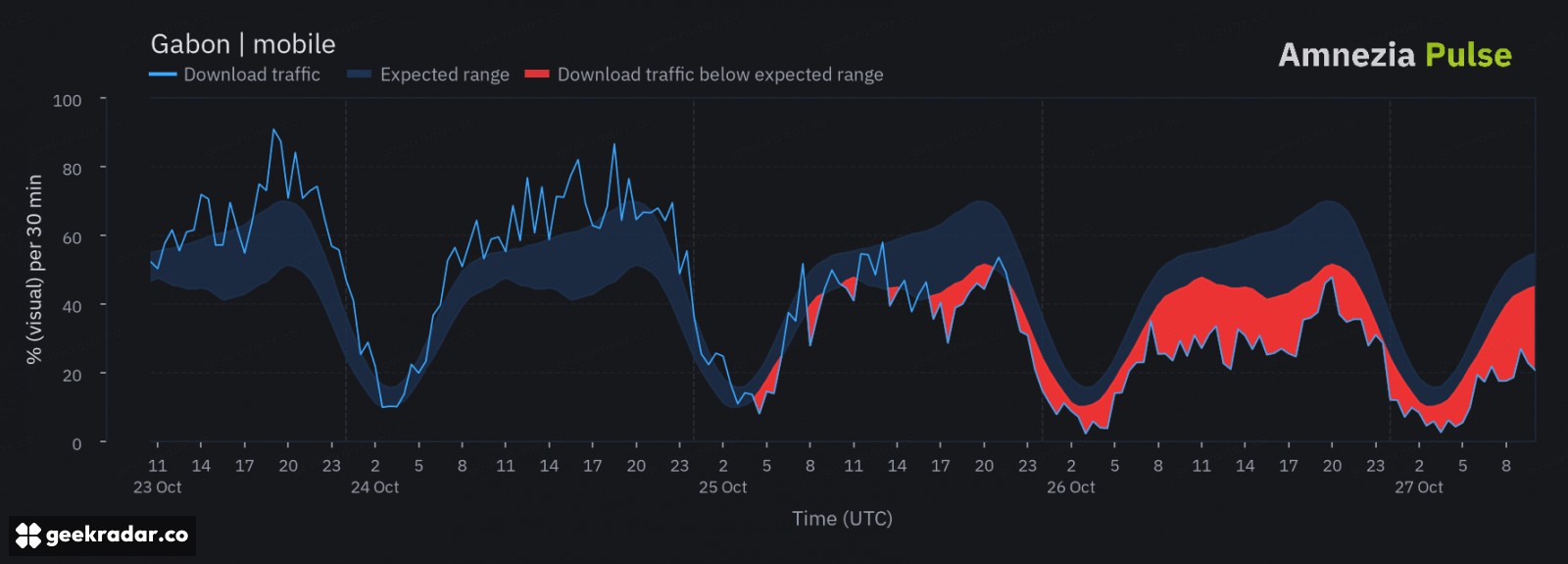
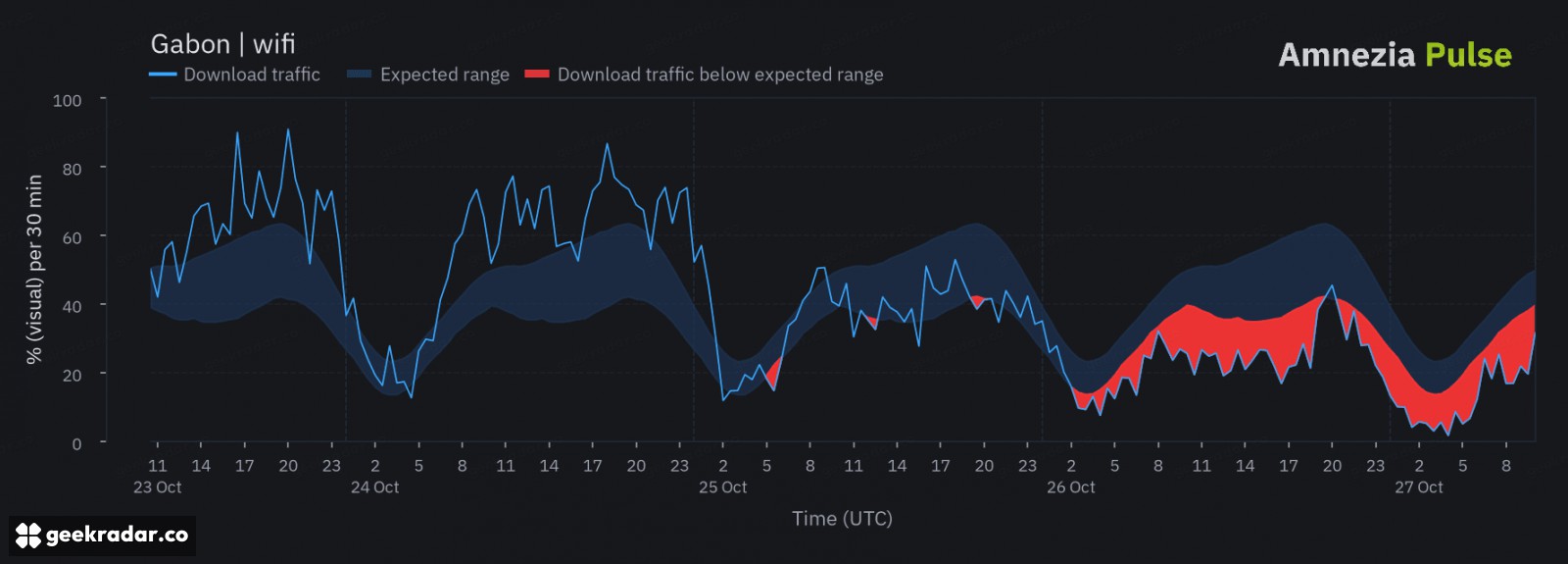
The distinction is visible in the Gabon example published by Amnezia. The company links earlier anomalies to social-media restrictions, then describes a later fall in traffic to its VPN nodes. It offers two explanations for the later change: users may have become unable to reach the service, or the restrictions may have ended and reduced their need to connect.
That uncertainty is not a reason to discard the observation. It tells a researcher which additional evidence to seek. A fall in measured traffic is real within the dataset, while its cause remains a separate question. Operator statements, measurements from other networks and reports from people in the affected area can help distinguish possible explanations.
The map uses colour to summarize the severity of observed problems, with regional detail available through graphs. The colour is a convenient entry point. It cannot replace checking the time range, the network being measured and whether enough observations exist to support a broader conclusion.
Coverage depends on participation
Amnezia explicitly says that more users produce a more detailed picture. That creates uneven visibility: a region with many participating connections can be easier to observe than one with few. An absence of reported disruption is therefore different from proof that all connections are working normally.
The company says the data are anonymized and that it does not collect users’ IP addresses for this system, instead processing region, provider and connection speed. These are the operator’s privacy claims, not the result of an independent audit presented with the launch. Users should evaluate them alongside the service’s own documentation.
An open API for researchers is described as forthcoming. The public tool’s release should not be mistaken for a completed API launch, and a research workflow should not depend on an endpoint that has not yet been announced as available.
Pulse adds a useful perspective to internet infrastructure reporting, particularly where reliable incident information is scarce. Its value is strongest when it helps identify a change worth investigating. Treating every red area as a fully explained shutdown—or every empty area as a healthy network—would throw away the very distinction that makes the measurements useful.