Moto G47 Power chooses battery capacity over a sharper display
Its 7,000 mAh battery and 30 W charging distinguish it from the standard G47. Resolution, physical RAM and weight deserve equal attention.
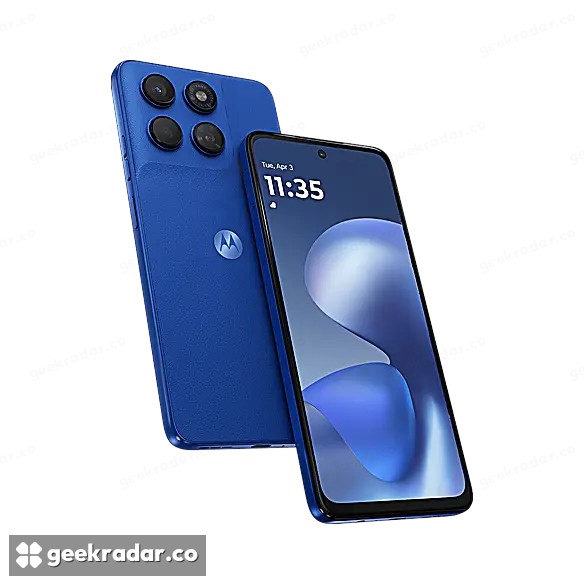
Motorola’s Moto G47 Power puts a larger battery into a familiar budget-phone formula. The new European model has 7,000 mAh and 30 W charging, compared with the regular G47’s 5,200 mAh and 20 W. It also becomes heavier: 215 g rather than 191 g. The benefit and the compromise will both be felt every day.
Motorola’s product page advertises up to 78 hours of use, a manufacturer estimate rather than an independent endurance result. GSMArena’s launch report lists European and UK prices of €339 and £299. Those are regional launch figures, not a guarantee of identical offers from every retailer.
The battery is the upgrade
The Power model largely retains the G47’s underlying hardware, including a Dimensity 6300, 4 GB of physical RAM and 128 GB of storage. That makes the larger battery the principal reason to consider this variant, rather than a new performance tier disguised by a familiar name.
Motorola also promotes RAM Boost, which uses storage to supplement memory management. It should not be added to the physical RAM figure as if the two were equivalent. Storage-backed memory can help the system manage background work, but it does not have the same characteristics as additional physical RAM.
For someone whose day is dominated by messaging, navigation and long periods away from a socket, the battery tradeoff can be more relevant than a faster benchmark. Someone regularly switching between demanding applications may reach the limits of memory or processing before battery capacity becomes the deciding factor.
A smooth display is not a sharper display
The 6.67-inch LCD refreshes at up to 120 Hz, while its resolution remains 720 × 1604. Refresh rate describes how often the image can change; resolution describes how much detail it contains. A high-refresh panel can make scrolling feel smoother without producing the finer text of a higher-resolution screen.
The phone retains useful physical features, including a headphone socket and microSD expansion. Those can matter more to a particular buyer than another camera mode: wired headphones need no charging, while removable storage can keep a local media library from consuming the phone’s internal space.
The 108-megapixel main camera is another specification that needs context. Motorola’s footnotes explain that its pixel-combining mode produces 12-megapixel images. The large sensor-pixel count does not mean every ordinary photograph is saved at 108 megapixels, nor does it independently establish low-light quality.
More endurance, with a visible cost
At 8.89 mm thick, the Power is also deeper than the standard G47. The additional battery is therefore not an invisible improvement: it changes the object carried in a pocket and held through a long call. Motorola lists Android 16, so buyers should also check the model’s support commitment rather than assume the newest hardware name means the newest software release.
The G47 Power’s appeal is unusually easy to define. It spends more of the phone’s physical budget on energy. That is a sensible priority for the person who keeps running out of charge, provided they are comfortable carrying the answer around all day.