
Windows’ APX preview is a compiler story before it becomes a speed story
More general-purpose registers can ease pressure on x86 code. A preview setting does not make existing PCs or applications automatically faster.
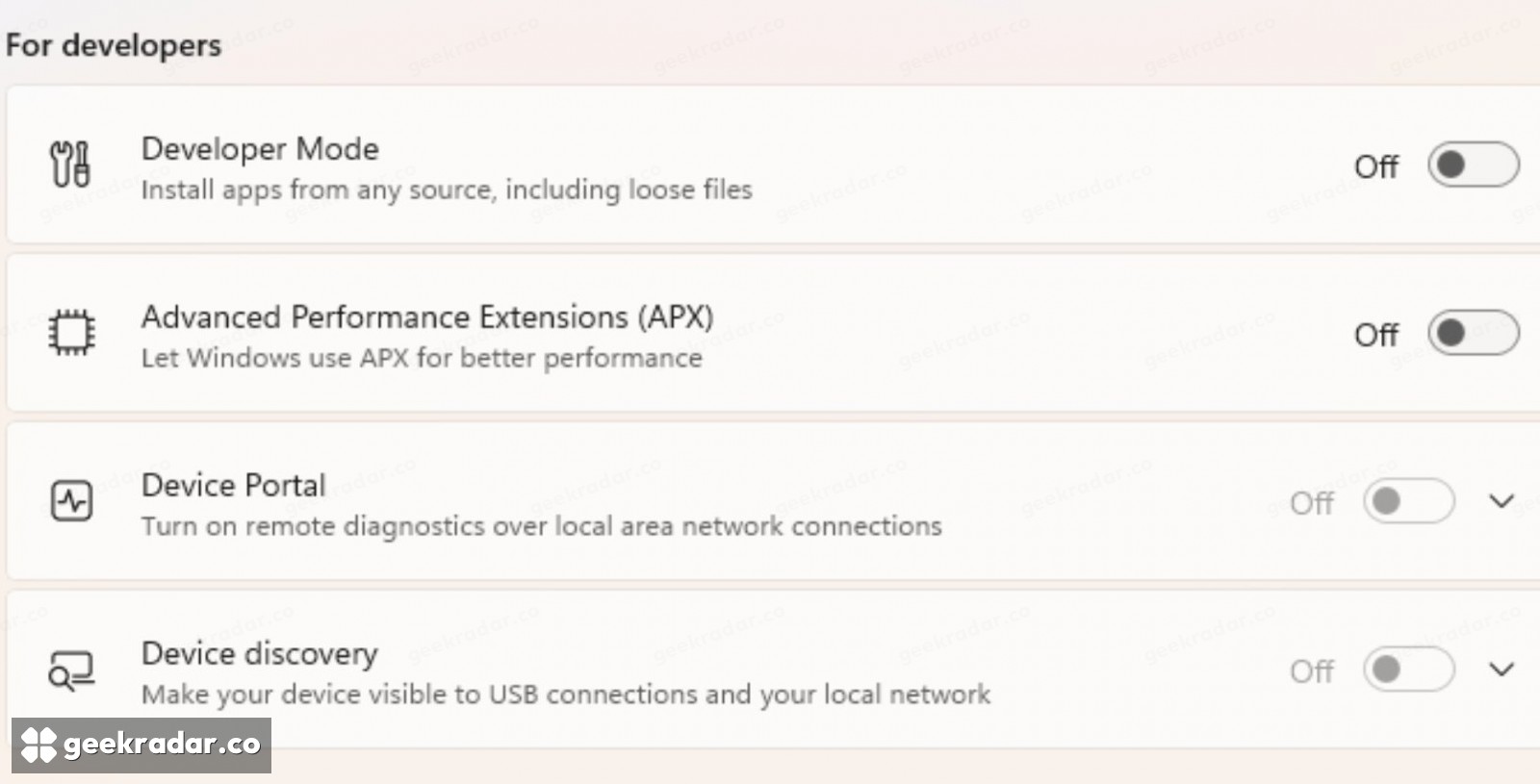
A Windows 11 preview has surfaced an option for Intel Advanced Performance Extensions, or APX. It is a sign of operating-system preparation for a new processor capability, not a hidden switch that makes an existing PC faster. The distinction matters because the work involves hardware, operating-system support and applications compiled to use the extension.
TechRadar's report, following a screenshot from Windows watcher XenoPanther, identifies the setting in preview build 29695. The reported switch does not currently deliver a usable performance improvement. A preview control also does not establish a public rollout date or the final user interface.
More working space inside the processor
Intel's technical explanation describes APX as an expansion of the x86 instruction set. One central change doubles general-purpose registers from 16 to 32. Registers are small, immediately accessible storage locations inside the processor. Giving compiled code more of them can reduce the need to move temporary values to and from memory.
The change also introduces more flexible instruction forms and additional conditional operations. These give compilers more opportunities to organize work efficiently, including reducing some branches that are difficult for a processor to predict. The benefits therefore depend on what the program is doing and how it has been compiled.
Intel cites fewer loads, stores and instructions in a prototype simulation using SPEC CPU 2017 Integer workloads. Those figures describe that analysis; they are not measured frame-rate gains for a retail laptop. Fewer instructions do not translate directly into an identical percentage reduction in the time taken by every application.
Recompilation is part of the upgrade
Intel says application developers can benefit through recompilation without necessarily rewriting source code. For software built on a dynamic-language runtime, the runtime itself must first gain support. The user may ultimately receive the benefit through an ordinary application update, but work has to happen further down the chain.
That is why an unsupported older processor cannot acquire APX through a Windows patch. It is also why a compatible processor alone does not prove that every existing program immediately runs faster. New hardware, enabled system software and suitable application code have to meet.
The preview is worth following as evidence that Windows is preparing for that chain. It is not a good reason to buy an unannounced machine or delay an otherwise suitable purchase on the assumption of a universal speed increase. The useful result will be a particular application completing a particular workload sooner. Until those measurements exist, a settings label is evidence of engineering work, not a benchmark.