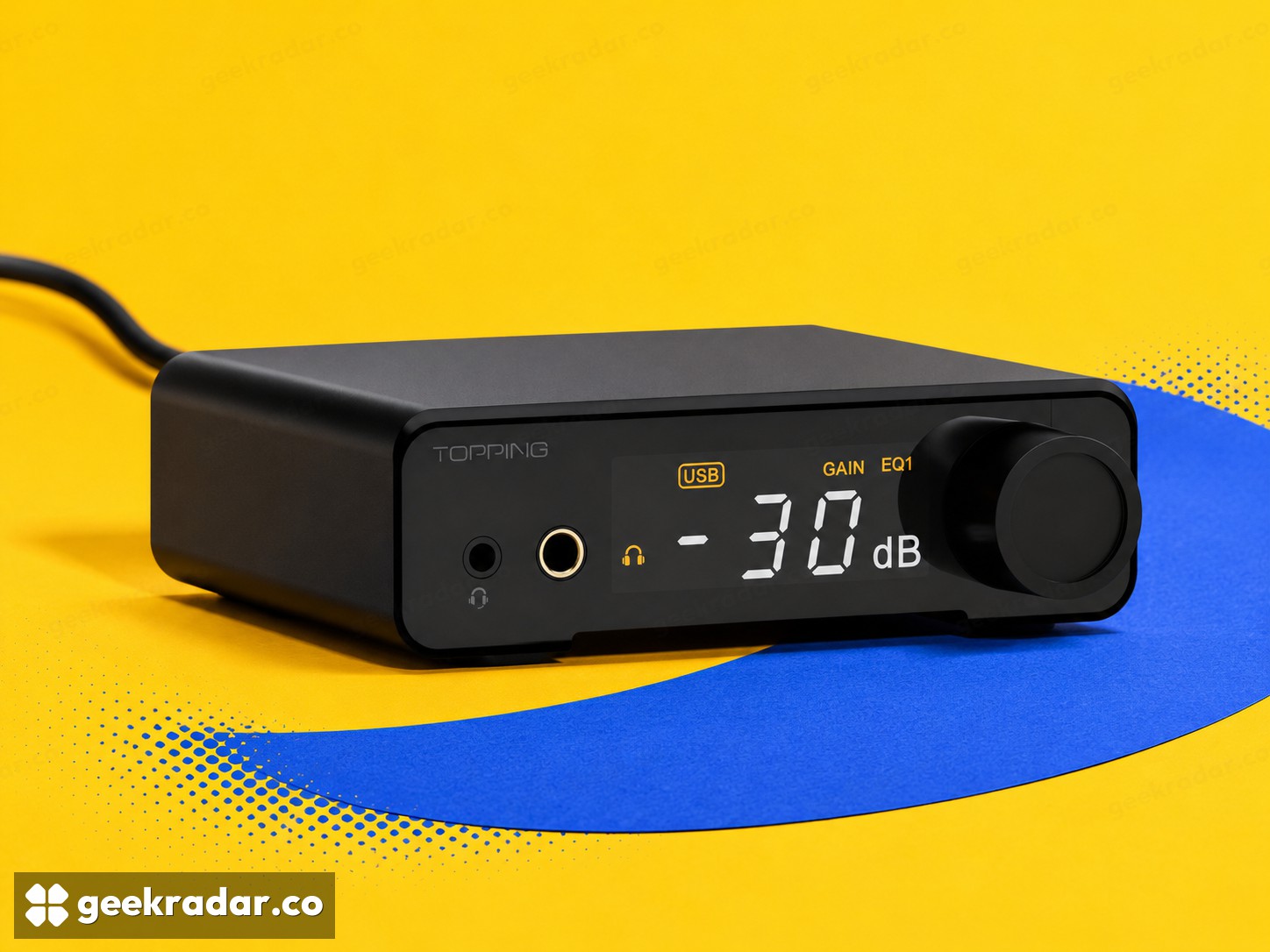
Topping DX1 adds headphone EQ to the small desktop DAC. Know which problem you are solving
The existing $119 device combines conversion, amplification and parametric EQ. Those functions affect listening in different ways.
The Topping DX1 II is a useful example of how a small desktop DAC can justify its place without pretending every listener needs a new audio component. Renewed attention from an independent review puts the emphasis on a combination of headphone amplification, console compatibility and adjustable equalization. This is an examination of an already available product, not a new October launch.
Topping's official store lists the unit at $119 in its US-dollar view. The relevant question is what problem it solves in a particular setup: insufficient headphone output, unwanted noise, missing connections or a desire to adjust the frequency balance. If none of those problems exists, a separate DAC is not automatically a meaningful upgrade.
Conversion and amplification do different jobs
A digital-to-analog converter turns digital audio into the electrical signal used by an analog output. The headphone amplifier then provides the voltage and current needed by the connected headphones. The DX1 II combines those functions with an ESS ES9039Q2M converter and XMOS XU316 USB interface, according to Topping.
Those component names describe the design; they do not establish how much better a particular song will sound than it does through a competent existing output. Headphone sensitivity, impedance and desired listening level affect the amplification requirement. More available power is useful when it supplies needed headroom, not as a reason to listen louder.
Equalization is the more direct adjustment
The unit's ten-band parametric equalizer gives the user a way to change frequency balance. Unlike replacing one adequately performing converter with another, an EQ adjustment deliberately changes the signal. That can be useful for a headphone's tonal character or a listener's preference, provided the adjustment is made carefully.
It also puts gaming claims in perspective. Raising a frequency region may make certain sounds more prominent, but it cannot guarantee better positional awareness in every game. The game's mix, headphone behavior and hearing all remain part of the result. A preset is a choice, not a competitive advantage certified by the presence of a DAC.
Console support is a compatibility feature
Topping specifies both USB Audio Class 1.0 and 2.0 modes, with PS5 and Nintendo Switch support. It also lists microphone support through the 3.5mm TRRS connection, optical input/output and RCA and balanced line outputs. Those options can make the box more useful across a desk than a headphone-only adapter.
The independent review's listening judgments remain that reviewer's findings; GeekRadar has not measured this unit. The buying decision can still be concrete. Map the source, microphone and output connections you actually need, then check whether the DX1 II replaces an awkward chain of adapters. Its best argument is a cleaner, controllable audio setup. A long list of supported sample rates is much less valuable if the current setup already does the job.