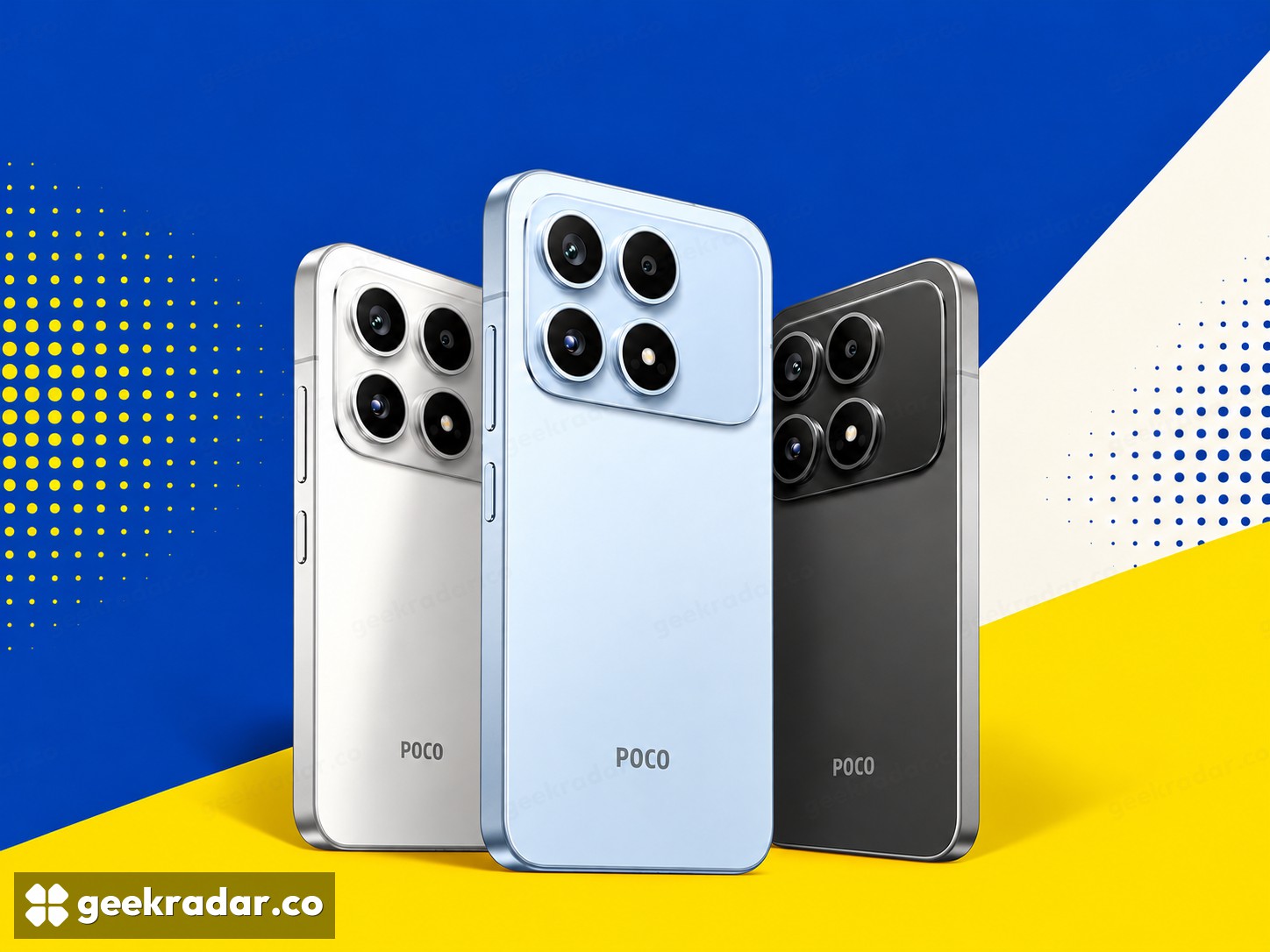
Poco X8s makes a smaller phone without surrendering the battery
A 6.35-inch display, 6,330mAh cell and separate telephoto camera make this a more interesting compromise than size alone suggests.
The Poco X8s puts a 6,330mAh battery and a separate telephoto camera into a phone with a 6.35-inch display. Its appeal is a specific combination rather than a record in one column: a relatively narrow body, substantial battery capacity and a camera beyond the main and ultrawide pair commonly used to fill out a midrange specification.
Poco's official specification gives the handset a width of 71.8mm, a weight of 187g and an 8.06mm body thickness, excluding the camera protrusion. Those measurements make the compact claim more useful than the display diagonal alone. It remains a substantial smartphone, but the width is a concrete figure to compare with the handset already in your hand.
The battery promise has two different parts
The typical capacity is 6,330mAh. Poco attributes the packaging to a silicon-carbon battery with 16% silicon content. Capacity tells us how much charge the cell is specified to hold; it does not independently establish screen-on time, gaming endurance or standby behaviour. The processor, screen brightness, network and software still determine how quickly that reserve disappears.
Charging is unusually flexible on paper. Alongside the 100W HyperCharge branding, Poco explicitly lists support for the PPS charging standard at up to 100W. That is more informative than a proprietary wattage alone because compatible adapters can negotiate charging parameters. It still does not mean every USB-C charger supplies 100W, or that the phone maintains that power throughout a recharge. Poco's own footnote distinguishes adapter output from actual charging behaviour.
The company also specifies wired reverse charging at up to 22.5W. In practical terms, the phone can act as a reserve for another compatible device, spending part of its own battery to do so. The included power adapter varies by market, so the charging headline and the contents of the box are separate questions.
A telephoto camera with a defined job
The main camera uses a 50MP Light Fusion 800 sensor with optical image stabilisation. The separate 50MP telephoto is described as a 57mm-equivalent lens with 2.5x optical zoom. That field of view offers a different starting point for portraits and tighter framing than cropping every image from the main camera.
The 8MP ultrawide rounds out the range, while a 20MP front camera handles selfies. Resolution figures do not make those cameras equivalent. Sensor size, lens quality, processing and available light remain important, and Poco's promotional samples are not independent comparative testing. The useful change here is having distinct focal lengths available; whether the processing uses them well requires evidence beyond a launch page.
Read the display figures at their proper scale
The AMOLED panel has a stated 2,656 × 1,220 resolution and an adaptive refresh range of 1–120Hz. Poco notes that actual refresh behaviour depends on the application and scenario. A 120Hz display does not guarantee that a demanding game renders 120 frames per second.
Likewise, the advertised 3,500-nit figure is peak brightness, not a promise of that brightness across the entire screen indefinitely. The Snapdragon 7 Gen 4 and the company's cooling system are relevant to responsiveness, but the announcement supplies no independent sustained-load comparison. These distinctions matter precisely because the phone combines several attractive specifications in a relatively small shell.
Launch reporting from GSMArena describes introductory dollar pricing. Local stock, tax-inclusive prices, configurations and the bundled adapter still need to be checked in the purchasing market. The official page also names HyperOS 3; the existence of a newer software announcement elsewhere does not change what this model's listing says.
The X8s makes its strongest case to someone who wants less width without giving up battery capacity or a useful second camera. That is a more meaningful proposition than calling it a miniature flagship. The decision turns on which everyday compromises the smaller body actually removes, a recurring question in Gear.