Rivian buys Third Dimension to turn rare driving situations into repeatable tests
Controllable 3D scenes can vary a recorded encounter. The acquisition expands development tools; it does not activate a new self-driving feature.
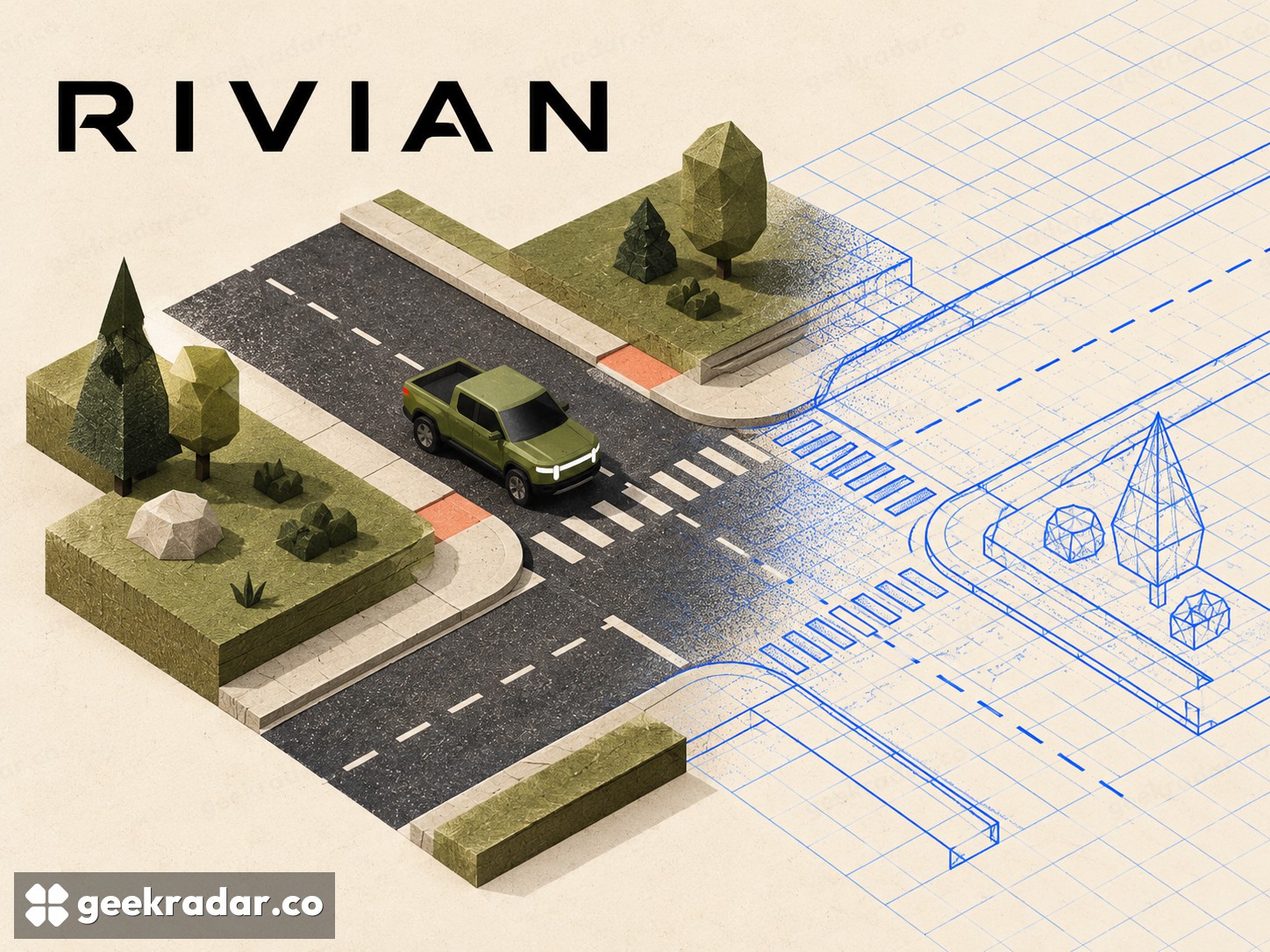
Rivian has acquired Third Dimension AI, a company that turns real-world data into controllable three-dimensional environments. The immediate purpose is to improve the material used to train and validate driving systems: reconstruct a difficult situation, vary it, and run it again without waiting for the same combination of events to occur on a road.
The October 22 acquisition announcement says the team will join Rivian's autonomy research and engineering organization. Financial terms were not disclosed. Rivian links the technology to its consumer and robotaxi development plans, but the transaction itself does not switch on a new driving feature in customer vehicles.
The useful part is changing the scene
A recording can show what happened at one moment. A controllable simulation aims to let engineers ask what would have happened if some part of that moment had been different.
Imagine an intersection at which a vehicle partly obscures another road user. Replaying the original recording can test whether a system recognizes what occurred. A sufficiently capable simulation could vary the position of the obstruction or the timing of the other participant. That is an illustrative explanation of controllable scenes, not a claim that Rivian demonstrated this specific scenario in the announcement.
The distinction matters because rare events are inconvenient training material. Waiting for a fleet to encounter every relevant variation would be slow, and deliberately creating dangerous situations on public roads would be unacceptable. Virtual environments give engineers a way to explore variations without treating the road as a laboratory for every experiment.
That last step is essential. A system can improve against a simulator's assumptions while still struggling with conditions the simulator represents poorly. Greater realism in appearance helps only if the properties relevant to sensing and driving are also represented faithfully.
Training and validation must remain distinguishable
Synthetic data can provide additional examples for learning. Validation asks whether the resulting system behaves acceptably under defined conditions. Using the same convenient scenarios for both risks confusing familiarity with capability.
A useful test needs a clear question. Did the system detect an obstacle earlier? Did it maintain a suitable path when the scene changed? Did a software revision introduce a regression in a previously handled situation? Without a defined comparison, millions of simulated miles can become an impressive quantity with an unclear meaning.
Rivian's announcement describes an expansion of its simulation capability, not published evidence that a particular safety metric has improved. The acquisition gives the company ownership of a tool and the team behind it. Integrating that tool, measuring its limits and connecting its results to real-world behavior remain engineering work.
What changes for a driver today
The relevant distinction for owners is between development infrastructure and a delivered vehicle function. Current feature scope depends on the vehicle, software, service eligibility and region, rather than on the existence of a new simulation team.
Rivian's Autonomy documentation describes driver-assistance features that support the driver without replacing their judgment or attention. Hands-free operation within supported conditions is not permission to stop supervising. An acquisition announcement does not alter that responsibility or establish approval for an unannounced deployment.
This is the same boundary readers should keep in mind across our automated-driving coverage: evidence that a company is developing a capability and evidence that a particular vehicle may safely use it in a particular place are different things.
Third Dimension's attraction is understandable. A rare encounter can become a family of controlled questions rather than a single recording filed away after review. The value of the deal will depend on how well answers from those virtual variations survive contact with the road—not on how convincing the simulated world looks in a demonstration.