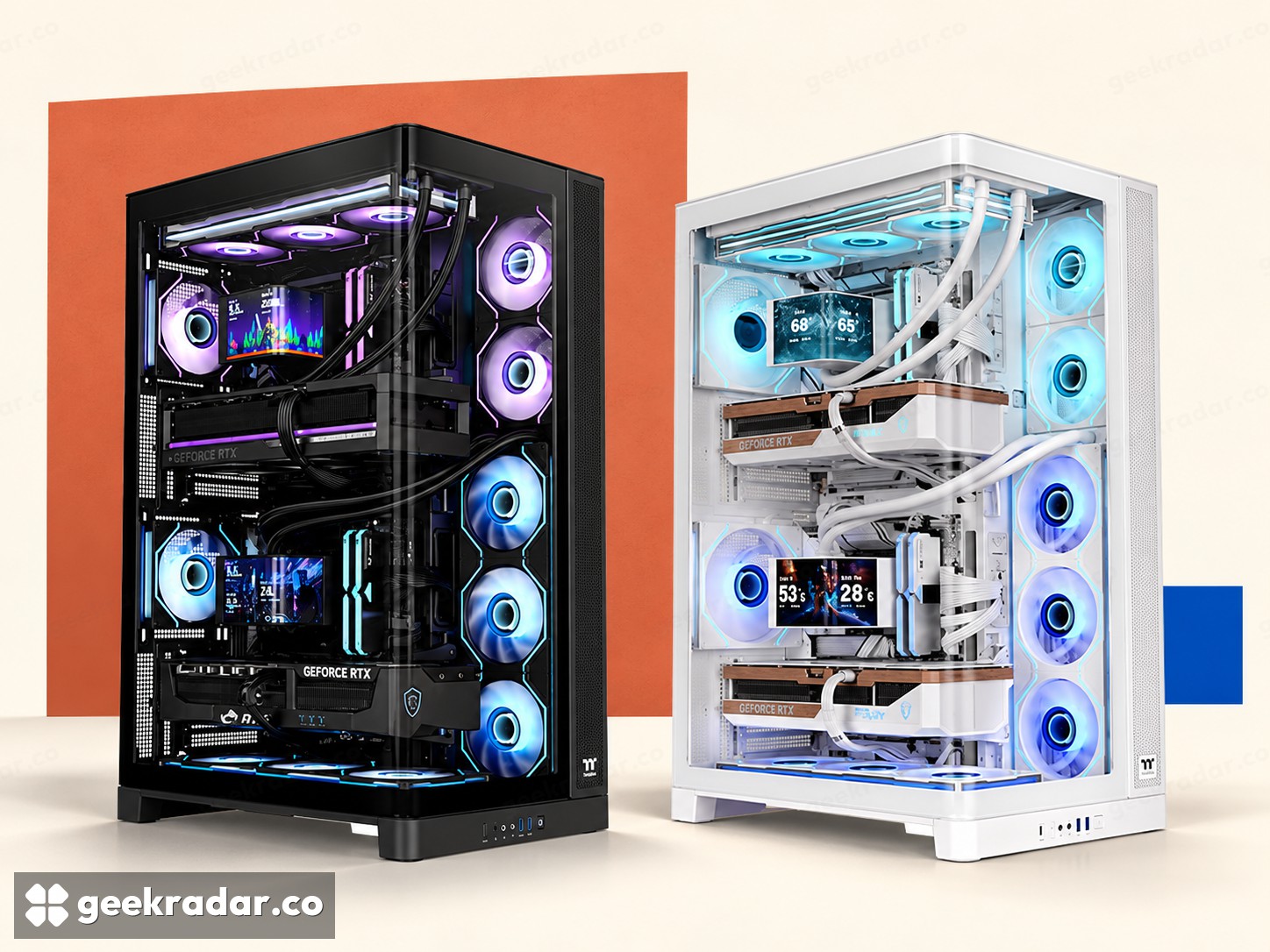
Thermaltake CAPO X fits two PCs in one case. The heat still has to go somewhere
The dual-Micro-ATX layout consolidates space, not computing resources. A sponsored build review illustrates why simultaneous load changes the cooling plan.
Thermaltake's CAPO X puts two independent Micro-ATX systems behind one curved glass enclosure. That makes it an unusual answer to a familiar enthusiast problem: how to keep a second computer without finding room for a second tower. It does not combine two PCs into one faster machine.
The case is receiving renewed attention after a Japanese build review, but it is not a newly announced October product. Thermaltake already described its dual-system layout on its Computex 2026 product page. The interesting question now is what sharing the enclosure changes—and what remains stubbornly doubled.
Two computers, one place to put them
The official specification lists support for two Micro-ATX systems, two 360mm radiators and up to thirteen 120mm fans, with black and Snow finishes. The photographs show the systems arranged vertically, each with its own motherboard and graphics hardware.
That can make sense for a user who already needs two environments: a main gaming PC and a separate machine handling another workload, or two operating-system setups that need to remain independently available. These are possible uses of the architecture, not bundled functions. A case does not supply capture hardware, remote control, shared storage or a keyboard-switching solution by itself.
The distinction is especially important for the word “dual.” This is not automatically a dual-GPU workstation in which one application gains access to both graphics cards. Each system still needs its own appropriate components and software. Whether a task can be distributed between computers is an application and network question, not a benefit created by the glass panel.
Independence does not extend to heat
The most useful observation in Hermitage Akihabara's October 5 review concerns simultaneous load. In its specific build, the upper system ran about 5°C warmer when both computers were stressed than when it ran alone. The article is marked sponsored, and its result should be treated as an attributed observation from that configuration, not an independent verdict on every CAPO X build.
Even with that limitation, it illustrates the right engineering issue. Two motherboards can be electrically separate while the air around them is not. Heat from one part of the enclosure can influence the intake or exhaust conditions of the other. The advertised maximum number of fans tells us about mounting opportunities, not how a particular arrangement will behave.
Planning therefore starts with the combined workload. Two machines that are rarely busy together create a different cooling problem from two systems rendering or gaming at once. Fan direction, radiator placement, cable obstruction and acceptable noise all need to be considered as parts of the same enclosure.
Consolidation can add maintenance work
A second motherboard brings another set of power, storage and cooling connections. Sharing a case can tidy the room while making the interior more involved. Access to one system should be considered before the other fills the space around it.
The review also notes the absence of a standard fan hub, a practical detail in a build with many fans. That does not make the case unsuitable, but it belongs in the parts plan rather than being discovered after the last cable has been routed.
Our SteamOS and Windows comparison examined the tradeoffs between software environments. A dual-system chassis offers physical separation for such choices, but often at a higher component and maintenance cost than one machine with a simpler setup. The reason for the second PC needs to exist before the case becomes attractive.
For PC builders, CAPO X is most convincing as a deliberate consolidation project. It can put two computers in one striking enclosure. It cannot halve the work of building them, and its most important boundary is the one the glass does not show: separate workloads sharing the same air.