Infineon and NVIDIA tackle the conversion chain behind an 800V AI rack
Higher voltage can reduce distribution current. Intermediate converters and protection still have to make that supply usable by computing hardware.
An 800-volt supply is useful to an AI rack only if the electricity can reach the components at the voltages they need. Infineon’s October 21 announcement describes the next part of its collaboration with NVIDIA: power conversion and protection for an architecture that distributes high-voltage direct current through the data center.
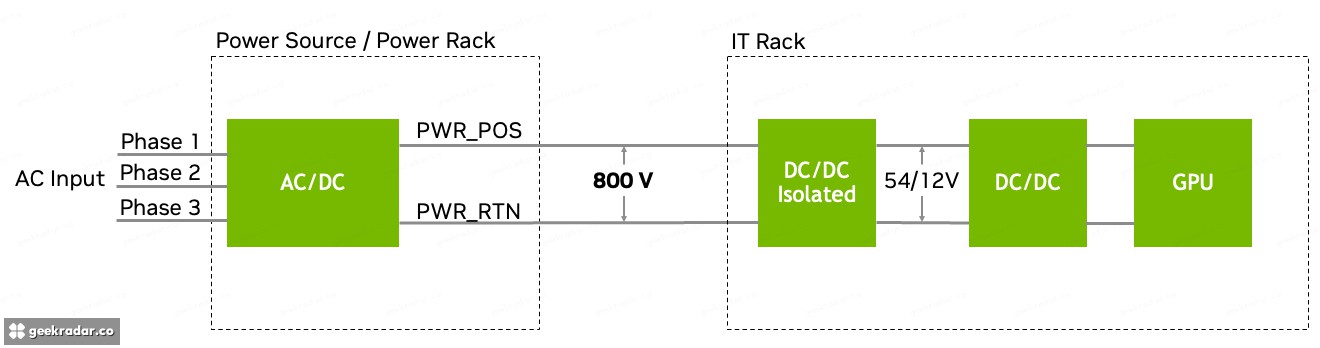
The technical point is the conversion chain. Infineon describes gallium-nitride intermediate bus converters that can take an 800V input down to 50V, 12V or 6V. The chips doing the computing still need subsequent regulation. A rack supplied at 800V is not a rack applying 800V directly to a processor.
Higher distribution voltage means less current for the same power
NVIDIA’s original architecture explanation sets out the problem as rack power rises: moving large amounts of electricity at lower voltage requires high current, substantial conductors and conversion equipment that consumes space.
For a given amount of transmitted power, raising voltage reduces current. Resistive losses depend on the square of current for a given resistance, which gives designers a reason to reconsider the distribution system. That physical relationship does not by itself establish the efficiency of a complete installation. Converters, connections, cooling and operating conditions still matter.
Infineon’s role includes the stages that make the higher-voltage supply usable. Its announcement describes switching frequencies up to 1MHz for the GaN conversion approach, with the aim of reducing the size of magnetic and passive components. This is the supplier’s design proposition, not an independently measured efficiency result for every future rack.
Protection belongs in the architecture too
A distribution system cannot be assessed only by how much power it carries under normal conditions. Components must also handle connections, disconnections and faults. Infineon includes protection and hot-swap capabilities in the collaboration, reflecting the operational work required around high-density computing hardware.
Hot-swap describes equipment designed to be connected or removed while the surrounding system remains powered under specified conditions. It is not permission to treat high-voltage infrastructure like an ordinary user-serviceable accessory. The relevant claim here is that protection is part of the product architecture, alongside conversion.
The collaboration extends work announced in 2025. NVIDIA’s earlier roadmap discusses 800V infrastructure for the next generation of large AI installations; that roadmap should not be presented as proof that existing data centers have already converted. Operators have installed equipment, site constraints and reliability requirements to work around.
Our coverage of Google and Voltus examines a different power problem: how computing demand interacts with the grid. More efficient distribution inside a building can reduce losses, but it does not create generating capacity or remove the need for a suitable connection to the electricity system.
That distinction keeps the announcement in proportion. The promise of 800V is a more manageable path for delivering large amounts of power inside future facilities. Whether that promise becomes a useful rack depends on the less photogenic stages between the incoming supply and the processor—converters, protection and the space those components occupy.