Mistral and NVIDIA want engineering AI judged on correct results, not fluent answers
Their collaboration proposes public tests for simulation and engineering agents. The benchmarks are a plan, not proof of a measured speedup.
Mistral and NVIDIA are proposing a more demanding test for engineering AI than whether it can produce plausible technical prose: can it operate engineering tools, complete a sequence of tasks and return a technically correct result at a measurable cost? Their new collaboration puts public benchmarks and open datasets alongside plans for faster simulation workflows.
The October 21 announcement describes work connecting Mistral models with NVIDIA's computing and simulation stack, including Warp and Omniverse. The evaluations are planned, not a published set of results. There is no demonstrated speedup in the announcement that can safely be turned into a headline about how much faster an engineering department will work.
A simulation has to answer the right question
Consider a team evaluating a component under load. An assistant might help prepare the model, configure a solver and organize the output. But a neatly completed workflow can still answer the wrong problem if a boundary condition is wrong, a material property is inappropriate or a unit has changed along the way. This is an illustrative workflow, not a reported trial by either company.
That makes correctness a property of the whole chain. Getting a file into the next tool is useful, but successful file transfer does not establish that the assumptions survived. A result also needs enough context for another person to understand what was calculated and reproduce it. Otherwise the automation saves clicks while making the work harder to audit.
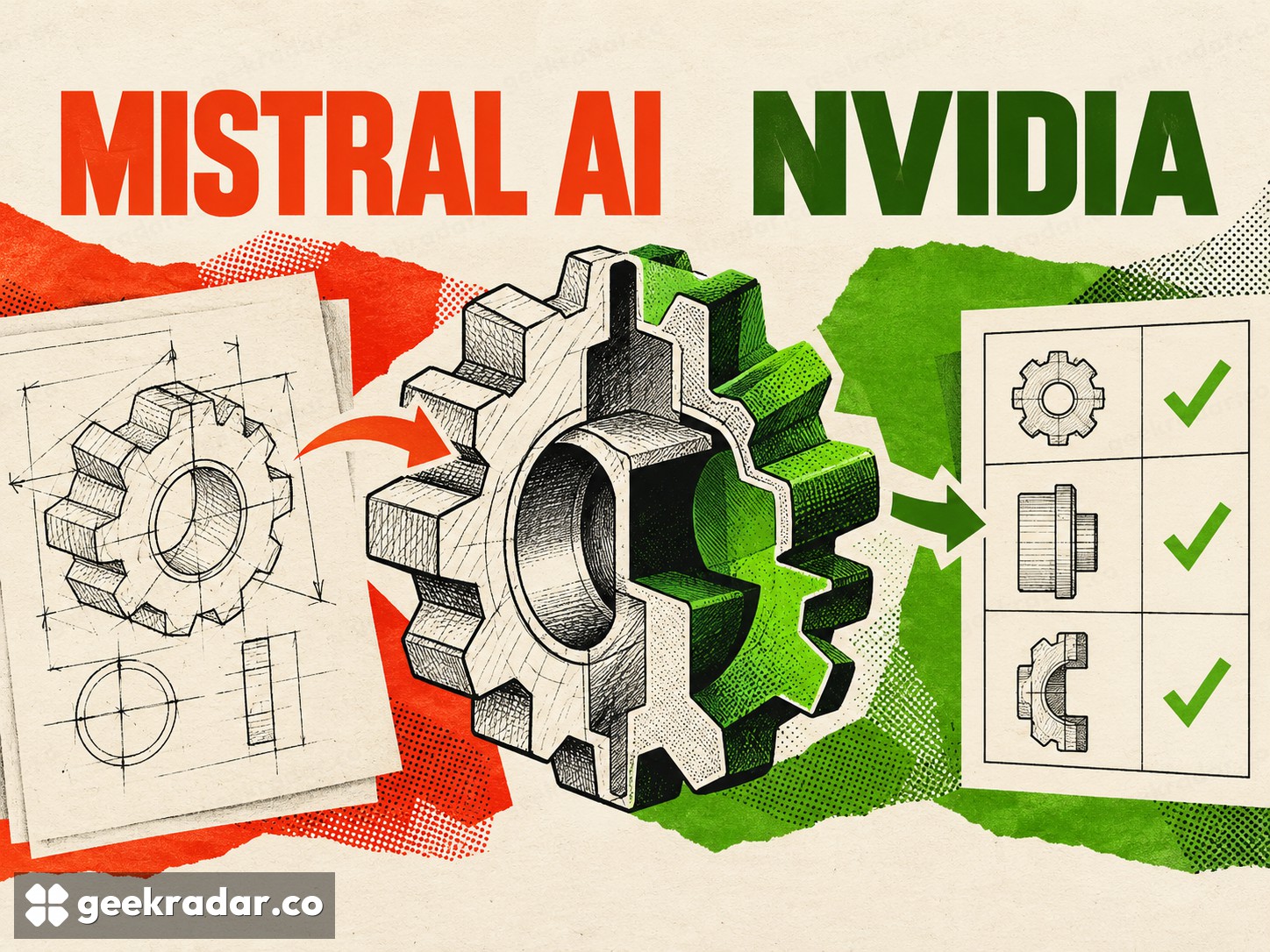
Mistral says the proposed evaluations will cover computer-aided engineering, or CAE, and electronic design automation, or EDA. It identifies tool use, multistep completion, technical correctness, execution time and computing cost as evaluation dimensions. Keeping those dimensions separate would be more informative than collapsing them into one flattering score.
Where Warp fits
NVIDIA describes Warp as an open-source Python framework for accelerated computational physics and related workloads. It compiles Python functions into lower-level code for execution on supported processors, and supports differentiable programming: calculations that can propagate information about how changes in inputs affect outputs.
That helps explain the collaboration's structure. A language model can participate in a workflow without being the numerical solver that determines the physical result. Specialized simulation tools still have a distinct job. The useful integration is the connection between specifying a problem, calculating it and using the result to inform another design choice.
It also explains why a faster model response is not the same as a faster project. Time spent fixing an invalid setup, checking a suspicious result or repeating a calculation belongs in the total. An evaluation that measures only the assistant's response time would miss those costs. Conversely, reducing repetitive setup work could be valuable even when the solver itself runs at the same speed.
Open tests would make the promise easier to inspect
Public datasets could let outside teams test whether a gain survives different problems and baselines. They would not automatically eliminate bias: task selection, scoring rules, hardware and allowed human intervention still shape the result. Those details determine whether a benchmark is useful to a working engineer rather than simply reproducible as a number.
The relevance to European and Italian industry is the workflow itself, not an announced national deployment. The collaboration does not establish an Italian customer contract or a generally available engineering service. For now it offers a direction and a proposed way to test it.
The consequential deliverable would be an evaluation in which a fast but technically wrong answer visibly loses. Until those tests and results arrive, the partnership's most useful promise is that engineering AI should have to show its working.