
Zapier vs Make: build the workflow, then account for its failures
Assisted setup, branching, recovery and billing units shape the choice between two automation platforms.
Zapier and Make can both connect applications into workflows, but their most important difference is not the number of logos in an integration directory. It is how clearly the person maintaining an automation can understand its decisions, recover from a failure and control the cost of repeated execution.
AI makes creating those workflows more approachable. It also makes it easier to build a plausible sequence before deciding what the sequence should do when information is missing. That is where a platform comparison becomes a design problem.
Zapier helps describe the workflow into existence
Zapier's Copilot guide describes assistance with creating and editing a Zap, including triggers, actions and field mappings. It offers automatic building and a mode that asks before making suggested changes. The feature is documented as an open beta.
This is a useful starting point for someone who can describe a business process but does not yet know where its controls live. “When a new request arrives, classify it and prepare a response” becomes something concrete to inspect. The advantage is a shorter path from intention to a draft workflow.
The limitation is that the description may omit the difficult cases. What if the customer cannot be identified? What if two records share the same email address? The builder can assist with configuration, but the business needs to supply the rules that make a correct action distinguishable from a convenient guess.
Make exposes branches as part of the design
Make's router documentation describes branching a scenario into routes with conditions and a fallback. Its error-handling guidance covers tools for responding to failed operations. These are useful foundations for processes whose exceptions deserve as much attention as their successful path.
For a maintainer comfortable tracing a visual flow, that explicit structure can make branching work easier to reason about. It can also become complicated as routes accumulate. A diagram with many connections is not automatically a clear process; names, ownership and a defined outcome for every branch still matter.
This is not a claim that Zapier lacks branching or that Make requires every step to be built without assistance. It identifies two useful evaluation points: how quickly Zapier's assisted builder produces an understandable workflow, and how comfortably Make's scenario structure expresses the routes the process needs.
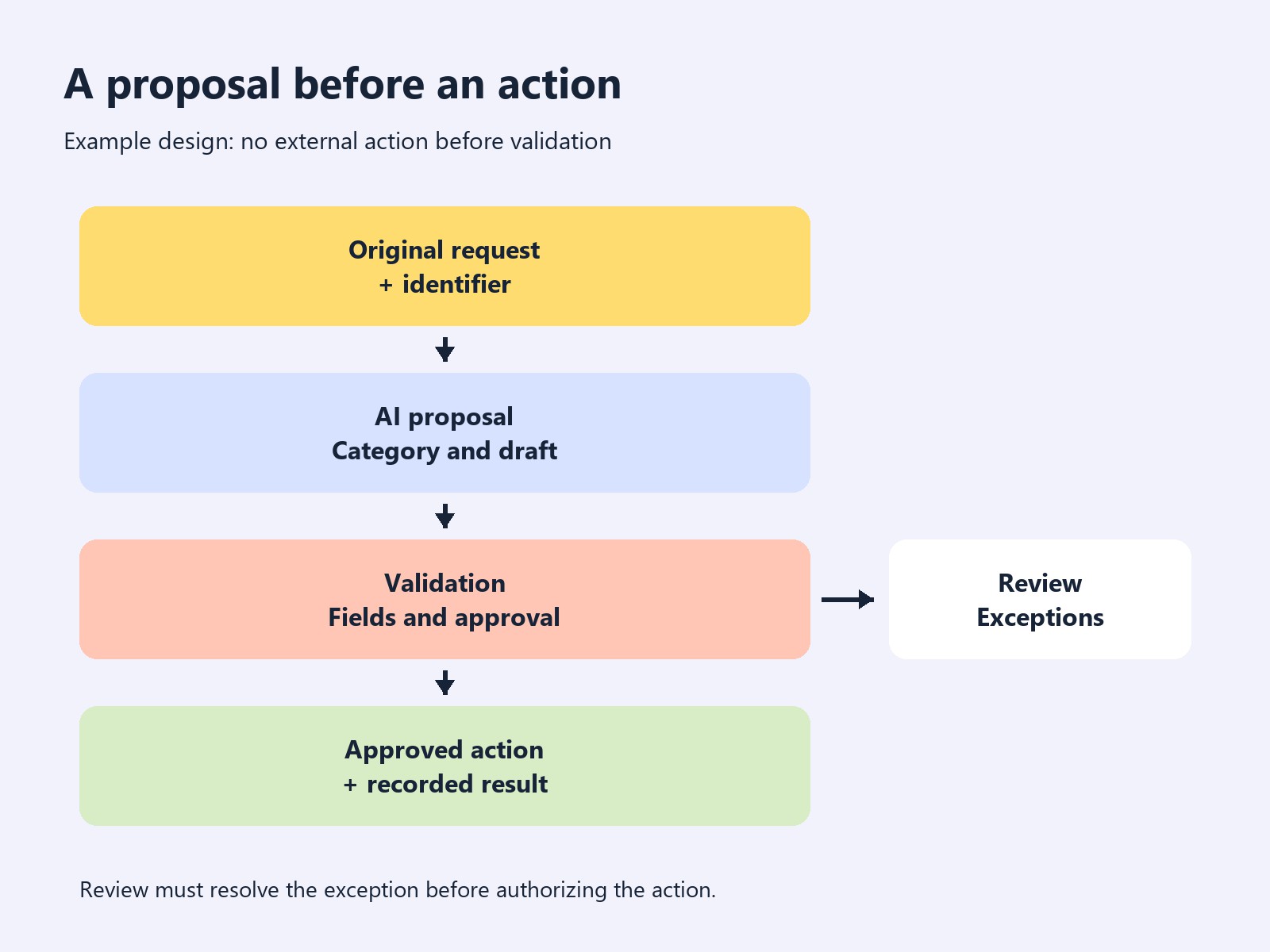
Separate a suggestion from an external action
A practical design for incoming requests can use AI to propose a category and draft a reply, then apply ordinary rules to determine where the item goes. Sending the reply can remain a distinct, reviewed action. That separation makes the uncertain part visible.
The identifier matters when a step is retried. If a contact has already been created, repeating the whole sequence may create a duplicate. Reliability depends on knowing what completed and what remains to do, not merely having a button that runs the process again.
Compare bills using the same workload
Zapier's task measurement guide explains successful-action accounting and exceptions. Make's credit documentation distinguishes fixed and variable consumption, including AI-related costs. A task and a credit are not interchangeable units.
| Cost driver | Why it changes the comparison |
|---|---|
| Actions per incoming item | One business request can execute several billable steps |
| Branches and repeated records | A short-looking workflow can process many individual items |
| AI requests | Model or connection choices can add consumption beyond ordinary steps |
| Recovery work | Retries need both a cost policy and protection against duplicate actions |
Estimate one representative process, including its exceptions, on each platform. Comparing the largest allowance printed on a pricing card without translating the workload can reward the wrong service.
The owner should understand the failure path
Zapier is a strong candidate when assisted setup helps a team express and maintain a straightforward process. Make is a strong candidate when explicit routing and scenario inspection fit the maintainer's way of working. The best choice is conditional on the actual applications, permissions and complexity involved.
The person who inherits the workflow should be able to explain what happens to an incomplete request and how a failed run resumes. If that answer is clear, AI has helped automate a process. If it is missing, the workflow has only automated its optimistic assumptions.