
Perplexity vs You.com: who should control your application's research?
Search APIs and managed investigations solve different problems. The deciding factor is how much retrieval and synthesis you want to own.
Perplexity and You.com both offer a way to put web research inside another product. The consequential choice is how much of that research the service should perform for you: return search material, or investigate a question and write an answer. Those are different building blocks, with different opportunities to verify what happened.
This comparison concerns their developer platforms, rather than the subscriptions for their consumer websites. A useful research feature in a company application needs predictable inputs, inspectable sources and a way to handle failure. A convincing answer in a browser is only a small part of that problem.
Search results or a completed investigation
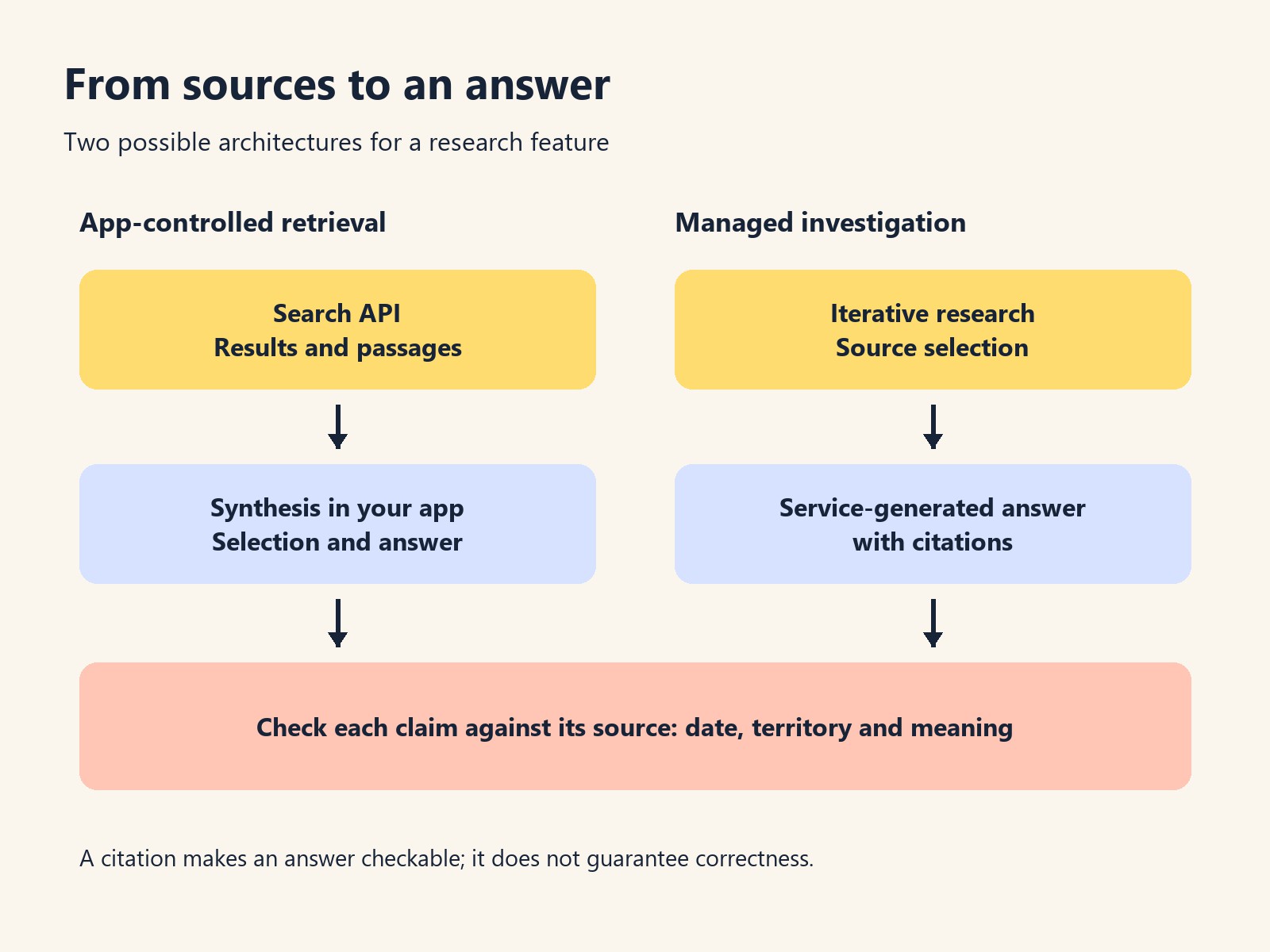
Perplexity's Search API returns structured, ranked results with domain, language and regional controls. Its separate Agent API supports generated answers with search tools and configurable presets. The distinction lets a developer decide whether to own the synthesis stage or delegate more of it.
You.com's Research API packages an iterative investigation into a research request, producing answers with inline citations. Effort settings control the depth of the process; its source controls include options for domains and freshness, with some features marked beta. These controls describe available mechanisms, not a guarantee of complete coverage.
For a product that displays source cards, the raw-search route can be attractive. Your application decides which passages to show and whether a language model should summarize them. For a product that needs an initial research brief, a managed investigation can save orchestration work. It also means accepting more of the provider's choices about what to search and when to stop.
A citation is a route back to evidence
Imagine an application comparing the European availability of two business services. A global launch announcement, a US price page and an Italian support article can all be relevant, yet answer different questions. Combining them without preserving territory and date can produce a confident claim that neither service actually supports.
The application should retain the source URL, the passage supporting the claim and the time it was retrieved. This is useful even when the provider returns a well-formatted answer. The citation may support only part of a sentence, or the page may have changed after the answer was produced. Evidence needs to remain attached to the individual claim.
Language filters deserve similar care. Restricting a search to Italian can improve local relevance while excluding the primary technical documentation. Searching only English can miss a local limitation. A deliberate research policy may need both, followed by an explicit distinction between global capability and Italian availability.
More effort has a cost beyond the invoice
An investigative service can perform more work than a straightforward lookup. That is valuable when a question requires several sources, but less attractive when the caller needs one known fact quickly. Depth, responsiveness and cost should be matched to the request rather than pushed to their maximum for every interaction.
| Application need | Sensible starting point | Responsibility that remains |
|---|---|---|
| A source browser or retrieval layer | Perplexity Search API | Decide what evidence to display and how to rank it for the user |
| A configurable search-capable assistant | Perplexity Agent API | Define tools, instructions and acceptance criteria |
| A researched brief from one request | You.com Research API | Check citations, scope and the selected effort level |
This is a comparison of entry points, not a claim that either company offers only one kind of tool. In particular, don't infer API costs or entitlements from a consumer subscription. Budget the actual request pattern, including retries and investigations that end without enough evidence.
Choose the boundary you want to own
Perplexity is compelling when separating retrieval from answer generation is central to the application. You.com's Research interface is compelling when an integrated investigation is the desired unit of work. The trade-off is how much orchestration to build yourself and how much provider behavior to accept.
A successful integration should be able to say that the evidence is insufficient. Without that outcome, a research feature is under pressure to manufacture certainty whenever a source is missing. The strongest product is the one that keeps an unsupported conclusion out of the final answer, even when doing so makes the answer shorter.